Reaktionsgleichung

[C:1]([CH:5]1[CH2:10][CH:9]([C:11]([CH3:14])([CH3:13])[CH3:12])[CH2:8][CH2:7][CH:6]1[OH:15])([CH3:4])([CH3:3])[CH3:2].CC(C)=O.OS(O)(=O)=O.O=[Cr](=O)=O.C(=O)([O-])[O-].[Na+].[Na+]>CC(C)=O.C(O)(C)C>[C:1]([CH:5]1[CH2:10][CH:9]([C:11]([CH3:14])([CH3:13])[CH3:12])[CH2:8][CH2:7][C:6]1=[O:15])([CH3:4])([CH3:3])[CH3:2]Komponenten
Edukt 3


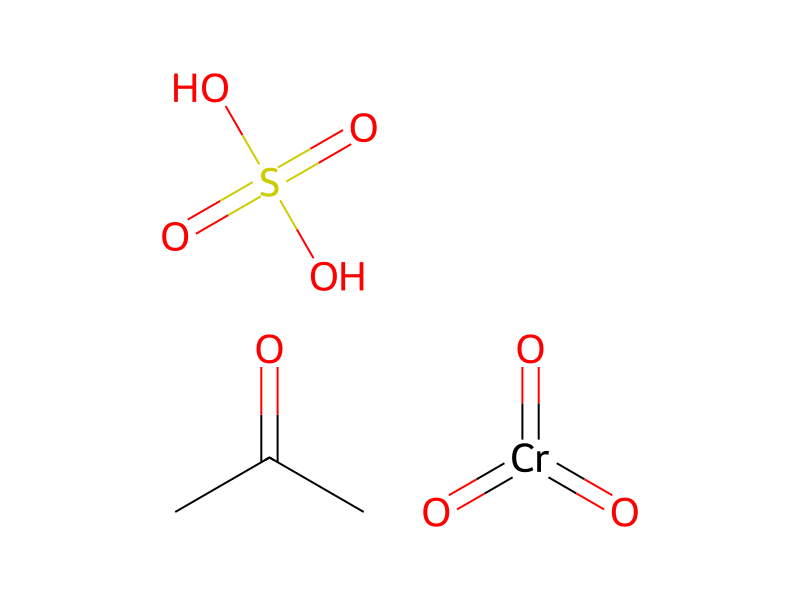
Produkt 1

Reagenzien, Katalysatoren, Lösungsmittel 2


Reaktionsbedingungen
- Temperatur
- 5 °C
Versuchsvorschrift
200 g (0.944 mole) of the 2,4-di-tert-butylcyclohexanol as prepared in Synthetic Example 2 and 2 l of acetone were introduced into a 3 l reactor. Then 320 g of a Jones reagent was added dropwise thereto under ice-cooling at 5° C. over 1.5 hour. After completion of the reaction, isopropyl alcohol was added to the reaction mixture until the brown color of the excessive reagent disappeared. Then the reaction mixture was allowed to stand. After separating the acetone reaction solution, the acetone solution was neutralized with sodium carbonate. Then the solution was filtered and the acetone was distilled off under reduced pressure to give 199 g of crude 2,4 di-tert butylcyclohexanone. This product had a cis/trans ratio of 92/8. It was subjected to precision distillation in a Helipack packing column of a number of theoretical plates of 5 to give 160 g of 2,4 di-tert-butyl cyclohexanone (b.p.: 93.5 to 94° C./3 mm Hg). The cis/trans ratio of this product was 94/6.
Aufarbeitung
- additionwere introduced into a 3 l reactor
- additionwas added to the reaction mixture until the brown color of the excessive reagent
- customAfter separating
- customthe acetone reaction solution
- filtrationThen the solution was filtered
- distillationthe acetone was distilled off under reduced pressure
Quellen und Nachweise
- ORD-Eintrag
- ord-eea22d50aed44f19ac315f7d527947c8
- Quelldatensatz
- uspto-grants-1989_12
- Patentnummer
- US04888323
Verknüpfte Notizen
Wird geladen…