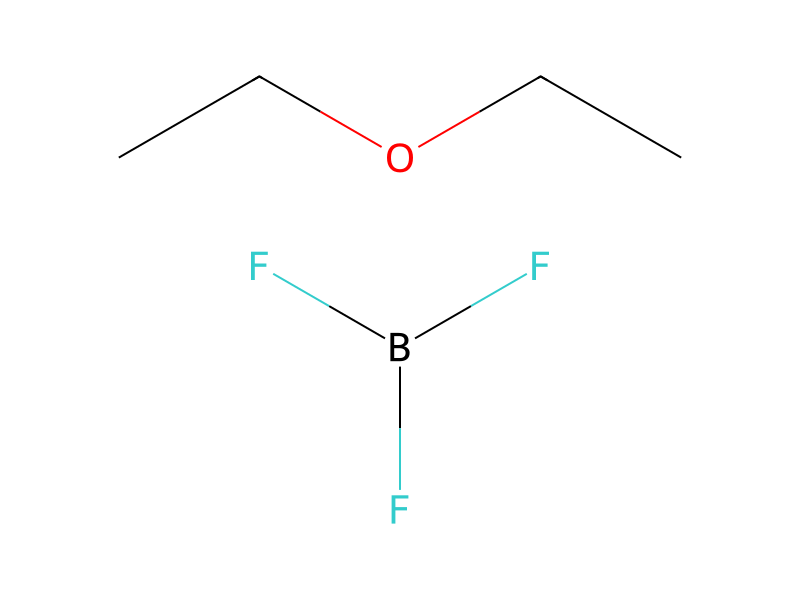
Boron trifluoride etherate → HCID 22349238, Verbindung
Reaktionsgleichung

CO[CH:3]([O:12][CH3:13])[C:4]1[CH:9]=[CH:8][CH:7]=[C:6]([O:10][CH3:11])[CH:5]=1.[P:14]([O:21]CC)([O:18][CH2:19][CH3:20])[O:15][CH2:16][CH3:17].B(F)(F)F.CCOCC.C(=O)(O)[O-].[Na+]>C(Cl)Cl>[CH3:13][O:12][CH:3]([C:4]1[CH:9]=[CH:8][CH:7]=[C:6]([O:10][CH3:11])[CH:5]=1)[P:14]([O:18][CH2:19][CH3:20])(=[O:21])[O:15][CH2:16][CH3:17]Komponenten
Edukt 4


Produkt 1

Reagenzien, Katalysatoren, Lösungsmittel 1

Versuchsvorschrift
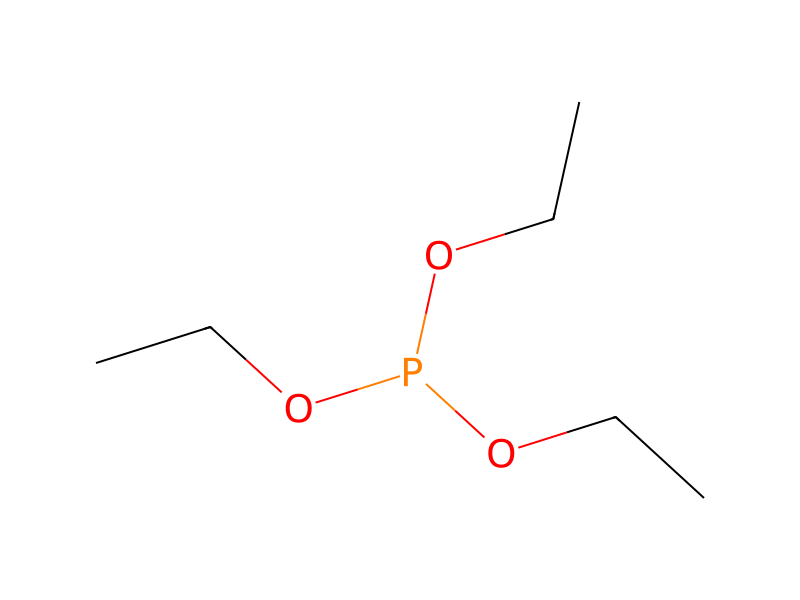
m-Methoxybenzaldehyde dimethyl acetal from Example 4 (271.4 g, 1.49 mol), triethyl phosphite (250.3 g, 1.51 mol), and methylene chloride (600 ml) were charged into a 3 liter 3-necked flask which was outfitted with a dropping funnel, an argon inlet, and an argon outlet. The flask was flushed with argon and the funnel was capped with a septum. The mixture was stirred and cooled to -40° in a liquid nitrogen-acetone bath. Boron trifluoride etherate (198.1 ml, 1.61 mol) was then added dropwise from the funnel over a 25 minute period. The mixture was allowed to slowly warm up to 5° over 3 hours. Stirring was then continued at room temperature for another 15 hours. The light yellow solution was then stirred rapidly as 500 ml saturated sodium bicarbonate solution was added. After 1 hour the mixture was transferred to a separatory funnel. The organic layer was isolated and washed with 500 ml water, 2×300 ml saturated sodium bisulfite, and 300 ml saturated bicarbonate solution. Drying was accomplished over 30 g anhydrous sodium sulfate just before decolorizing carbon (3 g) was added to the solution, and the whole was filtered under vacuum through celite. Concentration on the rotory evaporator and high vacuum pumping to a final pressure of 0.15 mm Hg at 100° C. provided a light yellow oil weighing 380 g (90%). I.R. (neat, cm-1): 2974, 1596, 1582, 1480, 1255 (P=O), 1098, 1050, 1020, 965, 1HNMR (400 MHz, CDCl3); δ1.21 and 1.25 (6H, two t, 7Hz, OCH2CH3); 3.37 (3H, s, ArCHOCH3); 3.80 (3H, s, ArOCH3); 3.90-4.10 (4H, m, OCH2CH3); 4.46 (1H, d, 15.6Hz, ArCHPO); 6.85 (1H, m); 7.00 (2H, m), 7.26 (1H, m). This product was sufficiently pure for use in a Horner-Emmons reaction. However, further purification to remove a trace of a non-polar fluorescent impurity may be accomplished with silica gel chromatography using dichloromethane to elute the impurity and subsequent elution with 20% ethyl acetate in dichloromethane to elute the phosphonate. ##STR28##
Aufarbeitung
- customwas outfitted with a dropping funnel, an argon inlet, and an argon outlet
- customThe flask was flushed with argon
- customthe funnel was capped with a septum
- temperaturecooled to -40° in a liquid nitrogen-acetone bath
- temperatureto slowly warm up to 5° over 3 hours
- stirringStirring
- additionwas added
- waitAfter 1 hour the mixture was transferred to a separatory funnel
- customThe organic layer was isolated
- washwashed with 500 ml water, 2×300 ml saturated sodium bisulfite, and 300 ml saturated bicarbonate solution
- customDrying
- additionwas added to the solution
- filtrationthe whole was filtered under vacuum through celite
- concentrationConcentration
- customon the rotory evaporator and high vacuum
- customat 100° C.
- customprovided a light yellow oil
- customThis product was sufficiently pure for use in a Horner-Emmons reaction
- customHowever, further purification
- customto remove a trace of a non-polar fluorescent impurity
- washto elute
- washthe impurity and subsequent elution with 20% ethyl acetate in dichloromethane
- washto elute the phosphonate
Quellen und Nachweise
- ORD-Eintrag
- ord-a493e4092bea464490fda814a2ea2cf7
- Quelldatensatz
- uspto-grants-1993_07
- Patentnummer
- US05225584
Notizen zur Reaktion
Wird geladen…