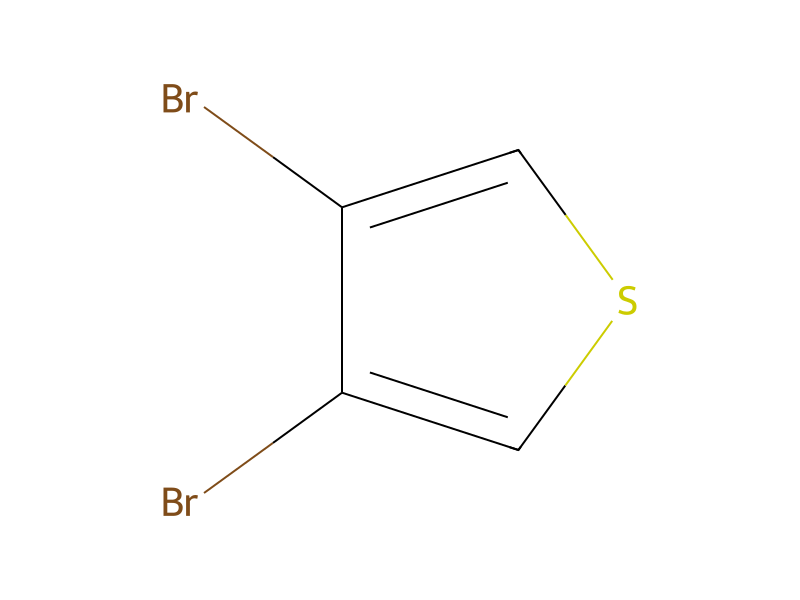
Br[C:2]1[C:6](Br)=[CH:5][S:4][CH:3]=1.[CH3:8][Si:9]([C:12]#[CH:13])([CH3:11])[CH3:10].O1[CH2:18][CH2:17]CC1.C(NC(C)C)(C)C>[Cu](I)I.C1(P(C2C=CC=CC=2)C2C=CC=CC=2)C=CC=CC=1>[CH3:8][Si:9]([C:12]#[C:13][C:2]1[C:6]([C:17]#[C:18][Si:9]([CH3:11])([CH3:10])[CH3:8])=[CH:5][S:4][CH:3]=1)([CH3:11])[CH3:10]2.5 ml (22.6 mmol) of 3,4-dibromothiophene, commercially available from Aldrich under the Product No. 24, 715-4, and 8 ml (56.5 mmol) of trimethylsilylacetylene were mixed with a solvent of tetrahydrofuran/diisopropylamine (1:1), and 0.15 g (0.23 mmol) of palladium dichlorodiphosphine, 21 mg (0.11 mmol) of copper iodide and 0.1 g (0.36 mmol) of triphenylphosphine were then sequentially added thereto. The reaction solution was heated at 70° C. for 8 hours, and washed with an aqueous solution of ammonium chloride. The resulting organic layer was dried over magnesium sulfate, dried under reduced pressure, and purified using silica gel column chromatography, thus obtaining 1.5 g of 3,4-bis(trimethylsilylethynyl)thiophene (IIa).
Wird geladen…