Reaktionsgleichung

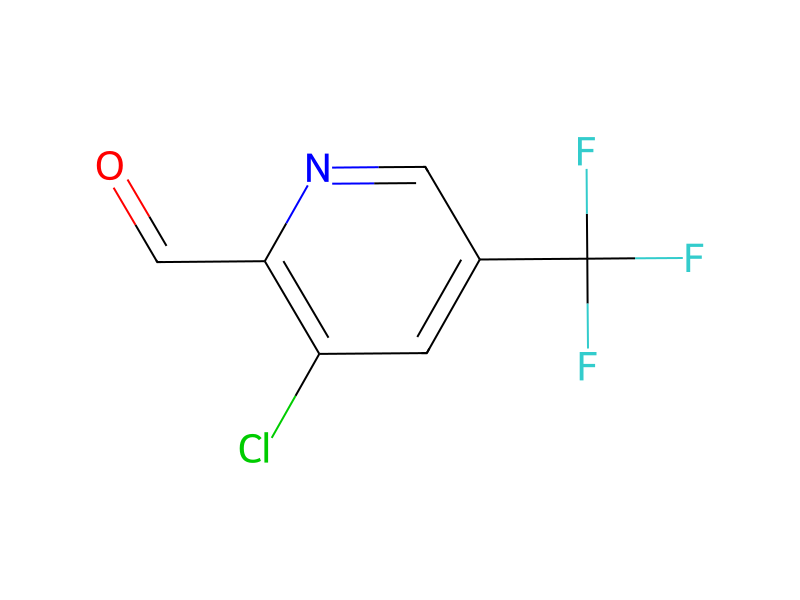
[Cl:1][C:2]1[C:3]([CH:12]=O)=[N:4][CH:5]=[C:6]([C:8]([F:11])([F:10])[F:9])[CH:7]=1.[N+:14]([C:17]1[CH:22]=[CH:21][CH:20]=[CH:19][C:18]=1[NH:23][NH2:24])([O-:16])=[O:15]>C(O)C>[N+:14]([C:17]1[CH:22]=[CH:21][CH:20]=[CH:19][C:18]=1[NH:23][N:24]=[CH:12][C:3]1[C:2]([Cl:1])=[CH:7][C:6]([C:8]([F:11])([F:10])[F:9])=[CH:5][N:4]=1)([O-:16])=[O:15]Komponenten
4
Edukt 2

Produkt 1

Reagenzien, Katalysatoren, Lösungsmittel 1

Versuchsvorschrift
A mixture of 3-chloro-5-(trifluoromethyl)pyridine-2-carboxaldehyde (1.05 g) and 2-nitrophenylhydrazine (0.76 g) in ethanol (75 ml) was heated at reflux for 2.5 hours and then allowed to cool to room temperature overnight. The resulting orange solid was isolated by filtration and recrystallised (petrol) to afford the title compound as admixture of isomers, m.p. 127-35° C.
Aufarbeitung
- temperaturewas heated
- temperatureat reflux for 2.5 hours
- customThe resulting orange solid was isolated by filtration
- customrecrystallised (petrol)
Quellen und Nachweise
- ORD-Eintrag
- ord-35658f78fa5c461cbe8d5acfc759eb93
- Quelldatensatz
- uspto-grants-2005_09
- Patentnummer
- US06939882B1
Verknüpfte Notizen
Wird geladen…