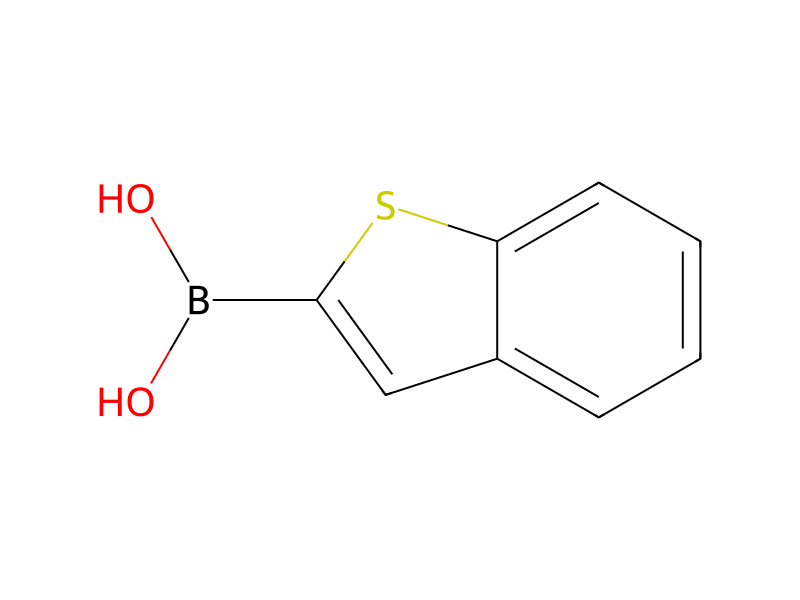
I[C:2]1[CH:10]=[CH:9][C:8]([N+:11]([O-:13])=[O:12])=[CH:7][C:3]=1[C:4]([NH2:6])=[O:5].C(=O)([O-])[O-].[Na+].[Na+].[S:20]1[C:24]2[CH:25]=[CH:26][CH:27]=[CH:28][C:23]=2[CH:22]=[C:21]1B(O)O>Cl[Pd](Cl)([P](C1C=CC=CC=1)(C1C=CC=CC=1)C1C=CC=CC=1)[P](C1C=CC=CC=1)(C1C=CC=CC=1)C1C=CC=CC=1.O1CCOCC1>[S:20]1[C:24]2[CH:25]=[CH:26][CH:27]=[CH:28][C:23]=2[CH:22]=[C:21]1[C:2]1[CH:10]=[CH:9][C:8]([N+:11]([O-:13])=[O:12])=[CH:7][C:3]=1[C:4]([NH2:6])=[O:5]2-Iodo-5-nitrobenzamide (Example 3A; 6.56 g) is introduced into dioxane (130 ml) and sat. sodium carbonate solution (65 ml) and, after addition of benzothiophene-2-boronic acid (6.00 g) and dichlorobis(triphenylphosphine)palladium (1.58 g), stirred at 80° C. overnight. The reaction mixture is filtered through kieselguhr and washed with ethyl acetate (250 ml) and water (100 ml). The organic phase is extracted with water (three times 100 ml) and sat. sodium chloride solution (100 ml) and then dried over sodium sulfate and concentrated in a rotary evaporator. The residue is chromatographed on silica gel (cyclohexane:ethyl acetate 10:1--->pure ethyl acetate). After the product fractions have been concentrated in a rotary evaporator, the target compound is suspended in diethyl ether, filtered off with suction and dried. 4.75 g of product (64% of theory) are obtained.