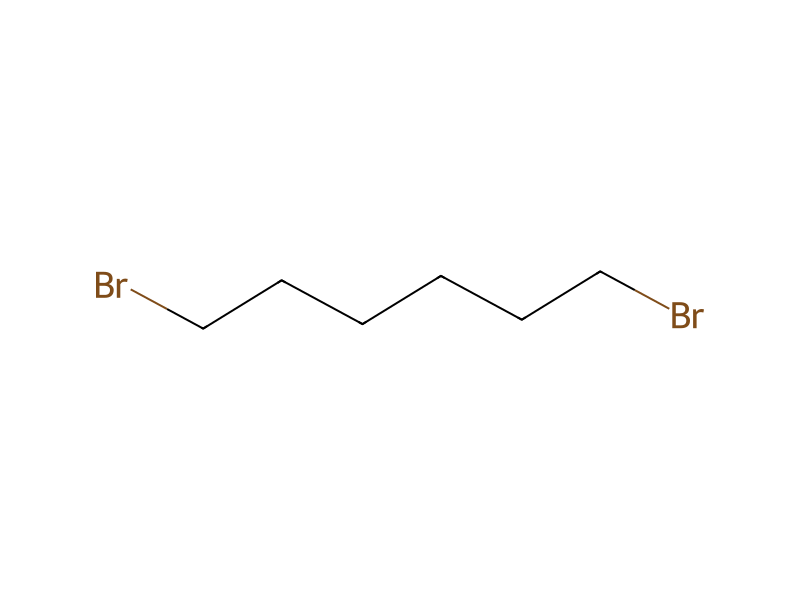
[Br:1][C:2]1[CH:14]=[CH:13][C:12]2[C:11]3[C:6](=[CH:7][C:8]([Br:15])=[CH:9][CH:10]=3)[CH2:5][C:4]=2[CH:3]=1.Br[CH2:17][CH2:18][CH2:19][CH2:20][CH2:21][CH2:22][Br:23].[OH-].[K+]>[Br-].C([N+](CCCC)(CCCC)CCCC)CCC.ClCCl>[Br:1][C:2]1[CH:14]=[CH:13][C:12]2[C:11]3[C:6](=[CH:7][C:8]([Br:15])=[CH:9][CH:10]=3)[C:5]([CH2:10][CH2:11][CH2:12][CH2:4][CH2:3][CH2:2][Br:1])([CH2:17][CH2:18][CH2:19][CH2:20][CH2:21][CH2:22][Br:23])[C:4]=2[CH:3]=1A mixture of 1 (5.0 g, 15.43 mmol), 1,6-dibromohexane (30 mL), tetrabutylammonium bromide (TBAB) (0.5 g), and potassium hydroxide aqueous solution (30 mL, 50% w/w) was stirred at 70° C. for 24 h under nitrogen. After diluting the reaction mixture with dichloromethane, the organic layer was washed with water and brine. The separated organic layer was dried over magnesium sulfate, and dichloromethane was evaporated. The residual 1,6-dibromohexane was distilled in a vacuum, and compound 2 (5.67 g, 56.5%) was obtained as a white crystal by chromatography with hexane/CH2Cl2 (95:5) as the eluent; m.p. 68° C. 1H NMR (500 MHz, CDCl3). δ (ppm): 7.51 (d, 2H, J=8.0 Hz), 7.45 (d, 2H, J=8.0 Hz), 7.42 (s, 2H), 3.27 (t, 4H, J=7 Hz), 1.91 (t, 4H, J=8.5 Hz), 1.65 (p, 4H, J=8 Hz), 1.18 (p, 4H, J=8 Hz), 1.06 (p, 4H, J=7.5 Hz), 0.57 (m, 4H).
Wird geladen…