Reaktionsgleichung

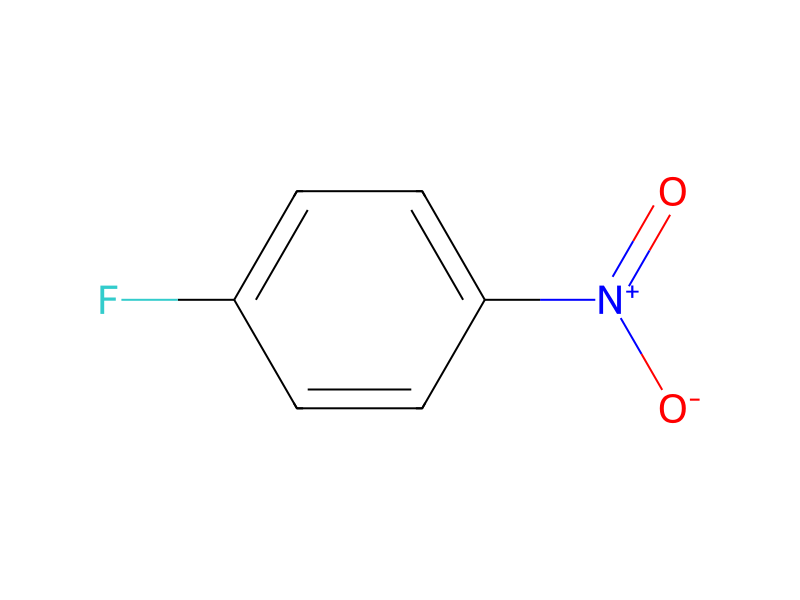
F[C:2]1[CH:7]=[CH:6][C:5]([N+:8]([O-:10])=[O:9])=[CH:4][CH:3]=1.[F:11][C:12]1[CH:17]=[CH:16][C:15]([OH:18])=[CH:14][CH:13]=1.C(=O)([O-])[O-].[K+].[K+]>CN(C)C=O>[F:11][C:12]1[CH:17]=[CH:16][C:15]([O:18][C:2]2[CH:7]=[CH:6][C:5]([N+:8]([O-:10])=[O:9])=[CH:4][CH:3]=2)=[CH:14][CH:13]=1Komponenten
5
Edukt 3


Produkt 1

Reagenzien, Katalysatoren, Lösungsmittel 1

Reaktionsbedingungen
- Temperatur
- 120 °C
Versuchsvorschrift
A mixture of 1-fluoro-4-nitrobenzene (4 g, 28.35 mmol, 1.00 equiv), 4-fluorophenol (3.177 g, 28.34 mmol, 1.00 equiv) and potassium carbonate (7.83 g, 56.24 mmol, 1.98 equiv) in N,N-dimethylformamide (50 mL) was stirred overnight at 120° C. The reaction was cooled to room temperature and then quenched by the addition of 200 mL of water. The resulting solution was extracted with 3×100 mL of ethyl acetate. The combined organic layers was washed with 3×150 mL of brine, dried over anhydrous sodium sulfate and concentrated under vacuum to yield 6.4 g (97%) of 1-fluoro-4-(4-nitrophenoxy)benzene as a yellow solid. 1H-NMR (400 MHz, CDCl3): δ 8.22-8.18 (m, 2H), 7.16-7.04 (m, 4H), 7.00-6.97 (m, 2H) ppm.
Aufarbeitung
- temperatureThe reaction was cooled to room temperature
- customquenched by the addition of 200 mL of water
- extractionThe resulting solution was extracted with 3×100 mL of ethyl acetate
- washThe combined organic layers was washed with 3×150 mL of brine
- dry with materialdried over anhydrous sodium sulfate
- concentrationconcentrated under vacuum
Quellen und Nachweise
- ORD-Eintrag
- ord-ea13940dea4f4bafad7559e24870d040
- Quelldatensatz
- uspto-grants-2016_05
- Patentnummer
- US09346761B2
Verknüpfte Notizen
Wird geladen…