Reaktionsgleichung
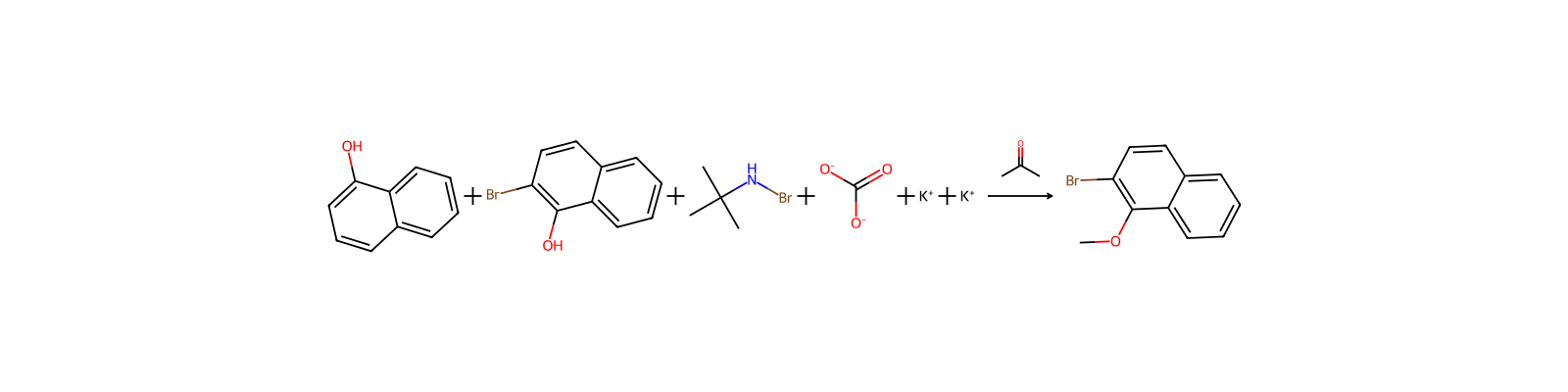
[C:1]1(O)C2C(=CC=CC=2)C=CC=1.[Br:12][C:13]1[CH:22]=[CH:21][C:20]2[C:15](=[CH:16][CH:17]=[CH:18][CH:19]=2)[C:14]=1[OH:23].BrNC(C)(C)C.C(=O)([O-])[O-].[K+].[K+]>CC(C)=O>[Br:12][C:13]1[CH:22]=[CH:21][C:20]2[C:15](=[CH:16][CH:17]=[CH:18][CH:19]=2)[C:14]=1[O:23][CH3:1]Komponenten
Edukt 4




Produkt 1

Reagenzien, Katalysatoren, Lösungsmittel 1

Reaktionsbedingungen
- Temperatur
- 25 °C
Versuchsvorschrift
1-naphthol was converted into 2-bromo-1-naphthol by reaction with a slurry of N-bromo-t-butylamine at -78° C. according to the procedure described in Pearson, Wysong, Breder, J. Org. Chem. 32, 2358 (1967). To a solution of 1 mole (crude) of the bromonaphthol in 750 mL of acetone was added 175 g of potassium carbonate. Over a 2-hous period, 95 mL of dimethylsulate was added dropwise to the mechanically stirred reaction mixture. The resulting slurry was stirred at 25° C. overnight. The solids were filtered and the solution was stripped to yield a dark brown oil. Initial purification was accomplished by vacuum distillation (80°-120° C., 0.2 Torr) followed by further purification by HPLC with hexane to yield 145 g of 2-bromo-1-methoxynaphthalene as a pale yellow oil. NMR confirmed the structure.
Aufarbeitung
- waitOver a 2-hous period
- addition95 mL of dimethylsulate was added dropwise to the mechanically stirred reaction mixture
- filtrationThe solids were filtered
- customto yield a dark brown oil
- customInitial purification
- distillationwas accomplished by vacuum distillation (80°-120° C., 0.2 Torr)
- customfollowed by further purification by HPLC with hexane
Quellen und Nachweise
- ORD-Eintrag
- ord-352027f5ace04caca5d1f5c9a25194cf
- Quelldatensatz
- uspto-grants-1993_09
- Patentnummer
- US05244771
Verknüpfte Notizen
Wird geladen…