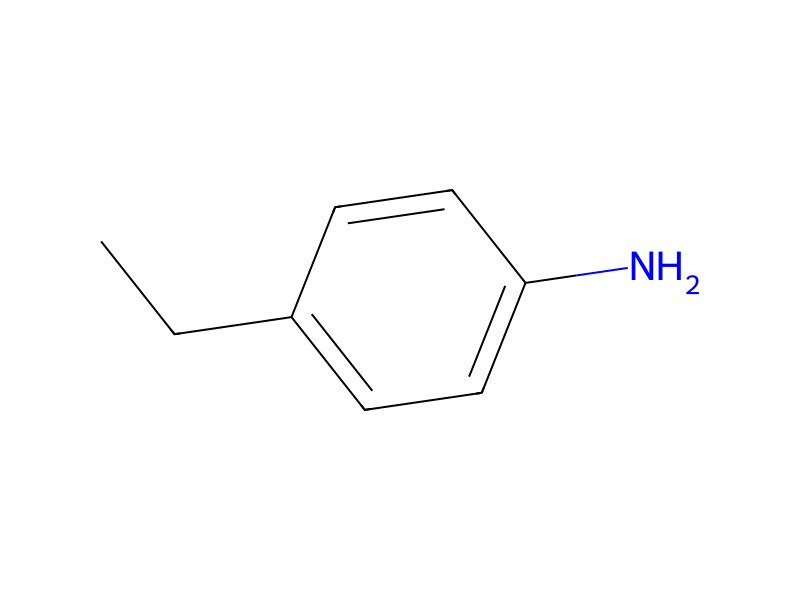
4-Ethylaniline → HCID 13121221, Verbindung
HRID 544386
Reaktionsgleichung

Cl[C:2]1[C:7]([CH3:8])=[C:6]([CH3:9])[N:5]=[CH:4][N:3]=1.[CH2:10]([C:12]1[CH:18]=[CH:17][C:15]([NH2:16])=[CH:14][CH:13]=1)[CH3:11]>>[CH2:10]([C:12]1[CH:18]=[CH:17][C:15]([NH:16][C:2]2[C:7]([CH3:8])=[C:6]([CH3:9])[N:5]=[CH:4][N:3]=2)=[CH:14][CH:13]=1)[CH3:11]Komponenten
3


Reaktionsbedingungen
- Temperatur
- 150 °C
Versuchsvorschrift
To 4.3 g (0.03 mole) of 4-chloro-5,6-dimethylpyrimidine were added 3.6 g (0.03 mole) of p-ethylaniline; the mixture was then heated at 150° C. for about 3 minutes. The reaction mixture quickly became a solution which, on cooling, precipitated crystals. These crystals were separated and then made alkaline by the addition of 50 ml of a dilute aqueous solution of sodium hydroxide. The insolubles were extracted with about 100ml of ethyl acetate and the resulting extract was washed, in turn, with water and with a saturated aqueous solution of sodium chloride; it was then dried over anhydrous sodium sulphate. The ethyl acetate was distilledoff under reduced pressure to give crystals, which were recrystallised frombenzene, affording 4.8 g (yield 71%) of the desired Compound No. 46, in theform of colourless needles melting at 97°-98° C.