Reaktionsgleichung

[C:1]1(=[O:11])[O:6][C:4](=O)[C:3]2=[CH:7][CH:8]=[CH:9][CH:10]=[C:2]12.[NH2:12][CH2:13][CH2:14][CH2:15][CH2:16][CH2:17][OH:18]>C1(C)C=CC=CC=1>[OH:18][CH2:17][CH2:16][CH2:15][CH2:14][CH2:13][N:12]1[C:1](=[O:11])[C:2]2=[CH:10][CH:9]=[CH:8][CH:7]=[C:3]2[C:4]1=[O:6]Komponenten
Edukt 2
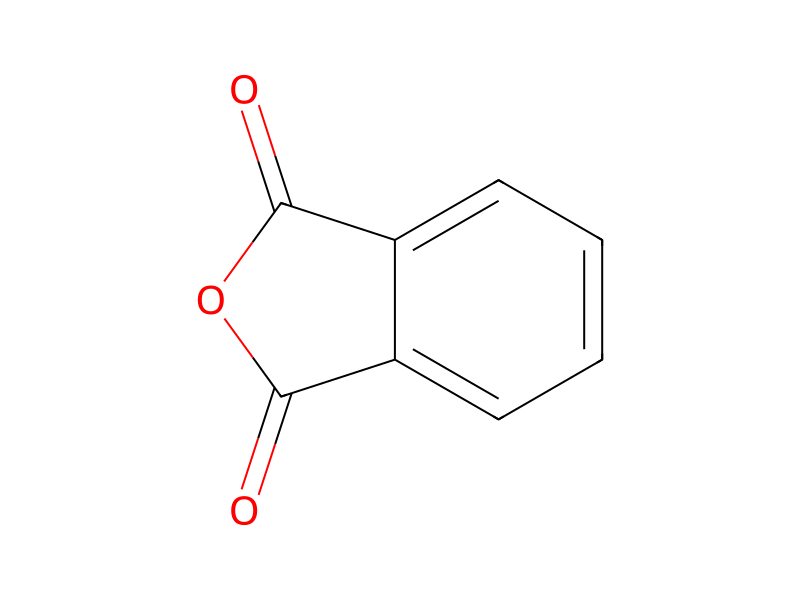

Produkt 1

Reagenzien, Katalysatoren, Lösungsmittel 1

Versuchsvorschrift
Step 1. A mixture of phthalic anhydride (1.48 g, 10 mmol) and 5-amino-1-pentanol (1.03 g, 10 mmol) in toluene (20 ml) was heated under reflux overnight. The solvent was removed under vacuum, and the residue was purified by chromatography to afford N-(5-hydroxypentyl)phthalimide (2.00 g, 88%) as a colorless oil. 1H NMR (500 MHz, CDCl3) δ 1.37-1.48 (m, 2H), 1.56-1.67 (m, 2H), 1.67-1.79 (m, 2H), 3.64 (t, J=6.5 Hz, 2H), 3.70 (t, J=7.5 Hz, 2H), 7.66-7.76 (m, 2H), 7.80-7.99 (m, 2H). Step 2. Diisopropyl azodicarboxylate (0.69 ml, 3.51 mmol) was added dropwise to a mixture of OZ288 (0.50 g, 1.4 mmol), N-(5-hydroxypentyl)phthalimide (0.65 g, 2.79 mmol), triphenylphosphine (0.92 g, 3.51 mmol), and triethylamine (0.5 ml, 3.51 mmol) in THF (50 ml) at 0° C. under N2 atmosphere. The resulting mixture was stirred at rt for 24 h. After removal of the solvent, the crude product was purified by crystallization from EtOH to afford the desired phenol ether (0.35 g, 44%) as a colorless solid. mp 115-116° C.; 1H NMR (500 MHz, CDCl3) δ 1.46-2.08 (m, 28H), 2.43-2.53 (m, 1H), 3.71 (t, J=7.0 Hz, 2H), 3.92 (t, J=6.5 Hz, 2H), 6.79 (d, J=9.0 Hz, 2H), 7.09 (d, J=9.0 Hz, 2H), 7.67-7.75 (m, 2H), 7.80-7.99 (m, 2H); 13C NMR (125.7 MHz, CDCl3) δ 23.42, 26.49, 26.89, 28.33, 28.85, 31.65, 34.76, 34.81, 36.41, 36.81, 37.85, 42.05, 67.55, 108.46, 111.34, 114.34, 123.18, 127.56, 132.15, 133.86, 138.20, 157.34, 168.43. Step 3. A mixture of the above phenol ether (0.30 g, 0.53 mmol) and hydrazine monohydrate (1 ml) in chloroform (30 ml) and methanol (3 ml) was heated at 50° C. for 24 h. After the reaction mixture was cooled to rt and filtered to the remove a solid by-product, the filtrate was washed with water (2×10 ml) and brine (10 ml), dried over MgSO4, filtered, and concentrated. The residue was dissolved in CH2Cl2 (5 ml) and a solution of methanesulfonic acid (0.05 g, 0.52 mmol) in ethyl acetate (20 ml) was added. The precipitate was collected by filtration to afford trioxolane OZ498 (0.19 g, 68%) as a colorless solid. mp 155-156° C.; 1H NMR (500 MHz, DMSO-d6) δ 1.38-1.98 (m, 28H), 2.30 (brs, 3H), 2.50-2.59 (m, 1H), 2.76-2.85 (m, 2H), 3.92 (t, J=6.3 Hz, 2H), 6.83 (d, J=8.8 Hz, 2H), 7.11 (d, =8.3 Hz, 2H), 7.63 (brs, 3H); 13C NMR (125.7 MHz, DMSO-d6) δ 22.72, 25.98, 26.39, 26.90, 28.35, 31.49, 34.28, 34.44, 35.96, 36.25, 38.97, 40.86, 67.22, 108.32, 110.71, 114.44, 127.58, 138.04, 157.08. Anal. Calcd for C28H43NO7S: C, 62.54; H, 8.06; N, 2.60. Found: C, 62.55; H, 7.93; N, 2.76.
Aufarbeitung
- temperaturewas heated
- temperatureunder reflux overnight
- customThe solvent was removed under vacuum
- customthe residue was purified by chromatography
Quellen und Nachweise
- ORD-Eintrag
- ord-d380433288e7407984d78a02789d77ba
- Quelldatensatz
- uspto-grants-2011_11
- Patentnummer
- US08067620B2
Verknüpfte Notizen
Wird geladen…