HuagongsheHuagongshe Chemie-Druckbericht · Nur für Forschungszwecke
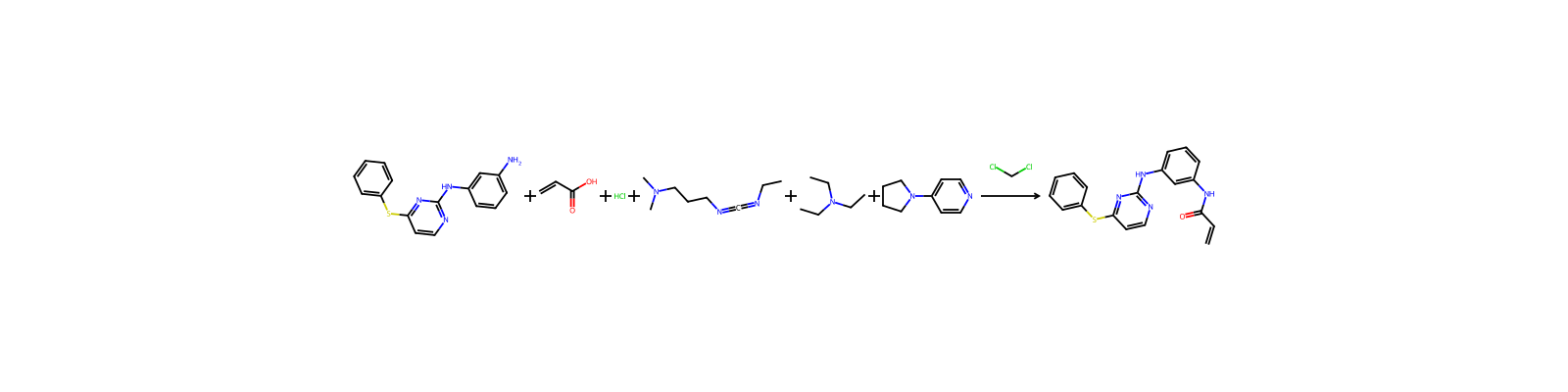
Acrylic Acid → N-(3-(4-(phenylthio)pyrimidin-2-ylamino)phenyl)acrylamide
Beteiligte Stoffe
| Rolle | Name | HCID | Einwaage |
|---|---|---|---|
| Edukt | Acrylic Acid | HCID 6581 | — |
| Edukt | Triethylamine | HCID 8471 | — |
| Edukt | 4-Pyrrolidinopyridine | HCID 75567 | — |
| Edukt | 1,3-Propanediamine, N'-(ethylcarbonimidoyl)-N,N-dimethyl-, monohydrochloride | HCID 2723939 | — |
| Edukt | N1-(4-(phenylthio)pyrimidin-2-yl)benzene-1,3-diamine | HCID 68746426 | — |
| Lösungsmittel | Dichloromethane | HCID 6344 | — |
| Produkt | N-(3-(4-(phenylthio)pyrimidin-2-ylamino)phenyl)acrylamide | HCID 59491563 | 33% |
Reaktionsschritte
To a stirred solution of N1-(4-(phenylthio)pyrimidin-2-yl)benzene-1,3-diamine (80 mg, 0.27 mmol) and acrylic acid (37 μL, 0.54 mmol) in anhydrous dichloromethane (2 mL), was added 1-[3-(dimethylamino)propyl]-3-ethylcarbodiimide hydrochloride salt (78 mg, 0.41 mmol), triethylamine (114 μL, 0.82 mmol) and 4-pyrrolidinopyridine (5 mg). The resulting mixture was stirred at room temperature under nitrogen atmosphere for 16 hours. It was diluted with dichloromethane (20 mL), washed with water, 2.0 M aqueous sodium carbonate solution, and dried (Na2SO4). After removal of the solvent in vacuo, the residue was flash chromatographed on silica gel using ethyl acetate:petroleum ether (50:50→100:0) as eluant to give the desired product (31 mg, 33%).
Herkunft & Nachweise
| DOI | 10.6084/m9.figshare.5104873.v1 |
|---|---|
| Patentnummer | US09040549B2 |
| Quelldatensatz | uspto-grants-2015_05 |
| ORD ID | ord-dbb147c27f0a4c56b7b2032b04cf4b80 |
| Quellennotiz | uspto-grants-2015_05 |