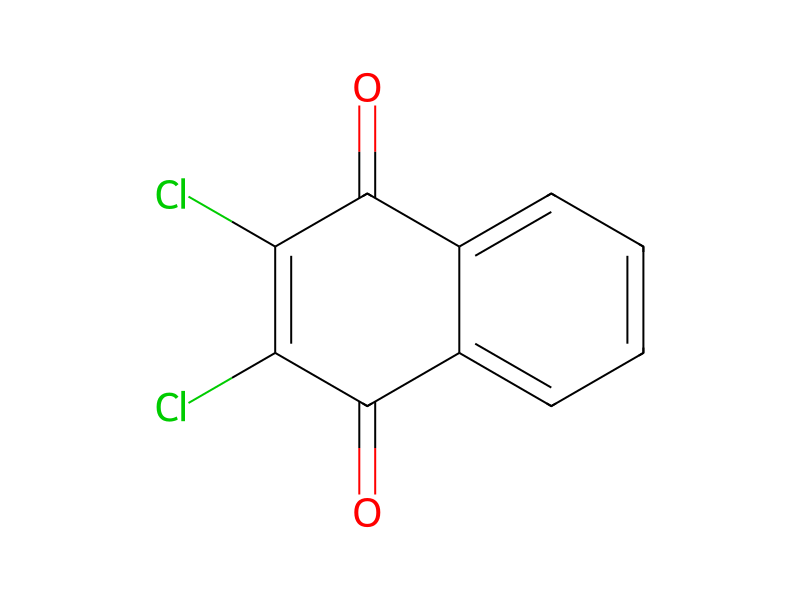
Cl[C:2]1[C:3](=[O:14])[C:4]2[C:9]([C:10](=[O:13])[C:11]=1Cl)=[CH:8][CH:7]=[CH:6][CH:5]=2.C([O-])([O-])=O.[K+].[K+].[CH3:21][NH:22][C:23]([NH2:25])=[S:24]>C(O)(C)C>[CH3:21][NH:22][C:23]1[S:24][C:11]2[C:10](=[O:13])[C:9]3[CH:8]=[CH:7][CH:6]=[CH:5][C:4]=3[C:3](=[O:14])[C:2]=2[N:25]=1A mixture of 2,3-dichloronaphthalene-1,4-dione 10.0 g (0.044 mol,), 18.0 g K2CO3 (0.13 mol, 3.0 eq) and 1-methylthiourea (0.056 mol, 1.2 eq) in 100 ml isopropanol was stirred at room temperature under N2 for 20 h. After removing all solvents under reduced pressure, the residue was diluted with CH2Cl2 and the K2CO3 was removed by filtration, the organic layer was concentrated, the residue was purified by chromatography to afford 0.1 g 2-(methylamino-) naphtho[2,3-d]thiazole-4,9-dione as black solid in a yield of 0.93%. 1HNMR (300 MHz, DMSO) δ3.59 (s, 3H); 7.78-7.81 (m, 2H); 7.89-7.93 (m, 1H); 7.98-8.01 (m, 1H); 9.06 (br, 1H) ppm. MS-ESI: cal. 244; found: 285 (M+Na+H2O).