Hydrochloric Acid → 7-Chloro-5-methyl-2-(trifluoromethyl)-[1,2,4]triazolo[1,5-a]pyrimidine
Reaktionsgleichung
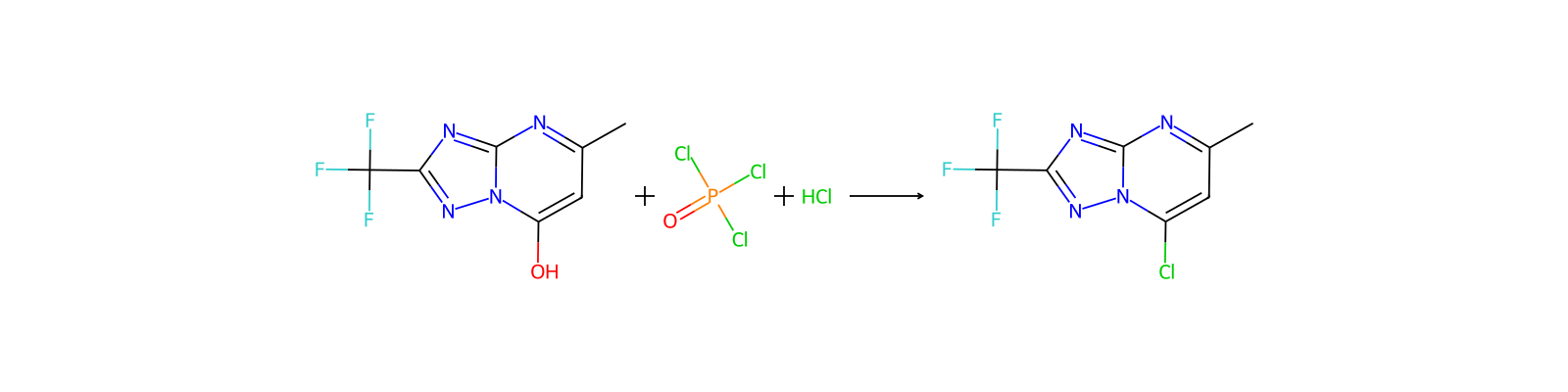
[CH3:1][C:2]1[CH:7]=[C:6](O)[N:5]2[N:9]=[C:10]([C:12]([F:15])([F:14])[F:13])[N:11]=[C:4]2[N:3]=1.P(Cl)(Cl)([Cl:18])=O.Cl>>[Cl:18][C:6]1[N:5]2[N:9]=[C:10]([C:12]([F:15])([F:14])[F:13])[N:11]=[C:4]2[N:3]=[C:2]([CH3:1])[CH:7]=1Komponenten
4




Versuchsvorschrift
A mixture of 0.750 g (3.44 mmol) 5-methyl-2-(trifluoromethyl)-[1,2,4]triazolo[1,5-a]pyrimidin-7-ol and 1.35 mL (14.46 mmol) of phosphorus oxychloride was heated under reflux for 60 minutes, during which time the pinkish solid dissolved gradually with the evolution of hydrogen chloride gas. The resultant dark red solution was distilled under reduced pressure to remove excess phosphorus oxychloride and the residue triturated with ice-water. The resultant aqueous solution was extracted with methylene chloride, the organic layer thus obtained was dried and the solvent was removed to give the desired product. Further washes of the crude residue with methylene chloride gave 0.547 g of 7-chloro-5-methyl-2-(trifluoromethyl)-[1,2,4]triazolo[1,5-a]pyrimidine. Yield 67.4%. The washed crude was used without purification in the next step.