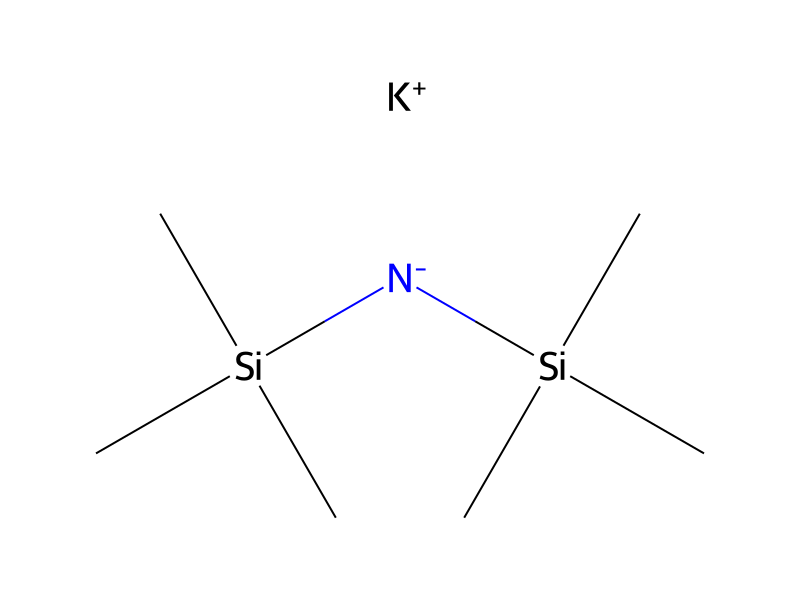
[CH3:1][C:2]1[C:10]2[C:5](=[CH:6][CH:7]=[C:8]([C:11]#[N:12])[CH:9]=2)[NH:4][C:3]=1[C:13]1[CH:14]=[N:15][CH:16]=[CH:17][CH:18]=1.C[Si]([N-][Si](C)(C)C)(C)C.[K+].Br[CH2:30][CH2:31][O:32][C:33]1[CH:38]=[CH:37][CH:36]=[CH:35][CH:34]=1.[Cl-].[NH4+]>C1COCC1>[CH3:1][C:2]1[C:10]2[C:5](=[CH:6][CH:7]=[C:8]([C:11]#[N:12])[CH:9]=2)[N:4]([CH2:30][CH2:31][O:32][C:33]2[CH:38]=[CH:37][CH:36]=[CH:35][CH:34]=2)[C:3]=1[C:13]1[CH:14]=[N:15][CH:16]=[CH:17][CH:18]=1To a solution of 3-methyl-2-pyridin-3-yl-1H-indole-5-carbonitrile (Example 6, 47 mg, 0.20 mmol) in THF (5 mL) at room temperature is added KHMDS (0.5 M in toluene, 0.60 mL, 0.30 mmol) followed with (2-bromo-ethoxy)-benzene (90 mg, 0.45 mmol). The mixture is stirred under N2 for 2 days and aqueous ammonium chloride (1 mL) is added to quench the reaction. The volatiles are removed in vacuo and the residue is purified by silica gel flash chromatography (ethyl acetate-heptane, 1:4 to 1:0) to give 3-methyl-1-(2-phenoxy-ethyl)-2-pyridin-3-yl-1H-indole-5-carbonitrile. 1H NMR (400 MHz, CDCl3) δ ppm 2.25 (s, 3H), 4.10 (t, J=5.2 Hz, 2H), 4.46 (t, J=5.3 Hz, 2H), 6.66 (d, J=7.8 Hz, 2H), 6.93 (t, J=7.3 Hz, 1H), 7.17-7.25 (m, 2H), 7.51-7.57 (m, 2H), 7.59-7.65 (m, 1H), 7.95 (d, J=8.6 Hz, 1H), 7.98 (s, 1H), 8.74-8.79 (m, 2H). HRMS (ESI) m/z 354.1618 [(M+H)+ Calcd for C23H20N3O: 354.1606].