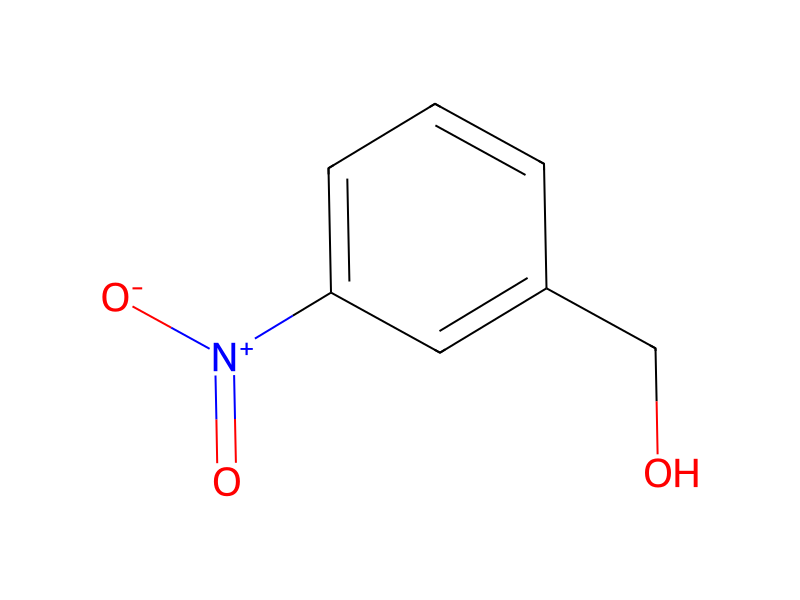
m-Nitro-benzyl alcohol was prepared by subjecting m-nitro-benzaldehyde to the Cannizarro Reaction at 45° C., with an aqueous formalin solution and potassium hydroxide. The m-nitro-benzyl alcohol was reacted with thionyl chloride to form m-nitro-benzyl chloride (m.p. 45° C.). By refluxing m-nitro-benzyl chloride with sodium cyanide in aqueous-ethanolic solution for five hours in the presence of potassium iodide, m-nitro-benzyl cyanide (m.p. 58° C.) was prepared which was subsequently hydrolized by boiling with concentrated hydrochloric acid to form m-nitrophenyl-acetic acid. The m-nitrophenyl-acetic acid thus obtained was then converted into 1-(m-nitro-phenyl)-propanone-(2), m.p. 62° C., by the method of Shtacker et al, J. Med. Chem. 15, 1174 (1972), and the 1-(m-nitro-phenyl)-propanone-(2) was reduced in water with nascent hydrogen generated by iron powder and concentrated hydrochloric acid, followed by 3 hours' stirring. The reduction product, 1-(m-amino-phenyl)-propanone-(2), was recovered from the reaction mixture by extraction with ether. Since the product thus obtained was not distillable without decomposition, it was purified via its oxalate, m.p. 127°-129° C., which was prepared by dissolving the base in acetonitrile and adding oxalic acid to the solution. By adding aqueous sodium hydroxide to the oxalate and extracting the aqueous mixture with ether, the free base was again obtained.