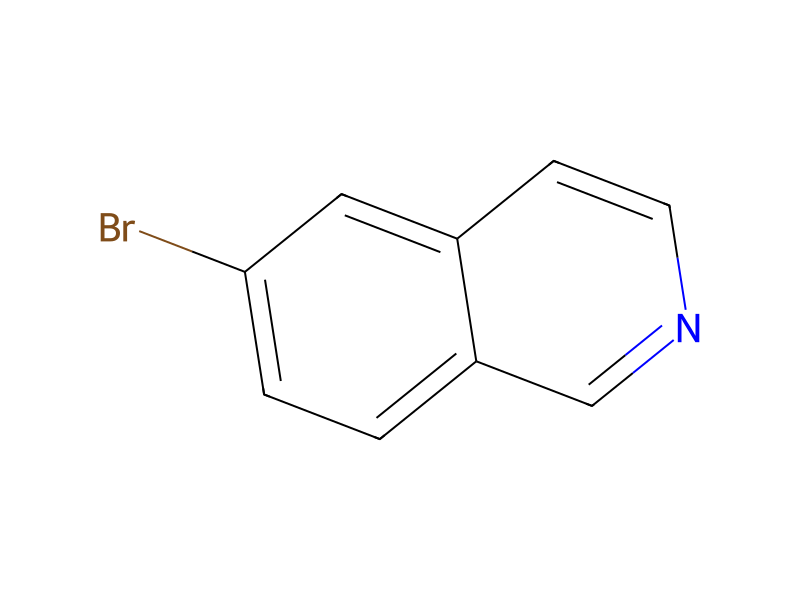
Br[C:2]1[CH:3]=[C:4]2[C:9](=[CH:10][CH:11]=1)[CH:8]=[N:7][CH:6]=[CH:5]2.[C:12]([Si:14]([CH3:17])([CH3:16])[CH3:15])#[CH:13]>CCN(CC)CC.Cl[Pd](Cl)([P](C1C=CC=CC=1)(C1C=CC=CC=1)C1C=CC=CC=1)[P](C1C=CC=CC=1)(C1C=CC=CC=1)C1C=CC=CC=1.[Cu]I>[CH3:15][Si:14]([CH3:17])([CH3:16])[C:12]#[C:13][C:2]1[CH:3]=[C:4]2[C:9](=[CH:10][CH:11]=1)[CH:8]=[N:7][CH:6]=[CH:5]2To a solution of 6-bromoisoquinoline (2.0 g, 9.6 mmol) (commercially available from Gateway Chemical Technology, Inc.) in 45 mL of Et3N was added PdCl2(PPh3)2 (0.34 g, 0.48 mmol) and copper(I) iodide (0.27 g, 1.4 mmol). The mixture was degassed by bubbling nitrogen through the mixture for 1 minute. Ethynyltrimethylsilane (2.7 mL, 19 mmol) was added. The mixture was heated to 50° C. After 1 hour, the solvent was removed by rotary evaporation and the residue was purified by flash chromatography on silica gel (5% to 30% EtOAc/hexanes), affording 6-(2-(trimethylsilyl)ethynyl)isoquinoline (2.2 g, 100% yield).
Wird geladen…