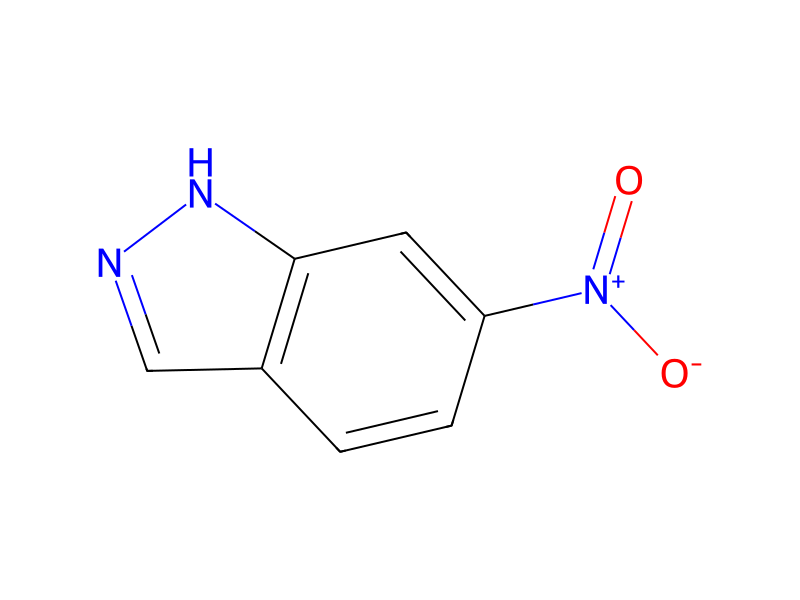
A 5 mL microwave reaction vessel was charged with 3-iodo-6-nitroindazole (1 mmol), copper (I) cyanide (2 mmol) and N,N-dimethylformamide (3 mL). The vessel was sealed and subjected to microwave irradiation at 185° C. for 600 sec. The reaction mixture was partitioned between ethyl acetate (100 mL) and water (100 mL) and the mixture was filtered through Celite. The organic layer was collected, washed with brine, dried (magnesium sulfate), and concentrated to give 122 mg of a 10/1 mixture of 3-cyano-6-nitroindazole and 6-nitroindazole as a yellow solid. The 10/1 mixture of 3-cyano-6-nitroindazole and 6-nitroindazole was dissolved in 10 N sodium hydroxide and the bright orange solution was heated at 100° C. for 1 h. The mixture was allowed to cool to room temperature and carefully acidified (pH=1) with 3 N hydrochloric acid. The solid was isolated and triturated with EtOAc to provide 51 mg of 6-nitroindazole-3-carboxylic acid as a brown solid. The acid was coupled with the bicyclobase according to procedure A.