Tetrahydrofuran → N-(2-methylcyclopentyl)-3,4-difluorobenzamide
Reaktionsgleichung
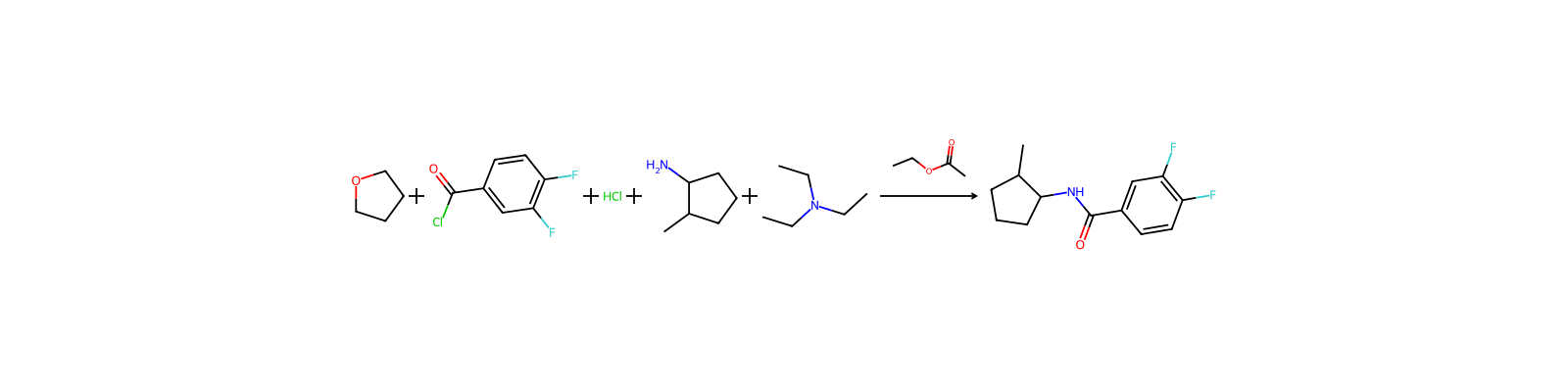
C1COCC1.[F:6][C:7]1[CH:8]=[C:9]([CH:13]=[CH:14][C:15]=1[F:16])[C:10](Cl)=[O:11].Cl.[CH3:18][CH:19]1[CH2:23][CH2:22][CH2:21][CH:20]1[NH2:24].C(N(CC)CC)C>C(OCC)(=O)C>[CH3:18][CH:19]1[CH2:23][CH2:22][CH2:21][CH:20]1[NH:24][C:10](=[O:11])[C:9]1[CH:13]=[CH:14][C:15]([F:16])=[C:7]([F:6])[CH:8]=1Komponenten
6
Edukt 4




Produkt 1

Reagenzien, Katalysatoren, Lösungsmittel 1

Versuchsvorschrift
To a mixture of 10 ml of THF and 0.60 g of 3,4-difluorobenzoyl chloride were added 0.37 g of 2-methylcyclopentylamine hydrochloride and 1.0 g of triethylamine, and the mixture obtained was stirred at room temperature for 3 hours. Then, ethyl acetate was added to the reaction mixture and filtered through Celite. The filtrate was concentrated under reduced pressure. The residue was subjected to silica gel column chromatography to obtain 0.55 g of N-(2-methylcyclopentyl)-3,4-difluorobenzamide.
Aufarbeitung
- customthe mixture obtained
- filtrationfiltered through Celite
- concentrationThe filtrate was concentrated under reduced pressure
Quellen und Nachweise
- ORD-Eintrag
- ord-8ab286347c77495d9716b68571a0fd09
- Quelldatensatz
- uspto-grants-2011_03
- Patentnummer
- US07902400B2
Notizen zur Reaktion
Wird geladen…