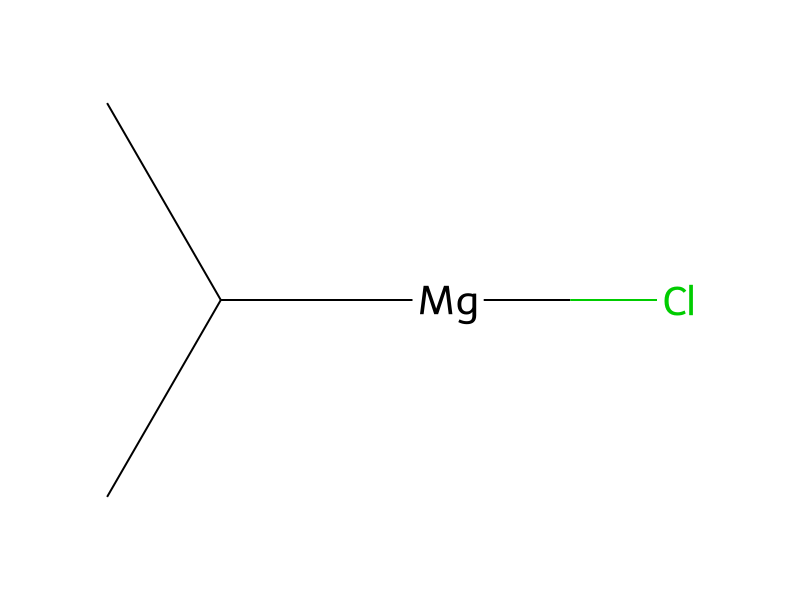
[CH2:1]([O:8][C:9]1[C:10](=[O:18])[N:11]([CH3:17])[C:12](Br)=[C:13]([Br:15])[CH:14]=1)[C:2]1[CH:7]=[CH:6][CH:5]=[CH:4][CH:3]=1.C([Mg]Cl)(C)C.CN(C1C=CC=CN=1)[CH:26]=[O:27]>C1COCC1>[CH2:1]([O:8][C:9]1[C:10](=[O:18])[N:11]([CH3:17])[C:12]([CH:26]=[O:27])=[C:13]([Br:15])[CH:14]=1)[C:2]1[CH:7]=[CH:6][CH:5]=[CH:4][CH:3]=1To a −78° C. solution of 3-(benzyloxy)-5,6-dibromo-1-methylpyridin-2(1H)-one (1.5 g, 4.02 mmol) in THF (20 mL) was added 2 M isopropylmagnesium chloride in THF (4.02 mL, 8.04 mmol) dropwise. This mixture was stirred at −78° C. for 15 minutes under nitrogen, and N-methyl-N-pyridin-2-ylformamide (1.4 mL, 12.06 mmol) was added. The mixture was allowed to slowly warm to room temperature overnight. Volatiles were removed under reduced pressure, and the resulting residue was partitioned between dilute aqueous hydrochloric acid and ethyl acetate. The aqueous layer was removed and discarded. The organic layer was collected, dried over anhydrous magnesium sulfate, and purified by silica gel chromatography to afford 5-(benzyloxy)-3-bromo-1-methyl-6-oxo-1,6-dihydropyridine-2-carbaldehyde (1.09 g, 3.38 mmol, 84% yield). ES-MS (M+H)+=323.