Reaktionsgleichung

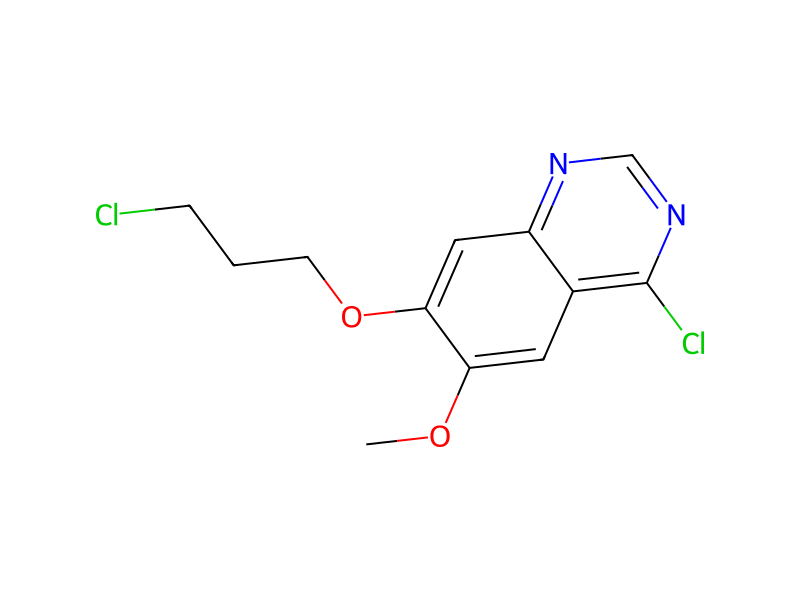
C1(P(C2C=CC=CC=2)C2C=CC=CC=2)C=CC=CC=1.[Cl:20][CH2:21][CH2:22][CH2:23][OH:24].[Cl:25][C:26]1[C:35]2[C:30](=[CH:31][C:32](O)=[C:33]([O:36][CH3:37])[CH:34]=2)[N:29]=[CH:28][N:27]=1.N(C(OC(C)(C)C)=O)=NC(OC(C)(C)C)=O>ClCCl>[Cl:25][C:26]1[C:35]2[C:30](=[CH:31][C:32]([O:24][CH2:23][CH2:22][CH2:21][Cl:20])=[C:33]([O:36][CH3:37])[CH:34]=2)[N:29]=[CH:28][N:27]=1Komponenten
6
Edukt 4



Produkt 1
Reagenzien, Katalysatoren, Lösungsmittel 1

Versuchsvorschrift
Triphenylphosphine (2.6 g, 10.1 mmol) and 3-chloropropanol (0.69 ml, 8.2 mmol) were added to a suspension of 4-chloro-7-hydroxy-6-methoxyquinazoline (1.65 g, 7.8 mmol) in dichloromethane (100 ml) under argon. The flask was placed in a water bath at 20° C. and di-tertbutyl azodicarboxylate (2.30 g, 10.1 mmol) added portion wise over a few minutes. The reaction mixture was stirred at ambient temperature for 2 hours. The reaction mixture was concentrated and the solution loaded directly onto a silica chromatography column. Elution with ethyl acetate:petroleum ether (3:7), yielded 4-chloro-7-(3-chloropropoxy)-6-methoxyquinazoline (2.0 g, 91% yield):
Aufarbeitung
- customThe flask was placed in a water bath at 20° C.
- concentrationThe reaction mixture was concentrated
- washElution with ethyl acetate:petroleum ether (3:7)
Quellen und Nachweise
- ORD-Eintrag
- ord-eb7626e449e04f46aadfe370377ff9e0
- Quelldatensatz
- uspto-grants-2010_04
- Patentnummer
- US07691867B2
Verknüpfte Notizen
Wird geladen…