Reaktionsgleichung

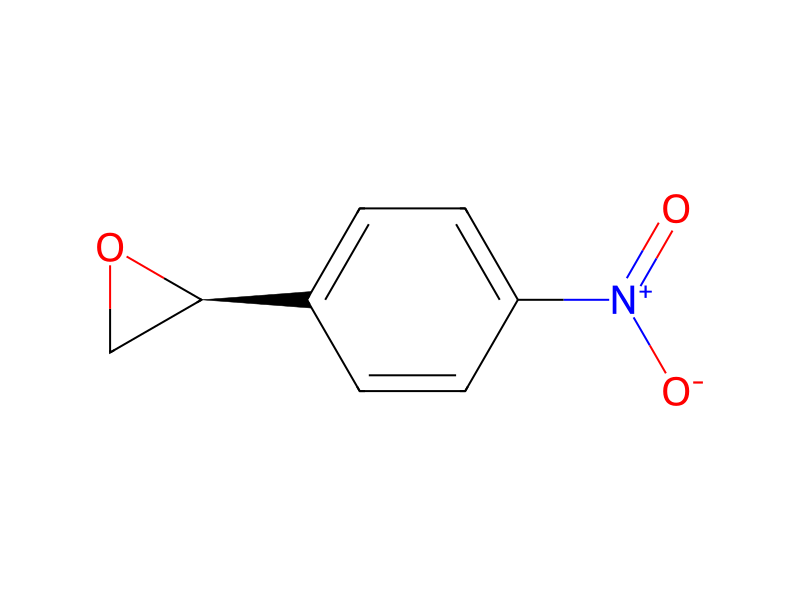
[N+:1]([C:4]1[CH:12]=[CH:11][C:7]([CH:8]2[O:10][CH2:9]2)=[CH:6][CH:5]=1)([O-:3])=[O:2].[N-]=[N+]=[N-].[Na+]>>[N+:1]([C:4]1[CH:12]=[CH:11][C:7]([C@@H:8]2[O:10][CH2:9]2)=[CH:6][CH:5]=1)([O-:3])=[O:2]Komponenten


Versuchsvorschrift
To 15 ml of Tris-SO4 buffer (50 mM, pH=7.3) containing 2 mM of para-nitro styrene oxide and 10 mM of NaN3, 2.8 mg of purified enzyme, obtained according to Example 1, was added. The reaction was monitored by periodically taking 200 μl samples and extracting them with 2 ml of diethylether. The reaction was stopped when an e.e. of higher than 99% of the remaining enantiomer was reached and the solution was twice extracted with diethylether. The organic phase was analysed by chiral HPLC using a chiralpak AS column from Daicel. The remaining (S)-para-nitro styrene oxide was obtained with an e.e. >99% and the product (R)-2-azido-1-(para-nitro-phenyl)-ethanol with an e.e. of 94%. The corresponding E-value was calculated to be higher than 200 from the e.e.'s of the epoxide and the azido alcohol (Straathof et al., Enzyme Microb. Technol. 1997, 21, 559). The other regio-isomer 2-azido-2-(para-nitro-phenyl)-ethanol was also formed due to a chemical side reaction in a ratio of 1:12 compared to (R)-2-azido-1-(para-nitro-phenyl)-ethanol.
Aufarbeitung
- customobtained
- additionwas added
- extractionextracting them with 2 ml of diethylether
- extractionthe solution was twice extracted with diethylether
Quellen und Nachweise
- ORD-Eintrag
- ord-f6290e7547154801ab3976d266dc733d
- Quelldatensatz
- uspto-grants-2010_04
- Patentnummer
- US07695942B2
Verknüpfte Notizen
Wird geladen…