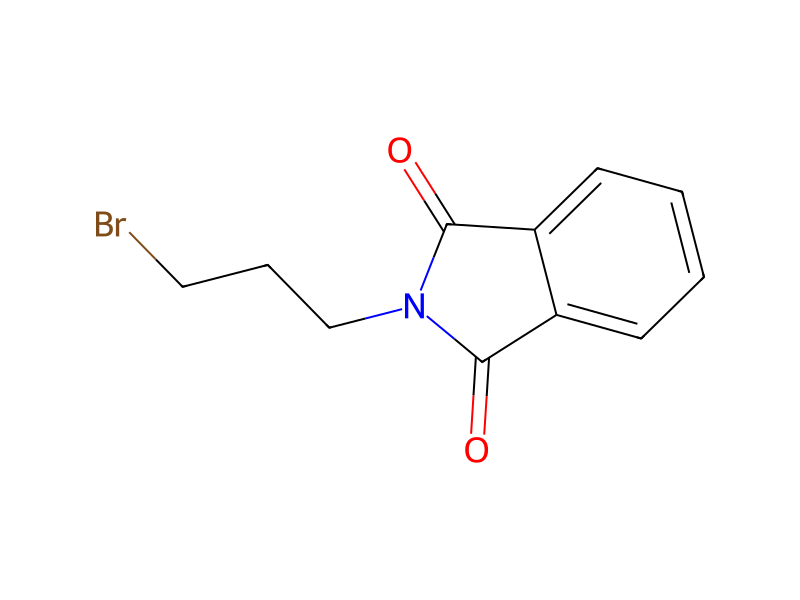
Br[CH2:2][CH2:3][CH2:4][N:5]1[C:9](=[O:10])[C:8]2=[CH:11][CH:12]=[CH:13][CH:14]=[C:7]2[C:6]1=[O:15].[C:16](=[O:19])([O-])[O-].[K+].[K+].[I-].[K+]>C(#N)C>[CH:9]([C:8]1[CH:11]=[C:16]([CH:13]=[CH:14][CH:7]=1)[O:19][CH2:2][CH2:3][CH2:4][N:5]1[C:9](=[O:10])[C:8]2=[CH:11][CH:12]=[CH:13][CH:14]=[C:7]2[C:6]1=[O:15])=[O:10]m-Hydroxybenzaldehyde (12.2 g), N-(3-bromopropyl)phthalimide (26.8 g), anhydrous potassium carbonate (13.8 g) and potassium iodide (1.7 g) were suspended in acetonitrile (600 ml), and the suspension was heated under reflux for 18 hours. After cooling, the precipitate was removed, and the solvent was evaporated under reduced pressure. The residue was distributed between benzene and water. The organic layer was washed successively with a 1N aqueous NaOH solution, water and a saturated aqueous solution of sodium chloride, and dried over anhydrous magnesium sulfate. The solvent was evaporated under reduced pressure to give 29.16 g (yield 94%) of N-[3-(3-formylphenoxy)propyl]phthalimide as crystals.