Reaktionsgleichung
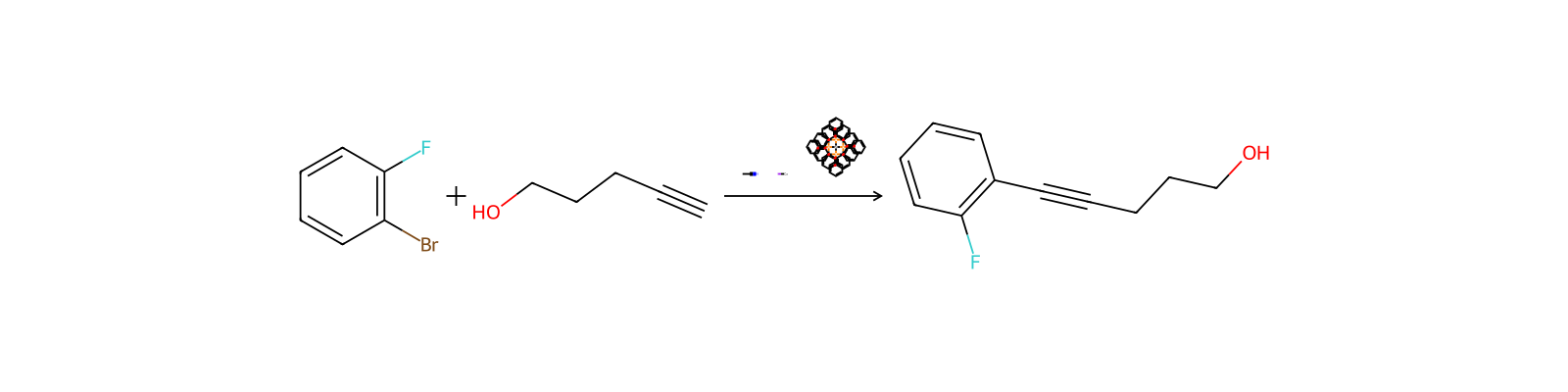
Br[C:2]1[CH:7]=[CH:6][CH:5]=[CH:4][C:3]=1[F:8].[CH2:9]([OH:14])[CH2:10][CH2:11][C:12]#[CH:13]>C(#N)C.[Cu]I.C1C=CC([P]([Pd]([P](C2C=CC=CC=2)(C2C=CC=CC=2)C2C=CC=CC=2)([P](C2C=CC=CC=2)(C2C=CC=CC=2)C2C=CC=CC=2)[P](C2C=CC=CC=2)(C2C=CC=CC=2)C2C=CC=CC=2)(C2C=CC=CC=2)C2C=CC=CC=2)=CC=1>[F:8][C:3]1[CH:4]=[CH:5][CH:6]=[CH:7][C:2]=1[C:13]#[C:12][CH2:11][CH2:10][CH2:9][OH:14]Komponenten
6
Edukt 2


Produkt 1

Reagenzien, Katalysatoren, Lösungsmittel 3



Versuchsvorschrift
1-Bromo-2-fluorobenzene [1072-85-1] (3.0 g, 17 mmol, 1.0 equiv) and pent-4-yn-1-ol [5390-04-5] (2.3 mL, 25 mmol, 1.5 equiv) were dissolved in acetonitrile (40 mL). CuI (0.13 g, 0.68 mmol, 0.04 equiv) and TEA (3.4 mL, 25 mmol, 1.5 equiv) was added to the stirred solution followed by tetrakis(triphenylphosphine)palladium(0) (0.39 g, 0.34 mmol, 0.02 equiv). The solution was heated at reflux for 16 hours. The solution was cooled, filtered through Celite, the Celite pad rinsed with EtOAc and the solvent removed by rotoevaporation. Column chromatography (9:1 hexanes:ethyl acetate) of the residue afforded pure 5-(2-fluorophenyl)pent-4-yn-1-ol Intermediate 60 (1.3 g, 43%).
Aufarbeitung
- temperatureThe solution was heated
- temperatureat reflux for 16 hours
- temperatureThe solution was cooled
- filtrationfiltered through Celite
- washthe Celite pad rinsed with EtOAc
- customthe solvent removed by rotoevaporation
Quellen und Nachweise
- ORD-Eintrag
- ord-aba1e866d2cd413daa1a31e8afd20c22
- Quelldatensatz
- uspto-grants-2014_09
- Patentnummer
- US08828973B2
Verknüpfte Notizen
Wird geladen…