Reaktionsgleichung

[Br:1][C:2]1[CH:9]=[CH:8][C:5]([CH2:6][NH2:7])=[C:4]([F:10])[CH:3]=1.Cl.Cl.BrC1C=CC(CN)=C(F)C=1.[C:23](Cl)(Cl)=[O:24]>C1(C)C=CC=CC=1>[Br:1][C:2]1[CH:9]=[CH:8][C:5]([CH2:6][N:7]=[C:23]=[O:24])=[C:4]([F:10])[CH:3]=1Komponenten
6
Edukt 4


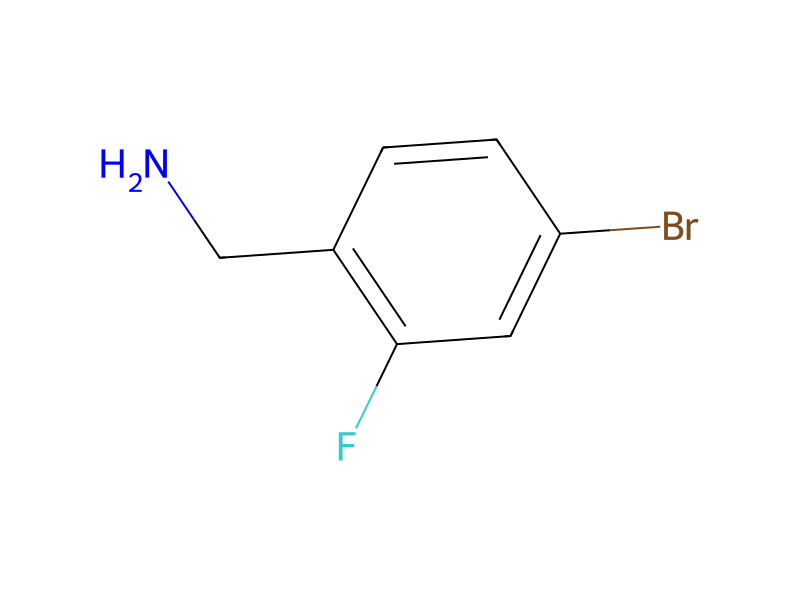

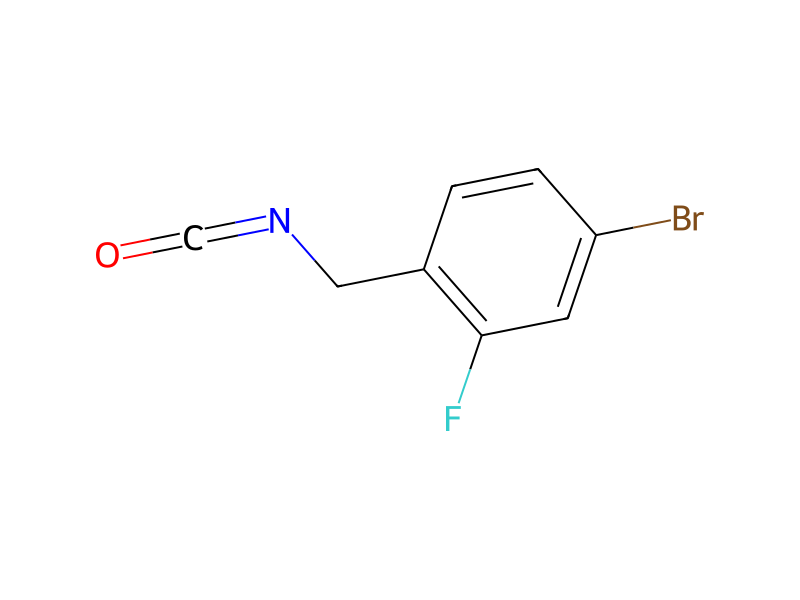
Produkt 1
Reagenzien, Katalysatoren, Lösungsmittel 1

Reaktionsbedingungen
- Temperatur
- 100 °C
Versuchsvorschrift
A solution of 4-bromo-2-fluorobenzylamine (20.4 g, 0.10 mol) in toluene (300 ml) is saturated with gaseous hydrochloric acid at 25° C. The resulting suspension of the 4-bromo-2-fluorobenzylamine hydrochloride is heated at 100° C. Phosgene is passed in at this temperature. Stirring of the solution, which has eventually become clear, is continued at 100° C. for 1 hour, and the mixture is then refluxed to remove the gases phosgene and hydrogen chloride. The batch is worked up by distillation. 21.2 g of 4-bromo-2-fluorobenzyl isocyanate (boiling point 109° C. at 4 mbar) are obtained. Yield: 92.1% of theory.
Aufarbeitung
- temperaturethe mixture is then refluxed
- customto remove the gases phosgene and hydrogen chloride
- distillationThe batch is worked up by distillation
Quellen und Nachweise
- ORD-Eintrag
- ord-f9950dc95a94410486aae253107a9552
- Quelldatensatz
- uspto-grants-1998_01
- Patentnummer
- US05710319
Verknüpfte Notizen
Wird geladen…