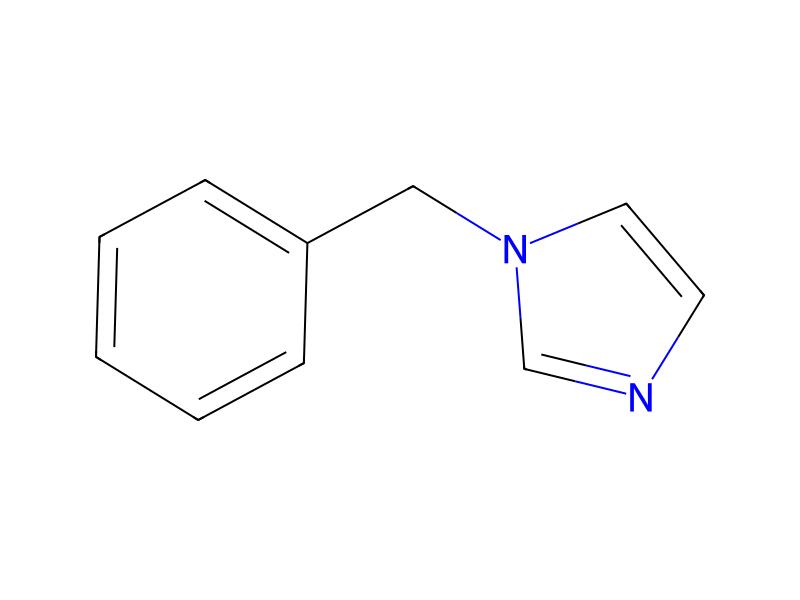
[Br:1][C:2]1[C:10]([CH3:11])=[CH:9][CH:8]=[CH:7][C:3]=1[C:4]([OH:6])=O.S(Cl)(Cl)=O.[CH2:16]([N:23]1[CH:27]=[CH:26][N:25]=[CH:24]1)[C:17]1[CH:22]=[CH:21][CH:20]=[CH:19][CH:18]=1.C(N(CC)CC)C>C(#N)C>[CH2:16]([N:23]1[CH:27]=[CH:26][N:25]=[C:24]1[C:4]([C:3]1[CH:7]=[CH:8][CH:9]=[C:10]([CH3:11])[C:2]=1[Br:1])=[O:6])[C:17]1[CH:18]=[CH:19][CH:20]=[CH:21][CH:22]=1A solution of 2-bromo-3-methylbenzoic acid (2.0 g, 9.3 mmol) in thionyl chloride (4.75 ml, 65.1 mmol) was heated at 65° C., under nitrogen, for 3 h. The mixture was concentrated in vacuo and to the residue was added acetonitrile (25 ml). This solution was concentrated in vacuo and the process was repeated. To the final residue was added acetonitrile (25 ml), 1-benzylimidazole (1.62 g, 10.2 mmol) and triethylamine (1.44 ml, 10.2 mmol) and the reaction mixture was heated at 60° C., under nitrogen, for 18 h. The mixture was concentrated in vacuo and to the residue was added ethyl acetate (80 ml). The solution was washed with water (40 ml) and saturated aqueous sodium hydrogen carbonate solution (40 ml), dried (MgSO4) and concentrated in vacuo to give the title compound (3.38 g).
Wird geladen…