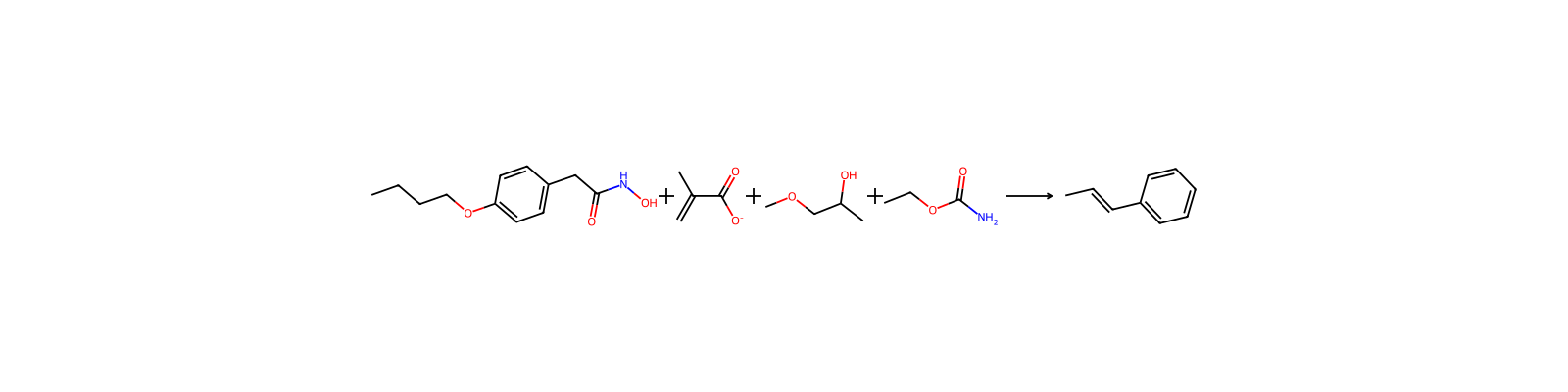
Beteiligte Stoffe
| Rolle | Name | HCID | Einwaage |
|---|
| Edukt | Bufexamac | HCID 2466 | — |
| Edukt | Carbamic acid, ethyl ester | HCID 5641 | — |
| Edukt | 1-Methoxy-2-propanol | HCID 7900 | — |
| Edukt | Methacrylate | HCID 87595 | — |
| Produkt | beta-Methylstyrene | HCID 12500 | — |
Reaktionsschritte
Functionalized zirconia nanoparticles in which 50%, 25%, and 25% of the surface sites reacted with bufexamac, 2a (Preparatory Example 1), and 2b (Preparatory Example 2), respectively, were prepared as follows. A clean vial was charged with 10 grams of ZrO2 sol (47.3% weight) followed by 20 grams of 1-methoxy-2-propanol. Then 0.739 grams (0.70 mmol/g ZrO2) of bufexamac, 0.383 grams (0.35 mmol/g ZrO2) of 2a and 0.243 grams (0.35 mmol/g ZrO2) 2b were added to the vial. The content of the vial was stirred for 2 hours. The solution was then dried down to a powder, under vacuum, at 70° C. A total of 4.93 grams of zirconia nanoparticle powder was recovered. The powder was placed in a clean vial and redispersed in 4.93 grams of ultra-pure THF to yield a clear, slightly yellow solution. To this solution 0.48 grams of 3-isopropenyl-α,α-dimethylbenzyl isocyanine was added. The vial was sealed and stirred for 12 hours at room temperature. An FT-IR was taken of the sample, and an IR peak was observed at 1751 cm−1 and attributed to the ν(C═O) stretch in the urethane.
Herkunft & Nachweise
| DOI | 10.6084/m9.figshare.5104873.v1 |
|---|
| Patentnummer | US08829079B2 |
|---|
| Quelldatensatz | uspto-grants-2014_09 |
|---|
| ORD ID | ord-54ad0f5650114efdb234fddac1cb1f15 |
|---|
| Quellennotiz | uspto-grants-2014_09 |
|---|