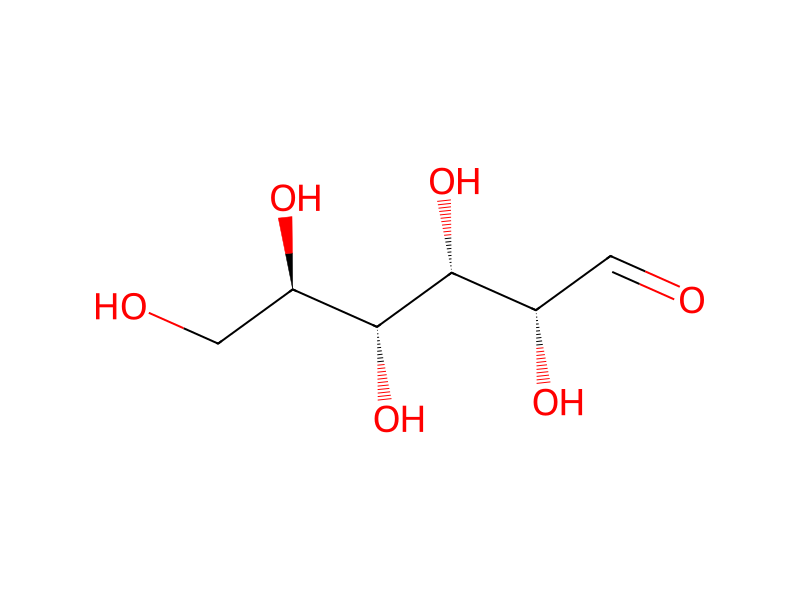
(2R,3S,4R,5R)-2,3,4,5,6-pentahydroxyhexanal → D-Arabinose
HRID 736591
Reaktionsgleichung

[O:1]=[CH:2][C@@H:3]([C@@H:5]([C@@H:7]([CH2:9][OH:10])[OH:8])[OH:6])O.[O:11]=[CH:12][C@@H:13]([C@H:15]([C@@H:17]([C@@H:19](CO)[OH:20])[OH:18])[OH:16])[OH:14]>>[O:1]=[CH:2][CH2:3][C@@H:5]([C@@H:7]([CH2:9][OH:10])[OH:8])[OH:6].[O:11]=[CH:12][C@H:13]([C@@H:15]([C@@H:17]([CH2:19][OH:20])[OH:18])[OH:16])[OH:14]Komponenten
4


Versuchsvorschrift
It was surprising that the process of Niedballa and Vorbruggen formed the β-anomer to the near exclusion of the α-anomer only in the examples wherein deoxyribose and arabinose were utilized (DE 1 919 307, Examples 3 and 14). However, such results were not at all surprising where ribose or glucose was employed, because it is known that 2′-ester derivatives of ribose normally form the β-anomer in preference to the α-anomer product. Noteworthy is that where a predominance of β-anomeric product was formed from deoxyribose and/or arabinose as starting materials. Only low percent yields of product were obtained (DE 1 919 307 at Example 3, 20.5% yield from a deoxyribose starting material, and Example 14, 27.2% yield from an arabinose starting material).