StartseiteMCPWorkbenchSkills
StartseiteWorkbenchBenachrichtigungenMein Bereich
llms.txt · MCP-AnleitungDatenschutz · Nutzungsbedingungen · Supportv1.8.3
  1. Startseite
  2. /Reaktion

Triethylamine → 1-Chloro-2-(4-ethynyl-benzyl)-4-(beta-D-glucopyranos-1-yl)-benzene

HRID 746811
Drucken

Reaktionsgleichung

Reaktionsgleichung von HRID 746811
C(N([CH2:6][CH3:7])CC)C.C[Si](C#C)(C)C.[Cl:14][C:15]1[CH:20]=[CH:19][C:18]([C@:21]2([O:30][C@H:29]([CH2:31][OH:32])[C@@H:27]([OH:28])[C@H:25]([OH:26])[C@H:23]2[OH:24])[OH:22])=[CH:17][C:16]=1[CH2:33][C:34]1[CH:39]=[CH:38][C:37](OS(C(F)(F)F)(=O)=O)=[CH:36][CH:35]=1.C(=O)([O-])O.[Na+]>CN(C)C=O.[Cu](I)I.Cl[Pd](Cl)([P](C1C=CC=CC=1)(C1C=CC=CC=1)C1C=CC=CC=1)[P](C1C=CC=CC=1)(C1C=CC=CC=1)C1C=CC=CC=1>[Cl:14][C:15]1[CH:20]=[CH:19][C:18]([C@:21]2([O:30][C@H:29]([CH2:31][OH:32])[C@@H:27]([OH:28])[C@H:25]([OH:26])[C@H:23]2[OH:24])[OH:22])=[CH:17][C:16]=1[CH2:33][C:34]1[CH:35]=[CH:36][C:37]([C:6]#[CH:7])=[CH:38][CH:39]=1


KomponentenReaktionsbedingungenVersuchsvorschriftAufarbeitungQuellen und NachweiseNotizen zur Reaktion

Komponenten

8

Edukt 4

HCID 8471TriethylamineHCID 66111Trimethylsilylacetylene2×HCID 516892Sodium BicarbonateHCID 866006751-chloro-4-(beta-D-glucopyranos-1-yl)-2-(4-trifluoromethylsulfonyloxy-benzyl)-benzene

Produkt 1

HCID 866006811-Chloro-2-(4-ethynyl-benzyl)-4-(beta-D-glucopyranos-1-yl)-benzene

Reagenzien, Katalysatoren, Lösungsmittel 3

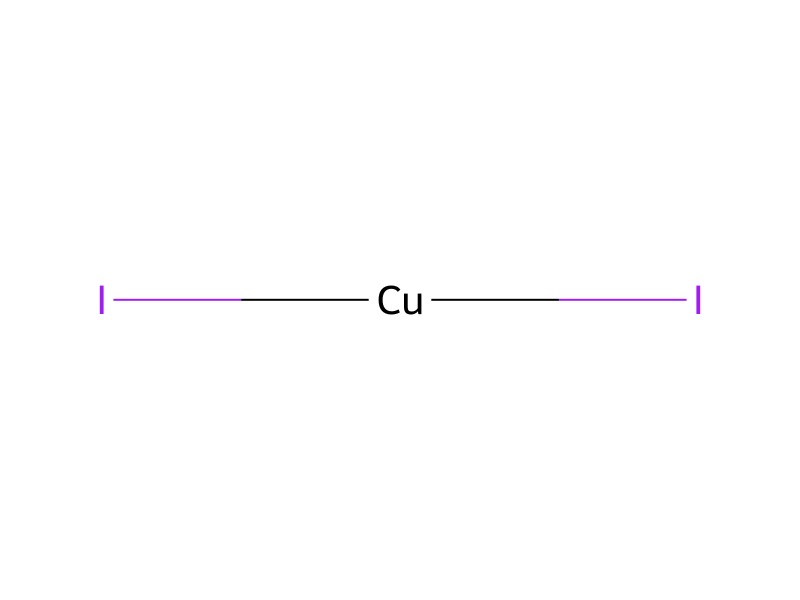
HCID 83717Copper iodideKatalysatorHCID 178418476HCID 178418476, VerbindungKatalysator2×HCID 6228DimethylformamideLösungsmittel

Reaktionsbedingungen

Temperatur
90 °C

Versuchsvorschrift

Under argon, 25 mg copper iodide, 44 mg bis-(triphenylphosphine)-palladium dichloride, 0.30 ml triethylamine and finally 0.14 ml trimethylsilylacetylene are added to a solution of 0.32 g 1-chloro-4-(β-D-glucopyranos-1-yl)-2-[4-(trifluoromethylsulphonyloxy)-benzyl]-benzene in 3 ml of dimethylformamide. The flask is tightly sealed and the mixture is stirred for 8 h at 90° C. Then another 25 mg bis-(triphenylphosphine)-palladium dichloride and 0.1 ml trimethylsilylacetylene are added, and the solution is stirred for a further 10 h at 90° C. Then aqueous sodium hydrogen carbonate solution is added, the mixture is extracted three times with ethyl acetate, and the collected organic phases are dried over sodium sulphate. After the solvent has been eliminated the residue is dissolved in 5 ml of methanol and combined with 0.12 g potassium carbonate. The mixture is stirred for 1 h at ambient temperature and then neutralised with 1 M hydrochloric acid. Then the methanol is evaporated off, the residue is combined with aqueous sodium chloride solution and extracted with ethyl acetate. The organic extracts collected are dried over sodium sulphate, and the solvent is removed. The residue is chromatographed on silica gel (dichloromethane/methanol 1:0->5:1).

Aufarbeitung

  1. customThe flask is tightly sealed
  2. stirringthe solution is stirred for a further 10 h at 90° C
  3. extractionthe mixture is extracted three times with ethyl acetate
  4. dry with materialthe collected organic phases are dried over sodium sulphate
  5. dissolutionis dissolved in 5 ml of methanol
  6. stirringThe mixture is stirred for 1 h at ambient temperature
  7. customThen the methanol is evaporated off
  8. extractionextracted with ethyl acetate
  9. customThe organic extracts collected
  10. dry with materialare dried over sodium sulphate
  11. customthe solvent is removed
  12. customThe residue is chromatographed on silica gel (dichloromethane/methanol 1:0->5:1)

Quellen und Nachweise

ORD-Eintrag
ord-3d51829840d349e184d3c7ac4973081f
Quelldatensatz
uspto-grants-2008_07
DOI
10.6084/m9.figshare.5104873.v1
Patentnummer
US07393836B2

Notizen zur Reaktion

Auf dieser SeiteKomponentenReaktionsbedingungenVersuchsvorschriftAufarbeitungQuellen und NachweiseNotizen zur Reaktion