HuagongsheHuagongshe Chemie-Druckbericht · Nur für Forschungszwecke
HRID 75475Erstellt: 23. Oktober 2026
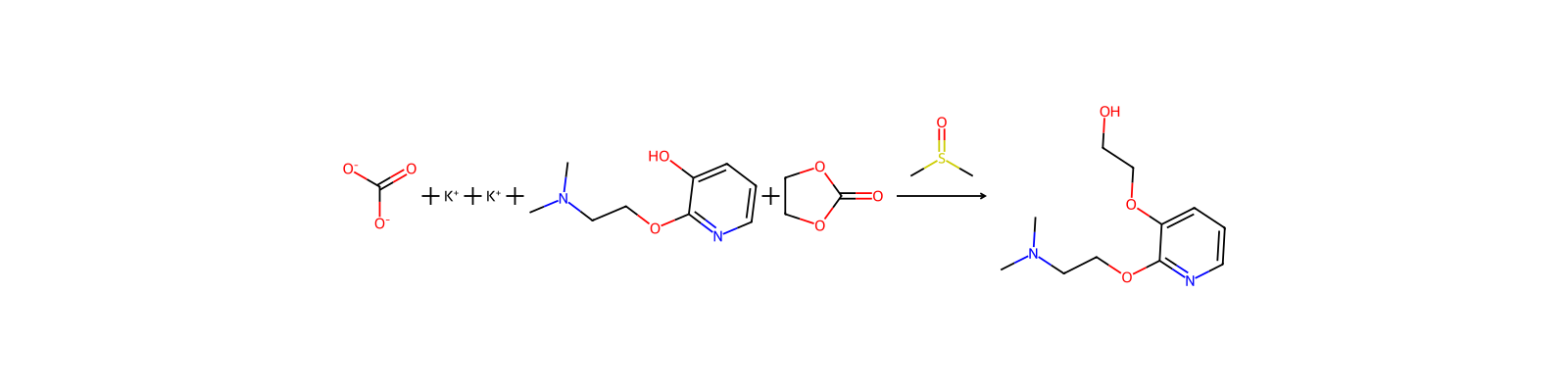
Ethylene carbonate → 2-{[2-(2-Dimethylaminoethoxy)-3-pyridinyl]oxy}ethanol
https://huagongshe.com/de/reaction/75475
Beteiligte Stoffe
| Rolle | Name | HCID | Einwaage |
|---|
| Edukt | Ethylene carbonate | HCID 7303 | — |
| Edukt | Potassium Carbonate | HCID 11430 | — |
| Edukt | 2-(2-Dimethylaminoethoxy)pyridin-3-ol | HCID 21908993 | — |
| Lösungsmittel | Dimethyl Sulfoxide | HCID 679 | — |
| Produkt | 2-{[2-(2-Dimethylaminoethoxy)-3-pyridinyl]oxy}ethanol | HCID 11708396 | — |
Reaktionsschritte
DMSO (17 L) and potassium carbonate (8.2 kg) were charged to the 100 L-glasslined reactor. The mixture was heated to 58° C. while stirring. 2-(2-Dimethylaminoethoxy)pyridin-3-ol (4.11 kg) was charged to the reactor during 25 minutes (gas evolution). The mixture was heated to 117° C. before the prepared ethylene carbonate solution was added through the manhood in portions. After 1 L ethylene carbonate solution was added IP-HPLC was taken to ensure that the title compound had started to form. The total addition of ethylene carbonate solution was made during 1 h 35 minutes. Temperature after the addition was 124° C. A HPLC sample was taken from the reaction mixture 10 minutes after finished addition. It showed 95% conversion to product. The reaction-mixture was allowed to cool to 70° C. before water (45 L) and sodium chloride (4.06 kg) was charged to the reactor. The mixture was then stirred for 20 minutes at 70° C. before cooled to RT. Ethyl acetate (137 L) was charged into a 328 L glass-lined reactor. The water mixture was transferred from the 100 L reactor to the 328 L reactor. The mixture was stirred for 25 minutes before the mechanical stirrer was turned off. After allowing the phases to separate for 40 minutes, the water-phase (65 L) was discharged. The mixture was heated to reflux and 102 L of ethyl acetate was distilled off. Toluene (72 L) was added and the mixture was heated to reflux again and 61 L of toluene/ethyl acetate was distilled off. The reaction mixture was then cooled to RT. The title compound was never isolated; it was directly used in Example 2C.
Herkunft & Nachweise
| DOI | 10.6084/m9.figshare.5104873.v1 |
|---|
| Patentnummer | US08835439B2 |
|---|
| Quelldatensatz | uspto-grants-2014_09 |
|---|
| ORD ID | ord-c1e22a7237c74b988d172c1343aeb4a4 |
|---|
| Quellennotiz | uspto-grants-2014_09 |
|---|