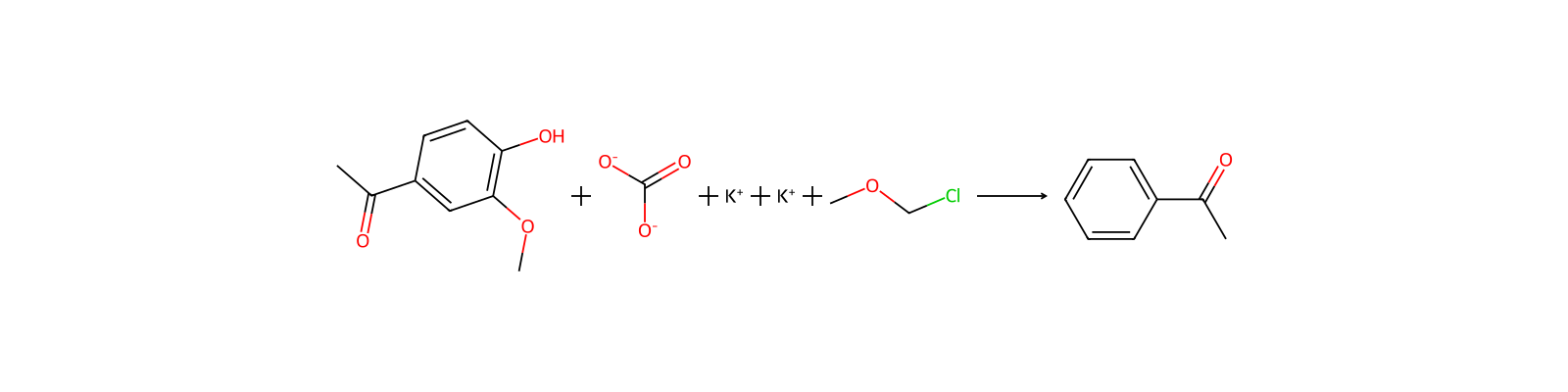
Beteiligte Stoffe
| Rolle | Name | HCID | Einwaage |
|---|
| Edukt | Acetovanillone | HCID 2214 | — |
| Edukt | Chloromethyl Methyl Ether | HCID 7864 | — |
| Edukt | Potassium Carbonate | HCID 11430 | — |
| Produkt | Acetophenone | HCID 7410 | — |
Reaktionsschritte
Analogs in series 3, which contain a 3-carbon spacer, were prepared as shown in Schemes 28-37. Analogs 45a and 45b contain two identical aryl rings separated by an unsaturated 3-carbon spacer having a single carbonyl and were designed to test the importance of the length of the spacer. Analog 45a was prepared as shown in Scheme 28 following the procedures described by Masuda (Masuda et al., Phytochemistry 32(6), 1557-1560 (1993)) and by Kohler and Chadwell (Kohler et al., Org. Synth., Coll. Vol. 178-80 (1932)). 4-Hydroxy-3-methoxyacetophenone (44a) was reacted with potassium carbonate and chloromethyl methyl ether (18) in a substitution reaction to give compound 44j. The formation of the product was verified by proton NMR by the appearance of signals at 3.33 ppm and 5.12 ppm for the protons of the protecting group. Compound 1j, prepared as shown in Scheme 12, was reacted with compound 44j and barium hydroxide in an aldol reaction to give compound 45j. The formation of the product was verified by proton NMR by the appearance of a pair of doublets in the aromatic region with J values of 15.5 Hz for the alkene protons on the spacer. Also observed in the proton NMR was the loss of a signal at 2.38 ppm for the methyl protons of the starting acetophenone (44j) and the loss of a signal at 9.75 ppm for the aldehyde proton of the starting benzaldehyde (1j). Compound 45j was then reacted with a catalytic amount of concentrated hydrochloric acid to give the phenol, analog 45a. The formation of the product was verified by proton NMR by the appearance of signals at 6.00 ppm and 6.19 ppm for the phenolic protons. Also observed in the proton NMR was the loss of signals at 3.50 ppm, 5.25 ppm
Herkunft & Nachweise
| DOI | 10.6084/m9.figshare.5104873.v1 |
|---|
| Patentnummer | US08841326B2 |
|---|
| Quelldatensatz | uspto-grants-2014_09 |
|---|
| ORD ID | ord-012f4d44787242e7a8e70cab32f230d5 |
|---|
| Quellennotiz | uspto-grants-2014_09 |
|---|