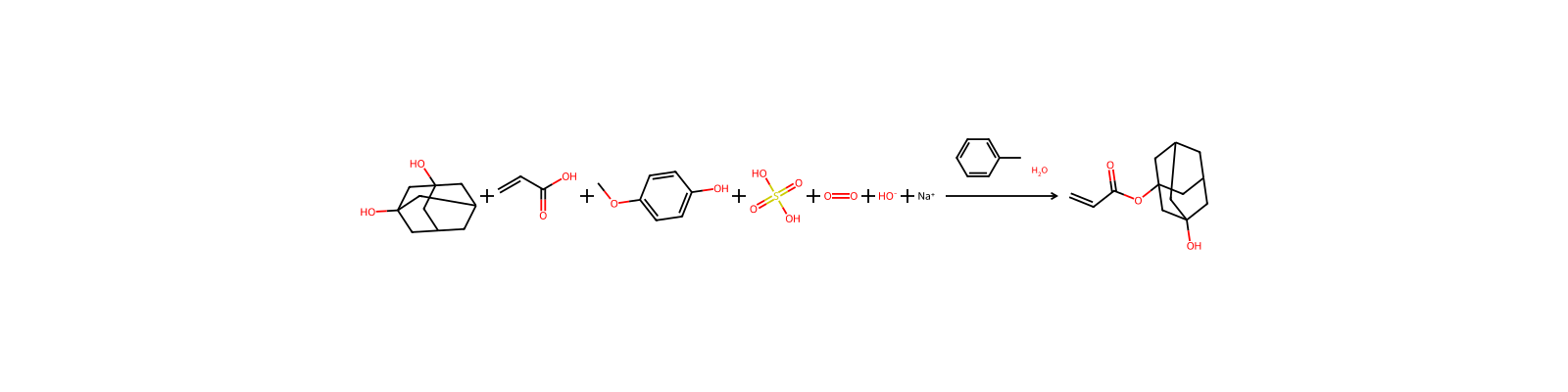
Beteiligte Stoffe
| Rolle | Name | HCID | Einwaage |
|---|
| Edukt | Oxygen | HCID 977 | — |
| Edukt | Sulfuric Acid | HCID 1118 | — |
| Edukt | Acrylic Acid | HCID 6581 | — |
| Edukt | 4-Methoxyphenol | HCID 9015 | — |
| Edukt | Sodium Hydroxide | HCID 14798 | — |
| Edukt | 1,3-Adamantanediol | HCID 573829 | — |
| Lösungsmittel | Water | HCID 962 | — |
| Lösungsmittel | Toluene | HCID 1140 | — |
| Produkt | 3-Hydroxy-1-adamantyl acrylate | HCID 22228790 | — |
Reaktionsschritte
To a 2 L jacket-equipped separable flask provided with a stirrer, a thermometer, a Dean-Stark water separator, a Dimroth condenser and a prepared gas introduction tube, 84 g of 1,3-adamantanediol, 108 g of acrylic acid, 0.76 g of p-methoxyphenol as a polymerization inhibitor, 1.3 g of concentrated sulfuric acid as an acid catalyst, and 750 ml of toluene as a solvent were put. Prepared gas diluted with nitrogen so as to have an oxygen concentration of about 5% by volume was supplied at a rate of 0.2 L/min. The reaction operation was performed as follows. While the solution was heated and water generated as a secondary product was removed by the Dean-Stark water separator, the reflux state was continued for 6 hours. Thus, 3-hydroxy-1-adamantyl acrylate was synthesized. The obtained reaction solution was cooled down to room temperature, and then a 10% by weight of aqueous solution of sodium hydroxide was added while stirring to neutralize the residual acrylic acid and sulfuric acid. Then, the neutralized water phase was drawn out from the two-phase solution. To the residual organic phase, 0.85 g of p-methoxyphenol was added as a polymerization inhibitor. The resultant solution was washed with 5% by weight of dilute sulfuric acid and with 500 ml of ion exchange water, twice for each. After the washing, precise filtration was performed by use of a Teflon® filter having a pore diameter of 0.1 μm. Then, cooling crystallization was performed at a temperature of an ice water bath to separate the crystal by filtration. The crystal was rinsed with heptane twice, and then dried at a reduced pressure at 25° C. for 24 hours. During the process from the dehydration esterification reaction to the solid-liquid separation and until the termination of rinsing performed by use of ion exchange water, the prepared gas was kept blown into the solution. Table 1 shows the analysis results of the obtained 3-hydroxy-1-adamantyl acrylate. Methylethylketone was used as the solvent for measuring the turbidity.
Herkunft & Nachweise
| DOI | 10.6084/m9.figshare.5104873.v1 |
|---|
| Patentnummer | US08846840B2 |
|---|
| Quelldatensatz | uspto-grants-2014_09 |
|---|
| ORD ID | ord-5b49aa7245f240439839520096704a9f |
|---|
| Quellennotiz | uspto-grants-2014_09 |
|---|