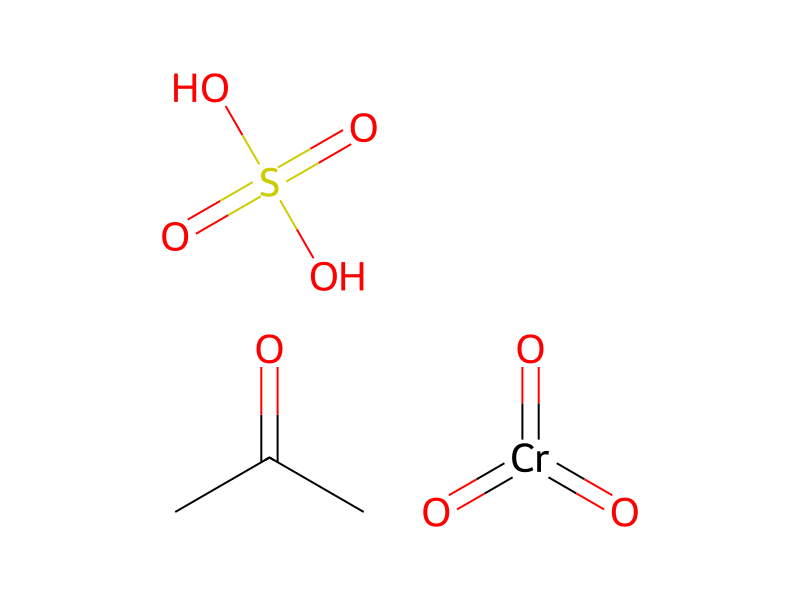
[OH:1][CH2:2][CH2:3][C@H:4]1[NH:7][C:6](=[O:8])[C@H:5]1[C:9]([CH3:25])([O:11][C:12]([O:14][CH2:15][C:16]1[CH:21]=[CH:20][C:19]([N+:22]([O-:24])=[O:23])=[CH:18][CH:17]=1)=[O:13])[CH3:10].CC(C)=[O:28].OS(O)(=O)=O.O=[Cr](=O)=O.C(O)(C)C>CC(C)=O>[CH3:10][C:9]([C@@H:5]1[C:6](=[O:8])[NH:7][C@@H:4]1[CH2:3][C:2]([OH:28])=[O:1])([O:11][C:12]([O:14][CH2:15][C:16]1[CH:17]=[CH:18][C:19]([N+:22]([O-:24])=[O:23])=[CH:20][CH:21]=1)=[O:13])[CH3:25]To a solution of (3R,4R)-4-(2-hydroxyethyl)-3-[1-methyl-1-(4-nitrobenzyloxycarbonyloxy)ethyl]-azetidin-2-one (10 mg) in acetone (0.6 ml) was added 2 N Jones reagent (50 μl) at 0° C. and the mixture was stirred at 0° C. for 20 minutes. Isopropyl alcohol (100 μl) was added to the mixture at 0° C. and the mixture was evaporated in vacuo. The residue was dissolved in chloroform (10 ml) and the solution was washed with brine. The aqueous layer was separated and extracted with chloroform (5 ml). The combined organic layers were washed with aqueous saturated sodium chloride, dried over magnesium sulfate, and evaporated in vacuo. The residue was chromatographed on silica gel (0.5 g) eluting with a mixture of methylene chloride and methanol (20:1 to 5:1) to give pure {(2R,3R)-3-[1-methyl-1-(4-nitrobenzyloxycarbonyloxy)ethyl]-4-oxoazetidin-2-yl} acetic acid (3 mg) and impure material (5 mg).
Wird geladen…