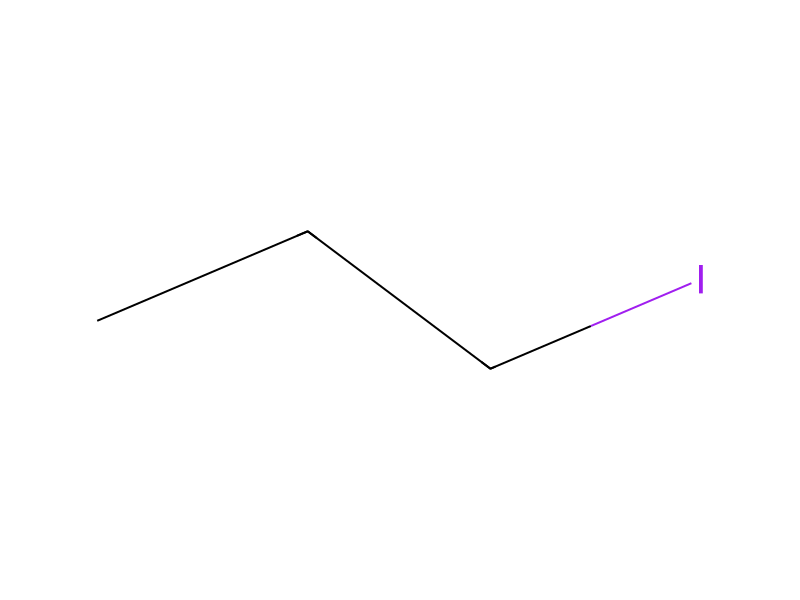
1-Iodopropane → 4-(5-Methyl-2-propylsulfanyl-pyrimidin-4-yl)-4H-pyrrole-2-carboxylic acid (2-hydroxy-1-(S)-phenyl-ethyl)-amide
HRID 852307
Reaktionsgleichung

[OH:1][CH2:2][C@@H:3]([NH:10][C:11]([C:13]1[NH:14][CH:15]=[C:16]([C:18]2[C:23]([CH3:24])=[CH:22][N:21]=[C:20]([SH:25])[N:19]=2)[CH:17]=1)=[O:12])[C:4]1[CH:9]=[CH:8][CH:7]=[CH:6][CH:5]=1.[CH2:26](I)[CH2:27][CH3:28]>N>[OH:1][CH2:2][C@@H:3]([NH:10][C:11]([C:13]1[N:14]=[CH:15][CH:16]([C:18]2[C:23]([CH3:24])=[CH:22][N:21]=[C:20]([S:25][CH2:26][CH2:27][CH3:28])[N:19]=2)[CH:17]=1)=[O:12])[C:4]1[CH:5]=[CH:6][CH:7]=[CH:8][CH:9]=1Komponenten
4
Edukt 2

Produkt 1

Reagenzien, Katalysatoren, Lösungsmittel 1

Versuchsvorschrift
To a solution of 4-(2-mercapto-5-methyl-pyrimidin-4-yl)-1H-pyrrole-2-carboxylic acid (2-hydroxy-1-(S)-phenyl-ethyl)-amide (7.7 mmol, 2.74 mmol) in aqueous ammonia (15%) was added at room temperature n-propyliodide (11.6 mmol, 1.1 mL). The solution was stirred overnight at room temperature. The resulting solid was collected by filtration and used directly for the next step. 1H NMR consistent with the structure.