Reaktionsgleichung

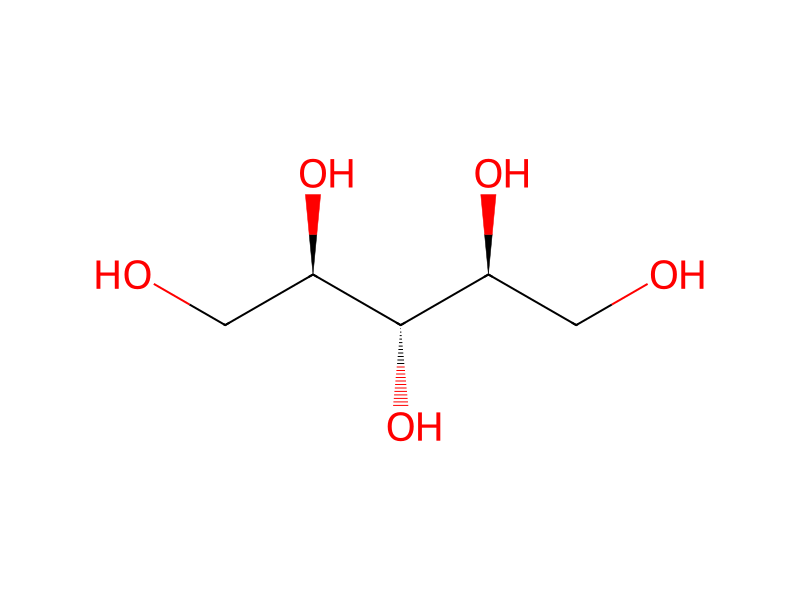
[O:1]=[C:2]([O-:11])[C@H:3]([C@@H:5]([C@@H:7]([CH2:9][OH:10])O)[OH:6])[OH:4].[Na+].[O:13]=[C:14]([O-])[C@@H:15]([C@@H:17]([C@@H:19]([CH2:21][OH:22])[OH:20])[OH:18])[OH:16].[Na+]>[Ni]>[C:2]1(=[O:1])[O:11][C@H:7]([CH2:9][OH:10])[C@@H:5]([OH:6])[C@H:3]1[OH:4].[CH2:14]([OH:13])[C@@H:15]([C@@H:17]([C@@H:19]([CH2:21][OH:22])[OH:20])[OH:18])[OH:16]Komponenten
Edukt 2


Produkt 2

Reagenzien, Katalysatoren, Lösungsmittel 1

Versuchsvorschrift
According to this example the dissolution of the nickel catalyst was prevented by lowering the acidity of the reaction solution with an addition of alkali. The hydrogenation proceeded smoothly and the yield of pentitols was close to the maximum value of 75% in this case. The salts of pentonic acids, of course, did not undergo hydrogenation. On the contrary, sodium D-arabinonate was partly isomerized to sodium D-ribonate, and the subsequent hydrogenation of D-ribono-1,4-lactone resulted in enhanced formation of ribitol. In spite of the isomerization of the starting material, the control of pH can be applied in the production of xylitol from D-arabinonic acid as both arabinitol and ribitol yield xylitol in the second isomerization step. On the contrary, the control of pH can not be applied when L-xylonic acid is to be converted to xylitol.
Aufarbeitung
- additionwith an addition of alkali
Quellen und Nachweise
- ORD-Eintrag
- ord-38311581f21548e4a6b21d10460f8d81
- Quelldatensatz
- uspto-grants-1996_10
- Patentnummer
- US05563303
Verknüpfte Notizen
Wird geladen…