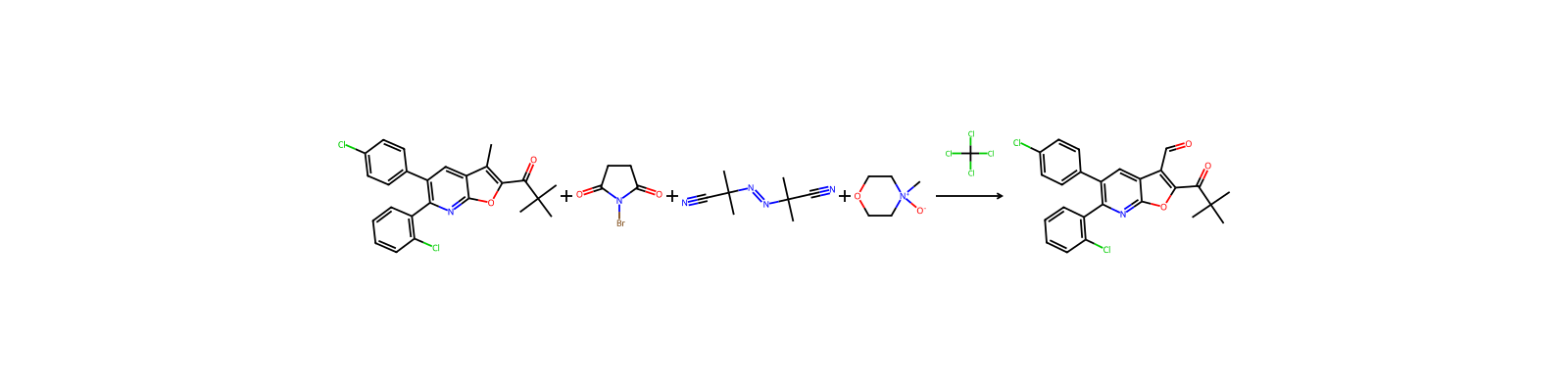
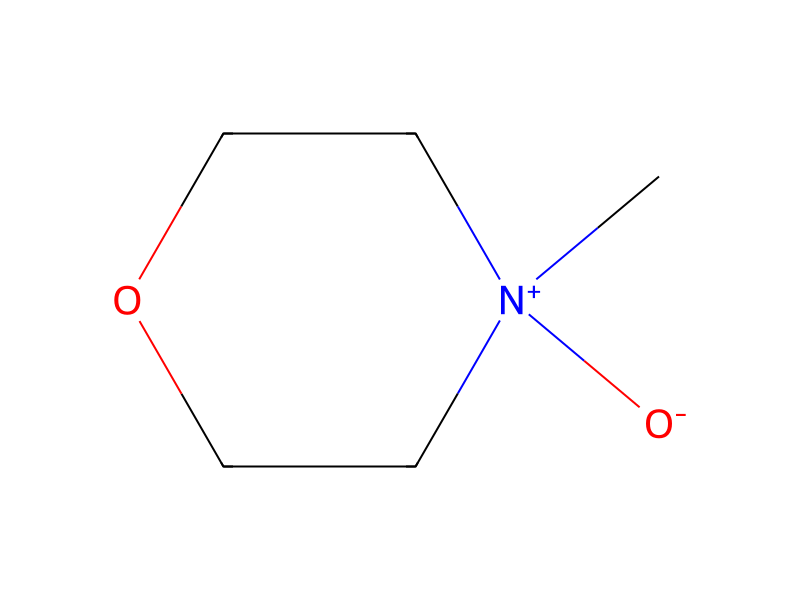
[Cl:1][C:2]1[CH:7]=[CH:6][CH:5]=[CH:4][C:3]=1[C:8]1[N:13]=[C:12]2[O:14][C:15]([C:18](=[O:23])[C:19]([CH3:22])([CH3:21])[CH3:20])=[C:16]([CH3:17])[C:11]2=[CH:10][C:9]=1[C:24]1[CH:29]=[CH:28][C:27]([Cl:30])=[CH:26][CH:25]=1.BrN1C(=[O:37])CCC1=O.N(C(C)(C)C#N)=NC(C)(C)C#N.C[N+]1([O-])CCOCC1>C(Cl)(Cl)(Cl)Cl>[Cl:1][C:2]1[CH:7]=[CH:6][CH:5]=[CH:4][C:3]=1[C:8]1[N:13]=[C:12]2[O:14][C:15]([C:18](=[O:23])[C:19]([CH3:22])([CH3:21])[CH3:20])=[C:16]([CH:17]=[O:37])[C:11]2=[CH:10][C:9]=1[C:24]1[CH:25]=[CH:26][C:27]([Cl:30])=[CH:28][CH:29]=1A 10 mL rb flask equipped with a magnetic stir bar was charged with 0.227 g (0.52 mmol) of the product of Example 89, 0.101 g (0.57 mmol) of N-bromosuccinimide, 3 mL CCl4 and ca. 5 mg of 2,2′-azobisisobutyronitrile (AIBN). The reaction mixture was heated to reflux under a nitrogen atmosphere for 2 h then cooled to room temperature and filtered. The filtrate was evaporated in vacuo, and the residue was then redissolved in 2 mL of DMSO. The solution containing the crude bromination product was transferred to a 10 mL reaction tube of a CEM Corporation Discover 300 Watt microwave reactor and 73 mg (0.62 mmol) of N-methylmorpholine-N-oxide was added. The reaction vessel was sealed, placed in the microwave reactor and heated at 150° C. for 2–3 min. After the reaction mixture had cooled to room temperature, it was partitioned between EtOAc and 10% aq. NaHSO4 and extracted. The organic layer was washed with 10% aq. NaHSO4, water, brine, dried (MgSO4), filtered and evaporated. The residue was purified on a silica gel flash chromatography column eluted with 0–10% EtOAc-hexane. Evaporation of the purified fractions and drying in vacuo afforded the title compound. HPLC/MS: 452.1 (M+1), 454.0 (M+3); Rt=4.63 min.
Wird geladen…