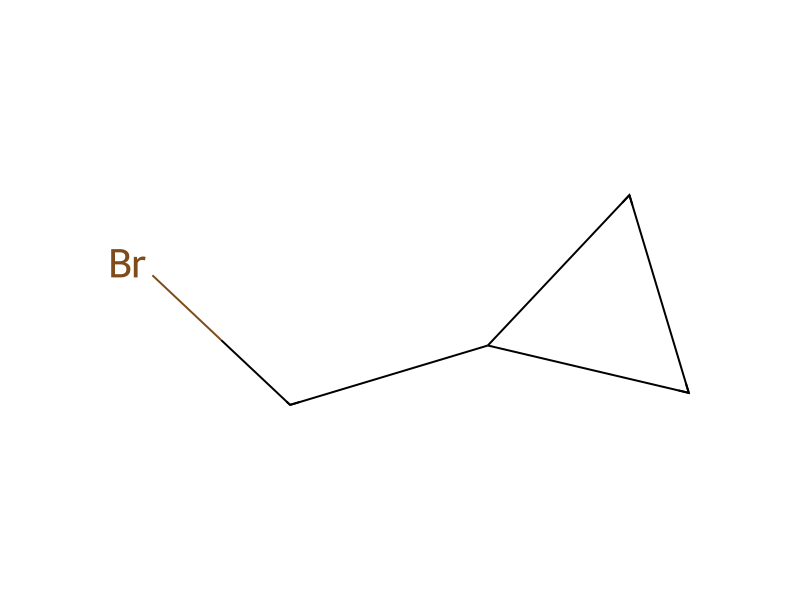
Bromomethylcyclopropane → Nalpha-Cyclopropylmethyl-L-phenylalanine Amide
Reaktionsgleichung

Cl.[NH2:2][C@H:3]([C:11]([NH2:13])=[O:12])[CH2:4][C:5]1[CH:10]=[CH:9][CH:8]=[CH:7][CH:6]=1.C(=O)(O)[O-].[Na+].Br[CH2:20][CH:21]1[CH2:23][CH2:22]1>C(O)C>[CH:21]1([CH2:20][NH:2][C@H:3]([C:11]([NH2:13])=[O:12])[CH2:4][C:5]2[CH:10]=[CH:9][CH:8]=[CH:7][CH:6]=2)[CH2:23][CH2:22]1Komponenten
Edukt 3


Produkt 1

Reagenzien, Katalysatoren, Lösungsmittel 1

Versuchsvorschrift
To 100 ml. of anhydrous ethyl alcohol were added 8 grams (0.04 mole) of L-phenylalanine amide hydrochloride. To the mixture then were added 13.4 grams (0.16 mole) of solid anhydrous sodium bicarbonate and 6.44 grams (0.048 mole) of bromomethylcyclopropane. The mixture was refluxed for seven hours and then was evaporated in vacuo to an oil. The oil was dissolved in ethyl acetate, and the ethyl acetate solution was extracted with water. The organic phase was dried over magnesium sulfate and evaporated in vacuo to an oil. The oil was applied to a 3×50 cm. column of Grace and Davison grade 62 silica gel in chloroform. The product was eluted with a gradient of chloroform containing up to 5 percent methanol. The product was isolated according to the thin-layer profile of the fractions collected to give 3.41 grams (39 percent) of the title compound.
Aufarbeitung
- temperatureThe mixture was refluxed for seven hours
- customwas evaporated in vacuo to an oil
- dissolutionThe oil was dissolved in ethyl acetate
- extractionthe ethyl acetate solution was extracted with water
- dry with materialThe organic phase was dried over magnesium sulfate
- customevaporated in vacuo to an oil
- washThe product was eluted with a gradient of chloroform containing up to 5 percent methanol
- customThe product was isolated
- customcollected
Quellen und Nachweise
- ORD-Eintrag
- ord-07f1715041954ce48d663284fa0f16b6
- Quelldatensatz
- uspto-grants-1981_08
- Patentnummer
- US04283330
Notizen zur Reaktion
Wird geladen…