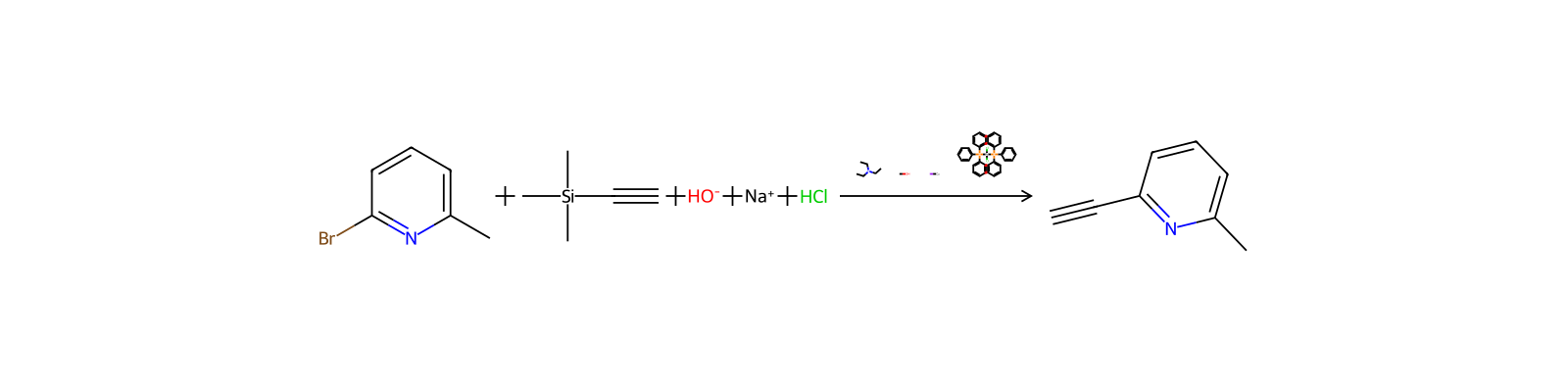
2-Bromo-6-methylpyridine (0.5 g, 2.9 mmol) and trimethylsilylacetylene (0.29 g, 2.9 mmol) in Et3N (15 mL) is purged with argon. Then CuI (11 mg, 0.06 mmol) and (PPh3)2PdCl2 (42 mg, 0.06 mmol) are added and the reaction stirred under argon at room temp for 2 hours. The solvent is removed in vacuo and the residue diluted in EtOAc (50 mL) and water (50 mL). The organic is separated and washed with brine. The solvent is removed to afford a dark oil. This oil is diluted in MeOH (50 mL) and treated with a 1 N NaOH solution (10 mL) and stirred for 3 hours at room temp. The aqueous is then acidified to pH=4 with 1 N HCl and extracted with dichloromethane. The solvent is removed in vacuo to afford 1.16 g (24%) as a light yellow oil used as is in following reactions. 1H NMR (CDCl3) δ: 7.54 (t, 1H), 7.29 (d, 1H), 7.12 (d, 1H), 3.12 (s, 1H), 2.55 (s, 1H). MS ES+ m/e 118.1 (M+1).