2-Chloro-6,7-dimethoxy-4-quinazolinamine → 2-{4-(1-Adamantanecarbonyl)-1-piperazinyl}-4-amino-6,7-dimethoxyquinazoline
HRID 904120
Reaktionsgleichung

Cl[C:2]1[N:11]=[C:10]([NH2:12])[C:9]2[C:4](=[CH:5][C:6]([O:15][CH3:16])=[C:7]([O:13][CH3:14])[CH:8]=2)[N:3]=1.[C:17]12([C:27]([N:29]3[CH2:34][CH2:33][NH:32][CH2:31][CH2:30]3)=[O:28])[CH2:26][CH:21]3[CH2:22][CH:23]([CH2:25][CH:19]([CH2:20]3)[CH2:18]1)[CH2:24]2>C(O)CCC>[C:17]12([C:27]([N:29]3[CH2:34][CH2:33][N:32]([C:2]4[N:11]=[C:10]([NH2:12])[C:9]5[C:4](=[CH:5][C:6]([O:15][CH3:16])=[C:7]([O:13][CH3:14])[CH:8]=5)[N:3]=4)[CH2:31][CH2:30]3)=[O:28])[CH2:18][CH:19]3[CH2:20][CH:21]([CH2:22][CH:23]([CH2:25]3)[CH2:24]1)[CH2:26]2Komponenten
4
Edukt 2
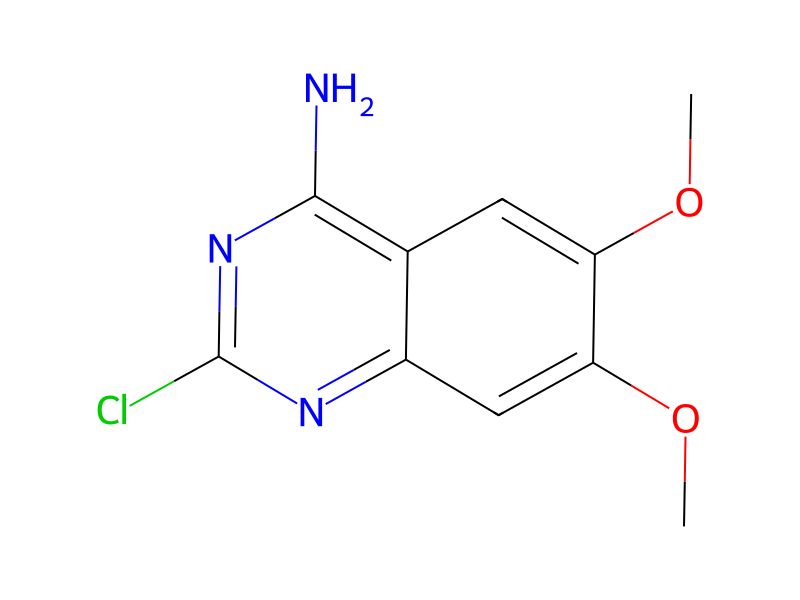

Produkt 1

Reagenzien, Katalysatoren, Lösungsmittel 1

Versuchsvorschrift
A mixture of 2-chloro-4-amino-6,7-dimethoxyquinazoline (2.4 g), 1-(1-adamantanecarbonyl)piperazine (2.5 g) and n-butanol (60 ml) was refluxed for 10 hours. After cooling, the solvent was evaporated under reduced pressure, and water was added to the residue. After treating with aqueous ammonia, the precipitated crystals were collected to give crude 2-{4-(1-adamantanecarbonyl)-1-piperazinyl}-4-amino-6,7-dimethoxyquinazoline, m.p. 237°-240° C. Recrystallization from methanol gave pure 2-{4-(1-adamantanecarbonyl)-1-piperazinyl}-4-amino-6,7-dimethoxyquinazoline, m.p. 242°-243° C.