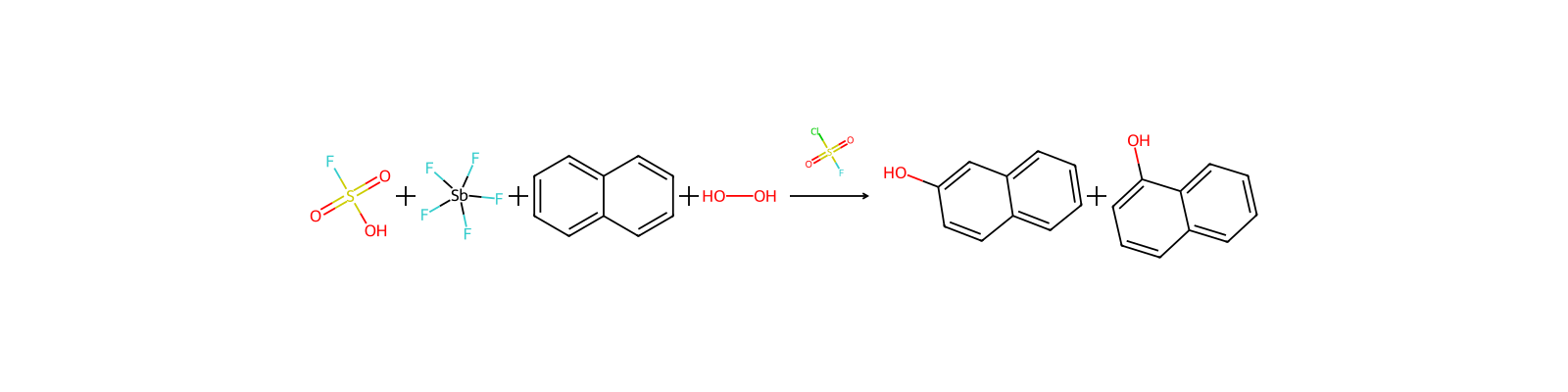
Beteiligte Stoffe
| Rolle | Name | HCID | Einwaage |
|---|
| Edukt | Hydrogen Peroxide | HCID 784 | — |
| Edukt | Naphthalene | HCID 931 | — |
| Edukt | Antimony pentafluoride | HCID 24557 | — |
| Edukt | Fluorosulfuric acid | HCID 24603 | — |
| Lösungsmittel | Sulfuryl chloride fluoride | HCID 26159 | — |
| Produkt | 1-Naphthol | HCID 7005 | 4,4% |
| Produkt | 2-Naphthol | HCID 8663 | 54,2% |
Reaktionsschritte
Using a 1:1 molar mixture of fluorosulfuric acid and antimony pentafluoride diluted with sulfuryl chloride fluoride, a solvent of low nucleophilicity, the reaction of naphthalene with hydrogen peroxide (90% solution) at temperatures between -78% and -70° C., gave 54.2% of β-naphthol with 4.4% of α-naphthol. About 6% of dihydroxynaphthalenes were also formed with only traces of polymeric material and 22% naphthalene was recovered. The yield of β-naphthol is 69% with an isomeric purity of 92.5%. Similar results showing high regioselectivity in the formation of β-naphthol were also obtained in other superacidic systems, such as in hydrogen fluoride-antimony pentafluoride, hydrogen fluoride-tantalum pentafluoride, trifluoromethanesulfonic acid-antimony pentafluoride, and the like.
Herkunft & Nachweise
| DOI | 10.6084/m9.figshare.5104873.v1 |
|---|
| Patentnummer | US04419528 |
|---|
| Quelldatensatz | uspto-grants-1983_12 |
|---|
| ORD ID | ord-45c590c5388b422da12f781d18417bea |
|---|
| Quellennotiz | uspto-grants-1983_12 |
|---|