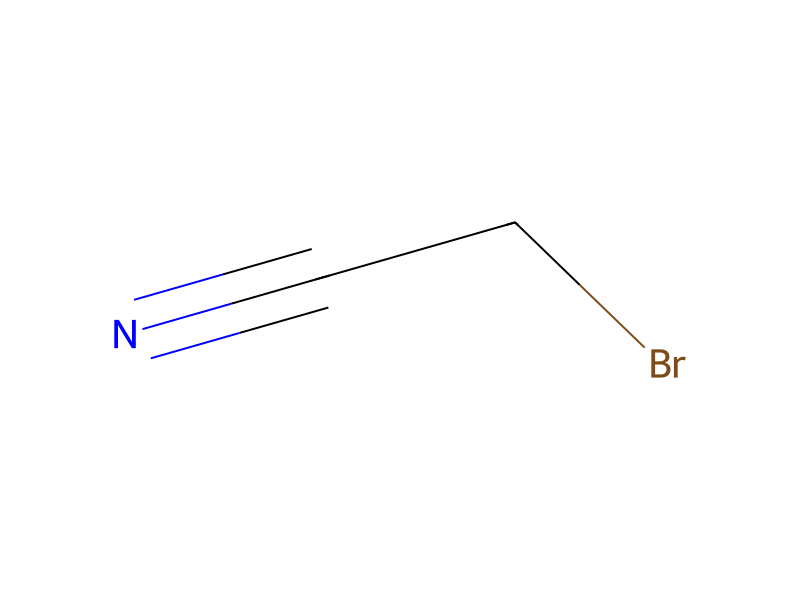
[Br:1][C:2]1[CH:3]=[CH:4][C:5]([OH:21])=[C:6]([C:8]([C:10]2[CH:11]=[N:12][N:13]([C:15]3[CH:20]=[CH:19][CH:18]=[CH:17][CH:16]=3)[CH:14]=2)=[O:9])[CH:7]=1.Br[CH2:23][C:24]#[N:25].C([O-])([O-])=O.[K+].[K+]>CC(C)=O>[Br:1][C:2]1[CH:3]=[CH:4][C:5]([O:21][CH2:23][C:24]#[N:25])=[C:6]([C:8]([C:10]2[CH:11]=[N:12][N:13]([C:15]3[CH:20]=[CH:19][CH:18]=[CH:17][CH:16]=3)[CH:14]=2)=[O:9])[CH:7]=1(5-Bromo-2-hydroxy-phenyl)-(1-phenyl-1H-pyrazol-4-yl)ketone (342 mg) was added bromoacetonitrile (122 mg), acetone (2 mL) and K2CO3 (140 mg), and the reaction was stirred for 24 h. The reaction mixture was concentrated and the residue was partitioned between water and EtOAc. The organic phase was washed with brine, dried (MgSO4) and concentrated to give 383 mg (100%) yellow solid, that was used directly in the next step: LC/MS (an10p8): Rt 4.39 min, m/z 381.5 [M+1]+; 1H NMR (CDCl3): δ 4.80 (s, 2H), 7.07 (d, J=8.7 Hz, 1H), 7.35-7.42 (m, 1H), 7.45-7.54 (m, 2H), 7.60-7.69 (m, 2H), 7.69-7.75 (m, 2H), 8.03 (s, 1H), 8.31 (s, 1H); 13C NMR (CDCl3): δ 55.2, 114.7, 116.6, 116.7, 120.1, 125.1, 128.2, 129.9, 131.0, 132.6, 133.2, 135.0, 139.3, 142.7, 153.0, 186.0.