Pyrrolidine → 1-(4,8-Dinitronaphthalen-1-yl)pyrrolidine, hydrochloride
HRID 916326
Reaktionsgleichung

[NH:1]1[CH2:5][CH2:4][CH2:3][CH2:2]1.[Cl:6][C:7]1[C:16]2[C:11](=[CH:12][CH:13]=[CH:14][C:15]=2[N+:17]([O-:19])=[O:18])[C:10]([N+:20]([O-:22])=[O:21])=[CH:9][CH:8]=1>>[ClH:6].[N+:17]([C:15]1[C:16]2[C:11](=[C:10]([N+:20]([O-:22])=[O:21])[CH:9]=[CH:8][CH:7]=2)[C:12]([N:1]2[CH2:5][CH2:4][CH2:3][CH2:2]2)=[CH:13][CH:14]=1)([O-:19])=[O:18]Komponenten
3
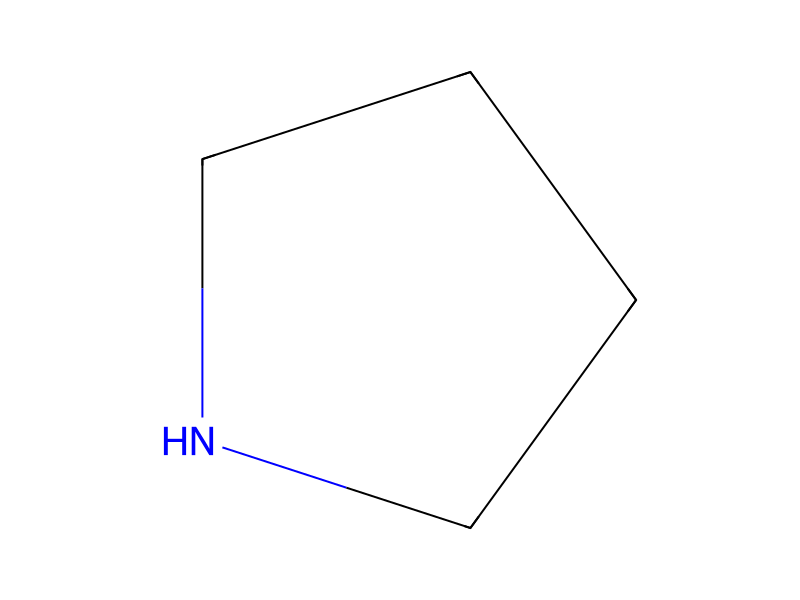


Versuchsvorschrift
Pyrrolidine (5.0 mL) was added to 1-chloro-4,8-dinitronaphthalene (50 mg, 0.20 mmol, Bassilios et al, Recueil, 1962, 81, 209-214) which resulted in an immediate, highly exothermic reaction. The reaction was further agitated for 5 min while heating using a heatgun. Volatiles were removed in vacuo and purification as in 159JP06 (dichloromethane/n-heptane 4:1, 5× eluted) afforded 12 mg (21%) of 159JP29 as an orange solid. The product was converted to the corresponding hydrochloride salt as described above.