Beteiligte Stoffe
| Rolle | Name | HCID | Einwaage |
|---|
| Edukt | Adipic Acid | HCID 196 | — |
| Edukt | Vinyl cyclohexene dioxide | HCID 7833 | — |
| Edukt | 1,2,3-Propanetricarboxylic acid | HCID 14925 | — |
| Edukt | 1,2,3,4-Butanetetracarboxylic acid | HCID 15560 | — |
| Produkt | 1,2,3-Propanetricarboxylic acid | HCID 14925 | — |
| Produkt | Carbon dioxide propylene oxide | HCID 18518868 | — |
Reaktionsschritte
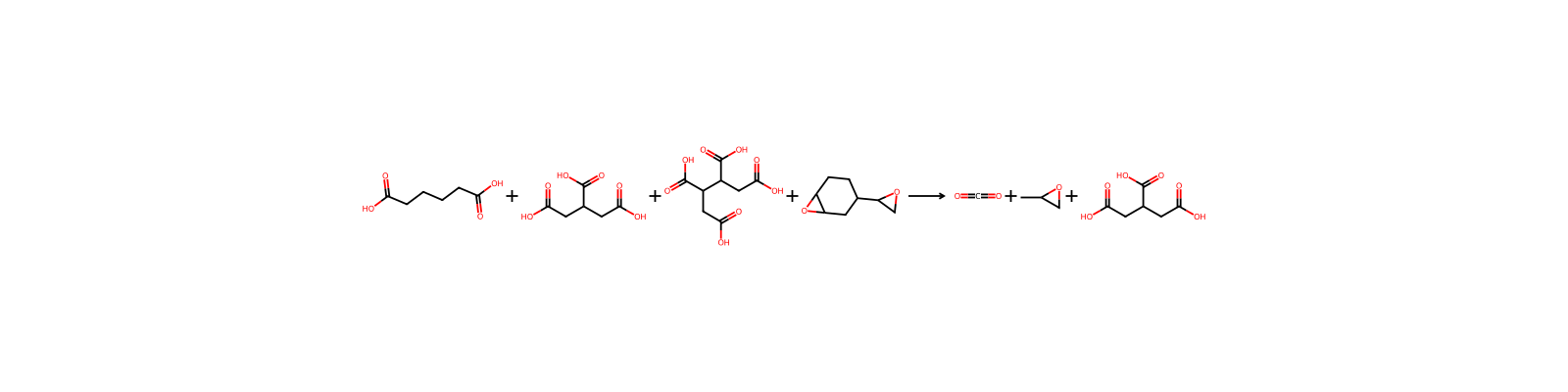
After fixing a chain transfer agent to control a molar fraction of —COOH group to 45 relative to a molar fraction of the catalyst and then introducing adipic acid, 5.9 mg (Entries 1 to 5); tricarballylic acid, 5.1 mg (Entries 6 to 10); 1,2,3,4-butane tetracarboxylic acid, 4.7 mg (Entries 11 to 15)) into a reactor, vinylcyclohexene dioxide was weighed to numeral values listed in TABLE 3, relative to the molar fraction of the catalyst and then introduced (into the reactor). Then, polymerization was executed and the catalyst was removed according to the same procedures as described in Example 1, resulting in pure copolymer. TABLE 3 summarizes results of the polymerization. FIG. 2 shows GPC curves of a copolymer obtained by carbon dioxide/propylene oxide copolymerization in the presence of tricarballylic acid (C3H5(CO2H)3) and diepoxide, wherein reference numeral in each curve denotes an entry number in TABLE 2.
Herkunft & Nachweise
| DOI | 10.6084/m9.figshare.5104873.v1 |
|---|
| Patentnummer | US09284407B2 |
|---|
| Quelldatensatz | uspto-grants-2016_03 |
|---|
| ORD ID | ord-49e07011850448748199983a8c14f118 |
|---|
| Quellennotiz | uspto-grants-2016_03 |
|---|