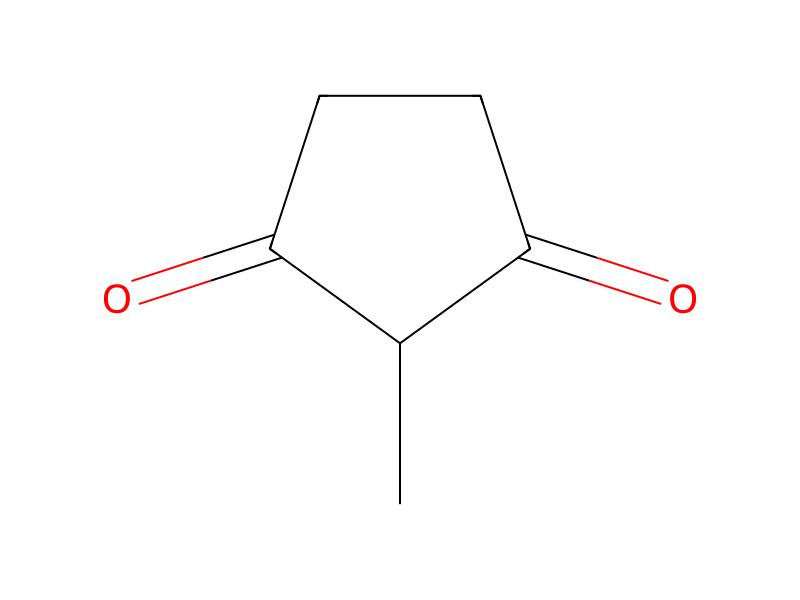
A solution containing 0.75 part of 2-methylcyclopentane-1,3-dione in 19 parts of dimethylformamide is treated sequentially with 1.0 part by volume of triethylamine and 1.9 parts of N,N,N-trimethyl-N-(2-[5,6-dihydro-3-methoxyisoquinol-8-yl]prop-2-en-1-yl)ammonium iodide. The resulting homogeneous solution is heated at about 135° for 43/4 hours. It is allowed to cool to room temperature and solvent is removed under reduced pressure. The remaining material is diluted with water-ether and enough 5% sodium hydroxide solution is added to bring the pH to 10. The aqueous and organic layers are separated and the aqueous layer is extracted with ether. The extracts are washed sequentially with 5% sodium hydroxide solution, 2.5% aqueous formic acid and saturated sodium chloride solution, then dried over anhydrous sodium sulfate. Upon solvent removal, an oil remains which is taken into ether. Then n-hexane is added until the solution becomes turbid. Charcoal is added and the mixture is filtered. Solvent is removed under reduced pressure to yield an oil which crystallizes upon standing. Recrystallization from acetone-water gives pure 5,6-dihydro-3-methoxy-8-[3-(2-methyl-1,3-dioxocyclopent-2-yl)prop-1-en-2-yl]isoquinoline, which is identical to the product obtained in Example 18A.