
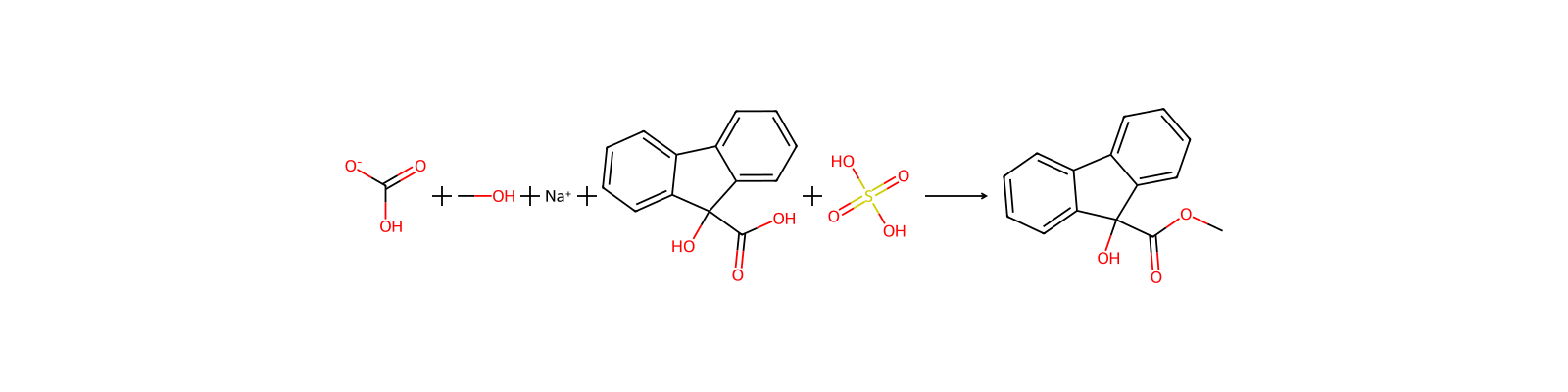
HRID 10367As reactant

467-69-6O=C(O)C1(O)c2ccccc2-c2ccccc21GXAMYUGOODKVRM-UHFFFAOYSA-NFlurecol is a member of fluorenes.
467-69-6DTXSID0075029CHEMBL1452438CHEBI:82015Herbicides
Active substance -> EU Pesticides database: Not approved
Safety information is for reference only and does not replace the supplier’s Safety Data Sheet (SDS), applicable regulations, or professional assessment.
H411: Toxic to aquatic life with long lasting effects [Hazardous to the aquatic environment, long-term hazard]
P273, P391, and P501 (click each P-code to see the statement)
H411 (100%): Toxic to aquatic life with long lasting effects [Hazardous to the aquatic environment, long-term hazard]
P273, P391, and P501 (click each P-code to see the statement)
Aggregated GHS information provided per 44 reports by companies from 1 notifications to the ECHA C&L Inventory.
H411: Toxic to aquatic life with long lasting effects [Hazardous to the aquatic environment, long-term hazard]
PMN - indicates a commenced PMN (Pre-Manufacture Notices) substance.
2004/129/EC
Aquatic Chronic 2 (100%)
Hazardous to the aquatic environment (chronic) - category 2
Aquatic Chronic 2
DescriptionFlurenol is a post-emergence plant growth regulator, often used in conjunction with phenoxy herbicides, to assist in the control of broadleaved weeds. It has a moderate water solubility and a low volatility. It is not usually persistent in soils or waterbodies. Very little data is available for human health but flurenol has a low oral mammalian toxicity. Limited toxicity data is available for biodiversity but data that is available is low to moderate.
Uses9-Hydroxy-9-fluorenecarboxylic acid was used in the synthesis of a hexameric organooxotin prismane.




DefinitionChEBI: Flurecol is a member of fluorenes.