HomeMCPWorkbenchSkills
HomeWorkbenchNotificationsMe
llms.txt · MCP GuidePrivacy Policy · Terms of Service · Supportv1.8.3
  1. Home
  2. /Compound

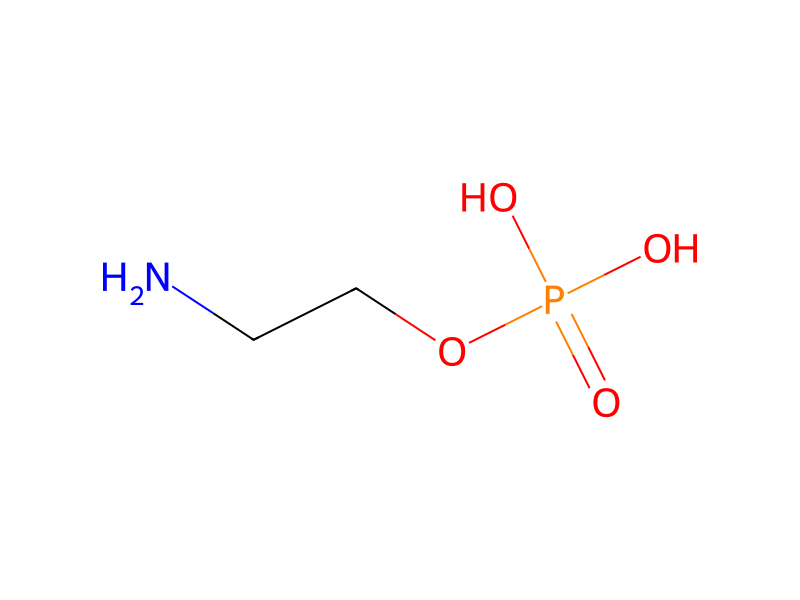
Phosphoethanolamine

HCID 1015
New reaction
Print
Basic informationOverviewNames & identifiersPropertiesSafety & regulationChemistry & industryRelated reactionsCompound notes
Substructure searchFind similar structures

Basic information

CAS
1071-23-4
Standard SMILES
NCCOP(=O)(O)O
InChIKey
SUHOOTKUPISOBE-UHFFFAOYSA-N
Molecular formula
C2H8NO4P
Average molar mass
141.06 g/mol
Monoisotopic mass
141.01909473

Overview

O-phosphoethanolamine is the ethanolamine mono-ester of phosphoric acid, and a metabolite of phospholipid metabolism. This phosphomonoester shows strong structural similarity to the inhibitory neurotransmitter GABA, and is decreased in post-mortem Alzheimer's disease brain. It has a role as a mouse metabolite, a human metabolite and an algal metabolite. It is a phosphoethanolamine and a primary amino compound. It is a conjugate acid of an O-phosphonatoethanaminium(1-).

Names & identifiers

Preferred name
Phosphoethanolamine
IUPAC
2-aminoethyl dihydrogen phosphate
English name
O-Phosphorylethanolamine
Molecular formula
C2H8NO4P
Molecular weight
141.06

Names & synonyms

O-Phosphorylethanolamine1071-23-42-Aminoethyl dihydrogen phosphateO-PhosphoethanolaminePhosphorylethanolaminephosphoethanolamineColamine phosphateethanolamine phosphateEthanolamine O-phosphatePhosphonoethanolaminePhosphorylcolamineMono(2-aminoethyl) phosphate
Show more names
PHOSPHORYL COLAMINEPe 104NSC 254167NSC 25416)PHOSPHOCOLAMINEFosforilcolamine
COLAMINE PHOSPHORIC ACIDColaminphosphoric acid(2-aminoethoxy)phosphonic acidmonoaminoethyl phosphate2-amino-ethanol phosphateEthanolamine acid phosphateEthanol, 2-amino-, dihydrogen phosphate (ester)phosphoryl-ethanolamine

Database identifiers

CAS
1071-23-4
PubChem CID
1015
DTXSID
DTXSID5061453
ChEMBL
CHEMBL146972
ChEBI
CHEBI:17553
UNII
78A2BX7AEU
EC Number
213-988-5
Nikkaji
J12.176B

Properties

Computed structural properties

XLogP
-4.8
Topological polar surface area
92.8 Ų
Hydrogen bond donors
3
Hydrogen bond acceptors
5
Rotatable bonds
3
Heavy atoms
8
Formal charge
0
Complexity
98.2

Experimental & physicochemical properties

DrugsPharmaceuticals -> Listed in ZINC15
Solubility72 mg/mL
Melting Point · 2 items

241-243 °C

241 - 243 °C

Physical DescriptionSolid
Collision Cross Section · 3 items

121.6 Ų [M-H]- [CCS Type: DT; Method: single field calibrated with Agilent tune mix (Agilent)]

123 Ų [M-H]- [CCS Type: DT; Method: single field calibrated with ESI Low Concentration Tuning Mix (Agilent)]

123.4 Ų [M-H]-

Physicochemical properties

Melting point
241 · 241-243 °C(lit.)
Boiling point
335.8 · 335.8±44.0 °C(Predicted)
Density
1.554 · 1.554±0.06 g/cm3(Predicted)
storage temp.
30 °C · Store below +30°C.
Water Solubility
Soluble in water
solubility
PBS (pH 7.2): 10 mg/ml
pka
1 · pK1:5.838(+1);pK2:10.638(0) (25°C)
form
powder to crystal
color
White to Light yellow
BRN
1758916 · 1758916
InChI
InChI=1S/C2H8NO4P/c3-1-2-7-8(4,5)6/h1-3H2,(H2,4,5,6)
InChIKey
SUHOOTKUPISOBE-UHFFFAOYSA-N
SMILES
C(OP(O)(O)=O)CN
CAS DataBase Reference
1071 · 1071-23-4(CAS DataBase Reference)
EWG's Food Scores
1 · 1
FDA UNII
78 A2BX7AEU · 78A2BX7AEU
EPA Substance Registry System
2 · Ethanol, 2-amino-, dihydrogen phosphate (ester) (1071-23-4)
UNSPSC Code
12352200 · 12352200
NACRES
25 · NA.25
Symbol(GHS)
5 · GHS05
Signal word
Danger
Hazard statements
314 · H314
Precautionary statements
280 · P280-P305+P351+P338-P310
Hazard Codes
T,C
Risk Statements
25 · 25-34
Safety Statements
26 · 26-36/37/39-45-27
RIDADR
3261 · UN 3261 8/PG 2
WGK Germany
3 · 3
RTECS
5830000 · KJ5830000
TSCA
TSCA listed
HazardClass
8 · 8
PackingGroup
III
HS Code
2922199090 · 2922199090
Storage Class
11 · 11 - Combustible Solids
Toxicity
50 orally · LD50 orally in Rabbit: 5820 mg/kg
Limited Quantities
1 Kg · 1 Kg (2.2 lbs) (solid)
Excepted Quantities
Max Inner Pack (30g or 30ml) and Max Outer Pack (500g or 500ml)

Safety & regulation

Safety information is for reference only and does not replace the supplier’s Safety Data Sheet (SDS), applicable regulations, or professional assessment.

GHS classification

GHS Classification · 5 items

This chemical does not meet GHS hazard criteria for 3.7% (3 of 80) of reports.

Danger

H314 (92.5%): Causes severe skin burns and eye damage [Danger Skin corrosion/irritation]

P260, P264, P264+P265, P280, P301+P330+P331, P302+P361+P354, P304+P340, P305+P354+P338, P316, P317, P321, P363, P405, and P501 (click each P-code to see the statement)

Aggregated GHS information provided per 80 reports by companies from 6 notifications to the ECHA C&L Inventory. Each notification may be associated with multiple companies.

Hazard information

Regulatory InformationPhosphorylethanolamine: Does not have an individual approval but may be used under an appropriate group standard
Hazard Classes and CategoriesSkin Corr. 1B (92.5%)

Safety data

wgk
3
tsca
TSCA listed
rtecs
KJ5830000
ridadr
UN 3261 8/PG 2
hs_code
2922199090
Toxicity
LD50 orally in Rabbit: 5820 mg/kg
risk_code
25-34
Signal word
Danger
Symbol(GHS)
GHS05
hazard_code
T,C
safety_code
26-36/37/39-45-27
hazard_class
8
Storage Class
11 - Combustible Solids
packing_group
III
Hazard statements
H314
Limited Quantities
1 Kg (2.2 lbs) (solid)
Excepted Quantities
Max Inner Pack (30g or 30ml) and Max Outer Pack (500g or 500ml)
Precautionary statements
P280-P305+P351+P338-P310

Chemistry & industry

Pharmacology

Tissue LocationsPlacenta
Cellular LocationsCytoplasm
Metabolite PathwaysFabry disease

Uses & manufacturing

General Manufacturing InformationEthanol, 2-amino-, 1-(dihydrogen phosphate): ACTIVE
Applications · 2 items

UsesO-PHOSPHORYLETHANOLAMINEe is used in the synthesis of Sphingomyelin, a type of sphingolipid found in animal cell membrane.

UsesO-Phosphorylethanolamine has been used:in LHC-8 medium as a supplement in culturing the transformed human liver epithelial (THLE)-2 and THLE-3 cellsin C-reactive protein (CRP) binding sucrose flotation experimentto incubate phosphomonoesters with anion-exchange chromatography (AEC) fractions for the detection of phosphatase activityto add in the washed beads for the preparation of phosphorylethanolamine (Pet) -conjugated sepharose column for chromatographic purification of mutant CRP

Additional notes · 1 item

DefinitionChEBI: The ethanolamine mono-ester of phosphoric acid, and a metabolite of phospholipid metabolism. This phosphomonoester shows strong structural similarity to the inhibitory neurotransmitter GABA, and is decreased in post-mortem Alzheimer's disease brain.

Related reactions

2 records
New reaction record
HRID 333523 reaction equation
HRID 333523As reactant
HRID 1110452 reaction equation
HRID 1110452As reactant

Compound notes

On this pageBasic informationOverviewNames & identifiersPropertiesSafety & regulationChemistry & industryRelated reactionsCompound notes