
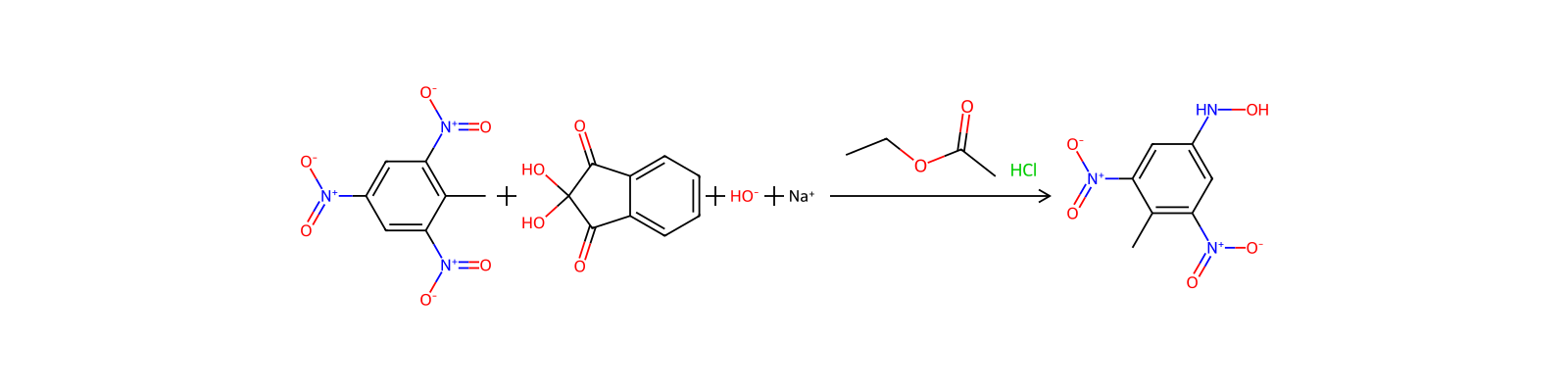
HRID 5898As reactant

485-47-2O=C1c2ccccc2C(=O)C1(O)OFEMOMIGRRWSMCU-UHFFFAOYSA-NNinhydrin appears as white to light yellow crystals or powder. Becomes anhydrous with reddening at 257-266 °F. (NTP, 1992)
485-47-2DTXSID7025716CHEMBL1221925CHEBI:863741 to 5 mg/mL at 68 °F (NTP, 1992)
Solubility in water: soluble
0.00000024 [mmHg]
0.000000236 [mm Hg] @25 °C
Ninhydrin appears as white to light yellow crystals or powder. Becomes anhydrous with reddening at 257-266 °F. (NTP, 1992)
White to light yellow crystals or powder; [CAMEO]
ODOURLESS COLOURLESS-TO-CREAM-COLOURED CRYSTALLINE SOLID.
Safety information is for reference only and does not replace the supplier’s Safety Data Sheet (SDS), applicable regulations, or professional assessment.
Chemical: 1H-Indene-1,3(2H)-dione, 2,2-dihydroxy-
Ninhydrin: Does not have an individual approval but may be used under an appropriate group standard
Flash point data for this chemical are not available. It is probably combustible. (NTP, 1992)
Combustible.
Fires involving this material can be controlled with a dry chemical, carbon dioxide or Halon extinguisher. (NTP, 1992)
Use water spray, powder, foam, carbon dioxide.
Fresh air, rest.
Substances used for the detection, identification, analysis, etc. of chemical, biological, or pathologic processes or conditions. Indicators are substances that change in physical appearance, e.g., color, at or approaching the endpoint of a chemical titration, e.g., on the passage between acidity and alkalinity. Reagents are substances used for the detection or determination of another substance by chemical or microscopical means, especially analysis. Types of reagents are precipitants, solvents, oxidizers, reducers, fluxes, and colorimetric reagents. (From Grant & Hackh's Chemical Dictionary, 5th ed, p301, p499)
Drugs used to potentiate the effectiveness of radiation therapy in destroying unwanted cells.
DescriptionNinhydrin is historically the most common reagent for processing fingerprints on porous substrates. It has been used as a fingerprint reagent since the 1950s but has been used as a cell stain since the early 1900s. Ninhydrin molecules form a complex with amino acids resulting in a purple product known as Ruhmann's purple. Purple fingerprints are easily visible on light-colored porous substrates but may be difficult to see on patterned or dark-colored substrates. DFO reacts with amino acids to produce a fluorescent product that is not readily seen with the naked eye. This makes it a useful reagent on dark or patterned porous items. DFO prints are viewed with an alternate light source or laser set to 530–570 nm (green light) through a red barrier filter. 1,2-indanedione is an emerging fingerprint reagent that results in visible pink fingerprints that are also fluorescent. The fluorescence is viewed under the same conditions as DFO. These chemicals can be used on their own or in sequence to develop latent prints on porous substrates. If they are used in sequence, they are used in the following order: indanedione, DFO, ninhydrin. If a reagent is used out of sequence, it will inhibit or limit the effectiveness of the other reagents. In this laboratory exercise you will develop fingerprints on a porous substrate using indanedione, DFO, and ninhydrin. ninhydrin structure


Remove contaminated clothes. Rinse skin with plenty of water or shower.
First rinse with plenty of water for several minutes (remove contact lenses if easily possible), then refer for medical attention.
EYES: First check the victim for contact lenses and remove if present. Flush victim's eyes with water or normal saline solution for 20 to 30 minutes while simultaneously calling a hospital or poison control center. Do not put any ointments, oils, or medication in the victim's eyes without specific instructions from a physician. IMMEDIATELY transport the victim after flushing eyes to a hospital even if no symptoms (such as redness or irritation) develop.
SMALL SPILLS AND LEAKAGE: Should a spill occur while you are handling this chemical, FIRST REMOVE ALL SOURCES OF IGNITION, then you should dampen the solid spill material with 60-70% ethanol and transfer the dampened material to a suitable container. Use absorbent paper dampened with 60-70% ethanol to pick up any remaining material. Seal the absorbent paper, and any of your clothes, which may be contaminated, in a vapor-tight plastic bag for eventual disposal. Solvent wash all contaminated surfaces with 60-70% ethanol followed by washing with a soap and water solution. Do not reenter the contaminated area until the Safety Officer (or other responsible person) has verified that the area has been properly cleaned.
Cough. Sore throat.
Redness.
Redness.
HistoryNinhydrin was discovered in 1910 by the German-English chemist Siegfried Ruhemann (1859–1943). In the same year, Ruhemann observed ninhydrin's reaction with amino acids. In 1954, Swedish investigators Oden and von Hofsten proposed that ninhydrin could be used to develop latent fingerprints.
UsesNinhydrin is used for the detection of free amino groups in amino acids, peptides and proteins.
UsesNinhydrin is an amino acid-sensitive reagent for the development of latent fingermarks on porous surfaces. More sensitive alternatives, such as DFO and IND-Zn, are now available and these have advantages on porous substrates that are not highly luminescent. However, ninhydrin can still be applied after these treatments and may reveal additional ridge detail, particularly on highly luminescent substrates where luminescence visualization may be problematic.
General DescriptionWhite to light yellow crystals or powder. Becomes anhydrous with reddening at 257-266°F.
DefinitionChEBI: Ninhydrin is a member of the class of indanones that is indane-1,3-dione bearing two additional hydroxy substituents at position 2. It has a role as a colour indicator and a human metabolite. It is a member of indanones, a beta-diketone, an aromatic ketone and a ketone hydrate.