
Completing data — usually done within a minute
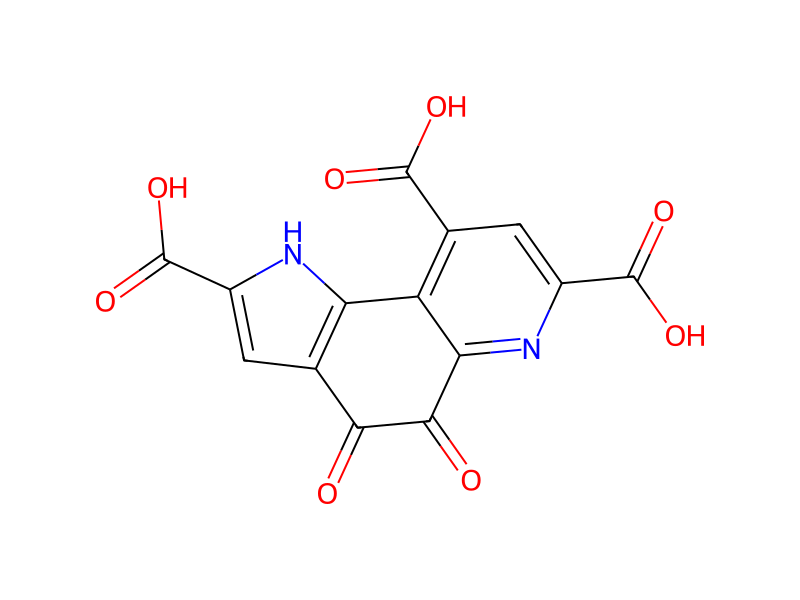
Basic information
- Standard SMILES
O=C(O)c1cc(C(=O)O)c2c(n1)C(=O)C(=O)c1cc(C(=O)O)[nH]c1-2- InChIKey
MMXZSJMASHPLLR-UHFFFAOYSA-N- Molecular formula
- C14H6N2O8
- Average molar mass
- 330.208 g/mol
- Monoisotopic mass
- 330.01241515
Names & identifiers
- Preferred name
- Methoxatin
- IUPAC
- 4,5-Dioxo-4,5-dihydro-1H-pyrrolo[2,3-f]quinoline-2,7,9-tricarboxylic acid
- English name
- Pyrroloquinoline quinone
- Molecular formula
- C14H6N2O8
- Molecular weight
- 330.21
Names & synonyms
PQQPPQMETHOXATINPYRROLOQUINOLINECoenzyme PQQ1H-Pyrrolo[2,3-f]quinoline-2,7,9-tricarboxylicacid, 4,5-dihydro-4,5-dioxo-PQQ Cofactor, Pyrroloquinoline quinone, 4,5-Dihydro-4,5-dioxo-1H-pyrrolo[2,3-f]quinoline-2,7,9-tricarboxylic acidPyrroloquinolinequinone,4,5-Dihydro-4,5-dioxo-1H-pyrrolo[2,3-f]quinoline-2,7,9-tricChemicalbookarboxylicacid,Methoxatin,PQQPQQ98%PQQ CAS
Database identifiers
- CAS
72909-34-3- PubChem CID
- 1024
- DTXSID
DTXSID3041162- ChEMBL
CHEMBL1235421- ChEBI
CHEBI:18315- UNII
- 47819QGH5L
- EC Number
- 839-691-6
- Nikkaji
- J126.218A
Properties
Physicochemical properties
- Melting point
- 222 · 222 - 224°C
- Boiling point
- 1018.6 · 1018.6±65.0 °C(Predicted)
- Density
- 1.963 · 1.963±0.06 g/cm3(Predicted)
- storage temp.
- 2 · 2-8°C
- solubility
- DMSO (Slightly), Methanol (Slightly)
- pka
- 1.88 · 1.88±0.20(Predicted)
- form
- Solid
- color
- Orange to Red
- biological source
- synthetic
- BRN
- 3596812 · 3596812
- Stability
- Light and Temperature Sensitive
- Cosmetics Ingredients Functions
- SKIN CONDITIONINGHUMECTANTSKIN PROTECTINGANTIOXIDANT
- InChI
- InChI=1S/C14H6N2O8/c17-10-4-2-6(14(23)24)15-8(4)7-3(12(19)20)1-5(13(21)22)16-9(7)11(10)18/h1-2,15H,(H,19,20)(H,21,22)(H,23,24)
- InChIKey
- MMXZSJMASHPLLR-UHFFFAOYSA-N
- SMILES
- N1C2=C(C3NC(C(O)=O)=CC=3C(=O)C2=O)C(C(O)=O)=CC=1C(O)=O
- FDA UNII
- 47819 QGH5L · 47819QGH5L
- UNSPSC Code
- 12352106 · 12352106
- NACRES
- 79 · NA.79
- Symbol(GHS)
- 7 · GHS07
- Signal word
- Warning
- Hazard statements
- 302 · H302-H315-H319-H332-H335
- Precautionary statements
- 261 · P261-P280-P305+P351+P338
- PPE
- 95 · Eyeshields, Gloves, type N95 (US)
- Safety Statements
- 22 · 22-24/25
- WGK Germany
- 3 · 3
- F
- 8 · 8
- HS Code
- 29339900 · 29339900
- Storage Class
- 11 · 11 - Combustible Solids
Safety & regulation
Safety data
- F
- 8
- PPE
- Eyeshields, Gloves, type N95 (US)
- wgk
- 3
- hs_code
- 29339900
- Signal word
- Warning
- Symbol(GHS)
- GHS07
- safety_code
- 22-24/25
- Storage Class
- 11 - Combustible Solids
- Hazard statements
- H302-H315-H319-H332-H335
- Precautionary statements
- P261-P280-P305+P351+P338
Chemistry & industry
Applications
DescriptionPyrroloquinoline quinone (PQQ) is a novel biofactor for which a proposition can be made for physiological importance. PQQ was first recognized as an enzyme cofactor in bacteria. It has recently been tentatively identified as a component of interstellar dust. Thus, PQQ may have been present throughout early biological conception and evolution. PQQ is also a potent plant growth factor. Consequently, for animals and humans, there has been constant exposure to PQQ. In animals, PQQ is reported to participate in a range of biological functions with apparent survival benefits (e.g., improved neonatal growth and reproductive performance). There are also benefits from PQQ supplementation related to cognitive, immune, and antioxidant functions, as well as protection from cardiac and neurological ischemic events. Although PQQ is not currently viewed as a vitamin, its involvement in cell signaling pathways, particularly those important to mitochondriogenesis in experimental animal models, may eventually provide a rationale for defining PQQ as vital to life. For humans, such evidence suggests there may be similar parallels or benefits from improving PQQ status.
UsesPyrroloquinoline quinone is an important growth factor for the body and a redox/cofactor found in a a class of enzymes called quinoproteins. It is a cofactor of microbial quinoprotein enzyme, and imidazopyrroline. it regulates the level of free radicals in the body, protects the body; anti-oxidative damage; enhances mitochondrial function; detoxification; disease, etc.
General DescriptionPQQ is pyrroloquinoline quinone. It is sometimes called methoxatin, pyrroloquinoline quinone disodium salt, and a longevity vitamin. It is a compound made by bacteria and is found in fruits and vegetables.PQQ in bacteria helps them digest alcohol and sugar, which makes energy. This energy helps them survive and grow. Animals and plants don’t use PQQ the same way that bacteria do, but it is a growth factor that helps plants and animals grow. It also seems to help them tolerate stress.
Upstream & downstream products
Upstream raw materials
Suppliers50 total
郑州阿尔法化工有限公司+86-18530059196 · [email protected]
上海阿拉丁生化科技股份有限公司400-6206333 13167063860 · [email protected]
Shanghai Biolang Biotechnology Co., Ltd.+86-15970428662 +86-13397199602 · [email protected]
西安江林生物科技有限公司18292036798; 18292036798
河北创海生物科技有限公司+86-86-13131129325 · [email protected]
T&W GROUP021-61551611 13296011611 · [email protected]
山东原力泰医药科技有限公司18668987081 18980869808
Ark Pharm, Inc.847-367-3680 · [email protected]
武汉易泰科技有限公司上海分公司18930552037 · [email protected]
上海波以尔化工有限公司[email protected]
安耐吉化学&3A(安徽泽升科技股份有限公司)400-0056266 · [email protected]
石家庄斯迪亚诺精细化工有限公司0311-89250318 13582355795 · [email protected]
广州市亿邦医药科技有限公司+86 (20) 28996708,29078958,28139708,29076128,28133708,28139728,28139738,28133718,021-31663278,021-31663578,021-60538387
上海钰康生物科技有限公司+86-18930848214 +86-021-56762820 · [email protected]
吉良化学21-62165282 · [email protected]
泰州凯美迪生物医药技术有限公司0523-86200218 18994667082 · [email protected]
嘉兴市艾森化工有限公司0573-85285100 18627885956 · [email protected]
上海瀚香生物科技有限公司177-54423994 17754423994 · [email protected]
南京春秋生物工程有限公司17388075642 13815430202 · [email protected]
立合生物(山东)有限公司13176691201 15588824841 · [email protected]
四川库利南科技有限公司400-1166-196 18981987031 · [email protected]
济南健丰化工有限公司0531-88110457; 18954159893
湖南汇百侍生物科技有限公司0731-85526065 13308475853 · [email protected]
泰州志诚化工科技有限公司0523-82837785 13914525028 · [email protected]
上海遐瑞医药科技有限公司+86 21 61551611
TOKYO CHEMICAL INDUSTRY CO., LTD.03-36680489 · [email protected]
深圳振强药物研发有限公司0755-66853366 13670046396 · [email protected]
泰州天鸿生化科技有限公司0523-86132544 15366717810 · [email protected]
南京生利德生物科技有限公司025-57798810 18652991625 · [email protected]
陕西帕尼尔生物科技有限公司13720616393;029-84385017-8003 13720616393 · [email protected]
Xunteng International Trading Co.,Limited—
湖南华腾制药有限公司400-8592883 · [email protected]
上海鑫圭生物科技有限公司15121041756 · [email protected]
上海麦克林生化科技股份有限公司15221275939 15221275939 · [email protected]
上海寰川实业有限公司021-61478794 · [email protected]
南京百鑫德诺生物科技有限公司025-58849295 · [email protected]
广州市慈铭生物科技有限公司020-38082199,29065168,38082986,29878298,29866629,4000192398
凯试(上海)科技有限公司021-50135380 · [email protected]
池州凯隆进出口贸易有限公司[email protected]
Sigma-Aldrich西格玛奥德里奇(上海)贸易有限公司021-61415566 800-8193336 · [email protected]
AN PharmaTech Co Ltd86(21)68097365 · [email protected]
西安康诺化工有限公司029-86107037 15829389671 · [email protected]
TargetMol中国(陶术生物)021-021-33632979 15002134094 · [email protected]
湖北康恩化学有限公司180-64105258 18064105258
上海昕凯医药科技有限公司21-619849051-1 18521059765 · [email protected]
上海陶术生物科技股份有限公司+1-781-999-5354; +1-00000000000 · [email protected]
无锡西玛生物科技有限公司0510-0510-85188225 18061978815
杭州鼎燕化工有限公司0571-87157530-8003 18267553885 · [email protected]
Hangzhou Proserre Chemical Co.,Ltd.+86-571-86088112 · [email protected]
Alfa Chemistry+1-5166625404 · [email protected]
Additional notes
DefinitionChEBI: Pyrroloquinoline quinone is a pyrroloquinoline having oxo groups at the 4- and 5-positions and carboxy groups at the 2-, 7- and 9-positions. It has a role as a water-soluble vitamin (role), a cofactor, an antioxidant and an anti-inflammatory agent. It is a member of orthoquinones, a tricarboxylic acid and a pyrroloquinoline cofactor. It is a conjugate acid of a pyrroloquinoline quinone(3-).
Related reactions
2 records

Linked notes
Loading…