
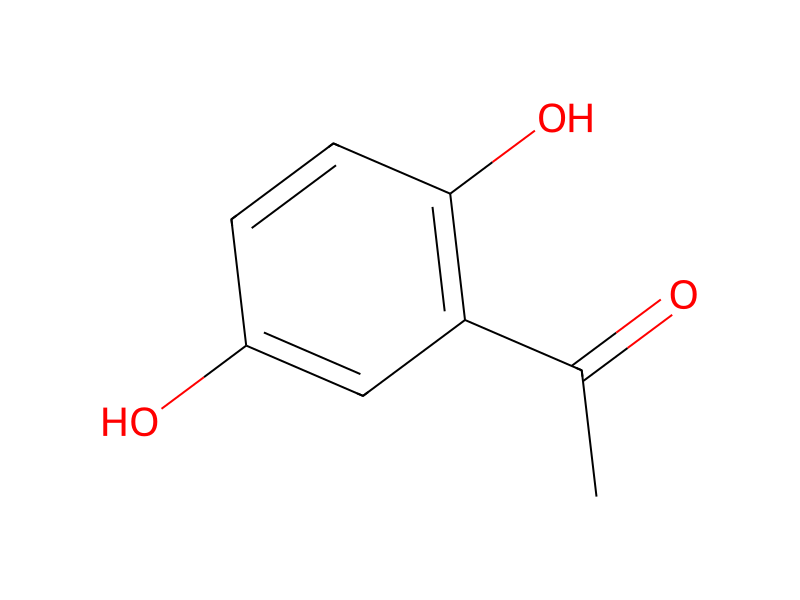
Basic information
- Standard SMILES
CC(=O)c1cc(O)ccc1O- InChIKey
WLDWSGZHNBANIO-UHFFFAOYSA-N- Molecular formula
- C8H8O3
- Average molar mass
- 152.15 g/mol
- Monoisotopic mass
- 152.04734411
Names & identifiers
- Preferred name
- 2-Acetylhydroquinone
- IUPAC
- 1-(2,5-dihydroxyphenyl)ethanone
- English name
- 2',5'-Dihydroxyacetophenone
- Molecular formula
- C8H8O3
- Molecular weight
- 152.15
Names & synonyms
490-78-81-(2,5-Dihydroxyphenyl)ethanone2',5'-DIHYDROXYACETOPHENONE2-AcetylhydroquinoneQuinacetophenoneAcetylhydroquinone1-(2,5-dihydroxyphenyl)ethan-1-oneEthanone, 1-(2,5-dihydroxyphenyl)-AcetylquinolAcetophenone, 2',5'-dihydroxy-1-Acetyl-2,5-dihydroxybenzene2,5-Dihydroxy-1-acetylbenzene
Show more names
2,5-DIHYDROXYACETOPHENONE2,5-DHAP2-hydroxy-1-(3-hydroxyphenyl)ethan-1-one2,5-Dihydroxyphenyl methyl ketone, 2-Acetyl-1,4-dihydroxybenzene, 2-Acetylhydroquinone, Acetylquinol, Quinacetophenone
NSC 3759EINECS 207-716-4K1H7QH11ZHBRN 0637903AI3-18221NSC-3759DTXSID90600772-ACETYL-1,4-BENZENEDIOL
Database identifiers
- CAS
490-78-8- PubChem CID
- 10279
- DTXSID
DTXSID9060077- ChEMBL
CHEMBL2348532- ChEBI
CHEBI:173647- UNII
- K1H7QH11ZH
- EC Number
- 207-716-4
- Nikkaji
- J6.045C
Properties
Computed structural properties
- XLogP
- 1.7
- Topological polar surface area
- 57.5 Ų
- Hydrogen bond donors
- 2
- Hydrogen bond acceptors
- 3
- Rotatable bonds
- 1
- Heavy atoms
- 11
- Formal charge
- 0
- Complexity
- 155
Experimental & physicochemical properties
Melting Point202 - 203 °C
Physical DescriptionSolid
Kovats Retention Index2162
Physicochemical properties
- Melting point
- 204 · 204-206 °C(lit.)
- Boiling point
- 234.6 °C · 234.6°C (rough estimate)
- Density
- 1.2143 · 1.2143 (rough estimate)
- refractive index
- 1.4447 · 1.4447 (estimate)
- storage temp.
- 30 °C · Store below +30°C.
- solubility
- 50 mg/mL, · dioxane: 50 mg/mL, clear
- pka
- 9.86 · 9.86±0.18(Predicted)
- form
- Crystals or Crystalline Powder
- color
- Yellow to yellow-green
- Water Solubility
- insoluble
- BRN
- 637903 · 637903
- Cosmetics Ingredients Functions
- SKIN CONDITIONINGBLEACHINGANTIOXIDANT
- InChI
- 1S/C8H8O3/c1-5(9)7-4-6(10)2-3-8(7)11/h2-4,10-11H,1H3
- InChIKey
- WLDWSGZHNBANIO-UHFFFAOYSA-N
- SMILES
- CC(=O)c1cc(O)ccc1O
- LogP
- 1.274 · 1.274 (est)
- CAS DataBase Reference
- 490 · 490-78-8(CAS DataBase Reference)
- EWG's Food Scores
- 1 · 1
- FDA UNII
- 1 H7QH11ZH · K1H7QH11ZH
- NIST Chemistry Reference
- 1 · Ethanone, 1-(2,5-dihydroxyphenyl)-(490-78-8)
- EPA Substance Registry System
- 1 · Ethanone, 1-(2,5-dihydroxyphenyl)- (490-78-8)
- UNSPSC Code
- 12352115 · 12352115
- NACRES
- 22 · NA.22
- Symbol(GHS)
- 7 · GHS07
- Signal word
- Warning
- Hazard statements
- 315 · H315-H319-H335
- Precautionary statements
- 264 · P264-P280-P302+P352+P332+P313+P362+P364-P305+P351+P338+P337+P313-P261-P280a-P304+P340-P305+P351+P338-P405-P501a
- target organs
- Respiratory system
- PPE
- 95 · dust mask type N95 (US), Eyeshields, Gloves
- Hazard Codes
- Xi
- Risk Statements
- 36 · 36/37/38
- Safety Statements
- 26 · 26-36
- WGK Germany
- 3 · 3
- RTECS
- 7700000 · AM7700000
- Hazard Note
- Irritant
- TSCA
- TSCA listed
- HS Code
- 29145000 · 29145000
- Storage Class
- 11 · 11 - Combustible Solids
- Hazard Classifications
- 4 OralEye · Acute Tox. 4 OralEye Irrit. 2Skin Irrit. 2STOT SE 3
Safety & regulation
GHS classification
GHS Classification
Warning
H315 (100%): Causes skin irritation [Warning Skin corrosion/irritation];H319 (100%): Causes serious eye irritation [Warning Serious eye damage/eye irritation];H335 (98%): May cause respiratory irritation [Warning Specific target organ toxicity, single exposure; Respiratory tract irritation]
P261, P264, P264+P265, P271, P280, P302+P352, P304+P340, P305+P351+P338, P319, P321, P332+P317, P337+P317, P362+P364, P403+P233, P405, and P501 (click each P-code to see the statement)
Aggregated GHS information provided per 50 reports by companies from 7 notifications to the ECHA C&L Inventory. Each notification may be associated with multiple companies.;Information may vary between notifications depending on impurities, additives, and other factors. The percentage value in parenthesis indicates the notified classification ratio from companies that provide hazard codes. Only hazard codes with percentage values above 10% are shown. For more detailed information, please visit ECHA C&L website.
Hazard information
Regulatory InformationEthanone, 1-(2,5-dihydroxyphenyl)-: Does not have an individual approval but may be used under an appropriate group standard
Hazard Classes and CategoriesSkin Irrit. 2 (100%);Eye Irrit. 2 (100%);STOT SE 3 (98%)
Regulatory information
Regulatory InformationEthanone, 1-(2,5-dihydroxyphenyl)-: Does not have an individual approval but may be used under an appropriate group standard
Safety data
- PPE
- dust mask type N95 (US), Eyeshields, Gloves
- wgk
- 3
- tsca
- TSCA listed
- rtecs
- AM7700000
- hs_code
- 29145000
- risk_code
- 36/37/38
- Signal word
- Warning
- Symbol(GHS)
- GHS07
- hazard_code
- Xi
- hazard_note
- Irritant
- safety_code
- 26-36
- Storage Class
- 11 - Combustible Solids
- target organs
- Respiratory system
- Hazard statements
- H315-H319-H335
- Hazard Classifications
- Acute Tox. 4 OralEye Irrit. 2Skin Irrit. 2STOT SE 3
- Precautionary statements
- P264-P280-P302+P352+P332+P313+P362+P364-P305+P351+P338+P337+P313-P261-P280a-P304+P340-P305+P351+P338-P405-P501a
Chemistry & industry
Pharmacology
Cellular LocationsCytoplasm;Extracellular
Uses & manufacturing
UsesSynthetic Polymer MALDI Matrix Compounds
General Manufacturing InformationEthanone, 1-(2,5-dihydroxyphenyl)-: ACTIVE
Applications
Description2',5'-Dihydroxyacetophenone is a natural phenolic compound that is found in many plants. It has been shown to have anti-inflammatory properties through its ability to inhibit the production of pro-inflammatory cytokines, such as tumor necrosis factor alpha and interleukin 1 beta.
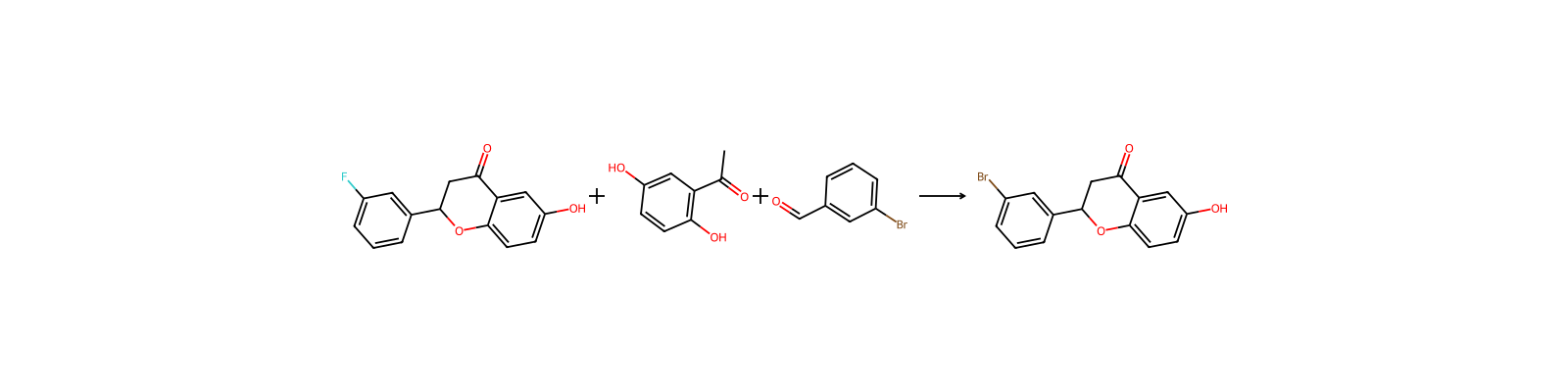
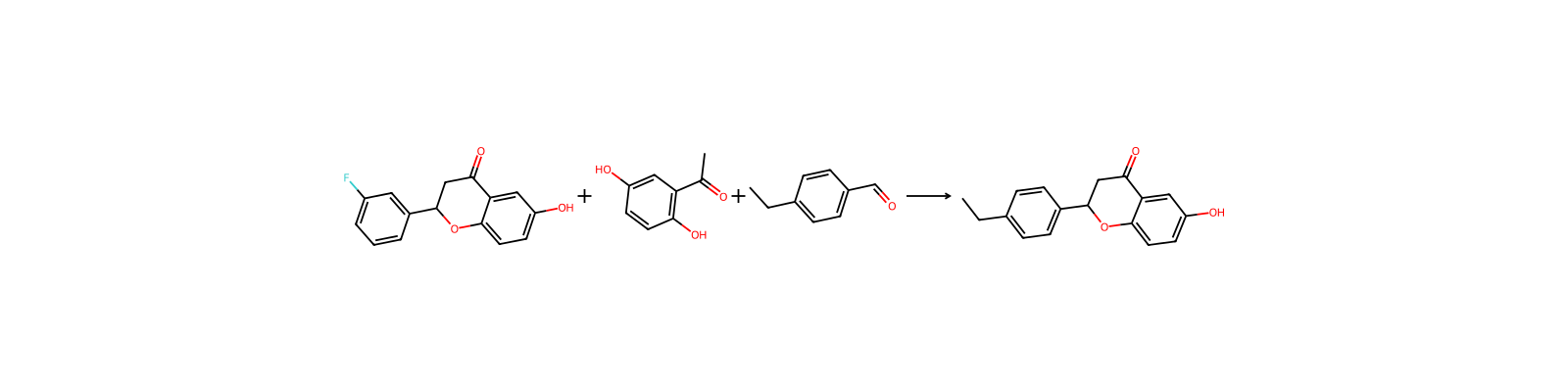
Uses1-(2,5-Dihydroxyphenyl)ethanone is an intermediate used in various synthetic preparations of pharmaceutical goods, 1-(2,5-Dihydroxyphenyl)ethanone was untilized in the synthesis of new flavonoid fatty acid esters with anti-adipogenic and glucose consumption enhancing activities.
Uses2',5'-Dihydroxyacetophenone is an intermediate used in various synthetic preparations of pharmaceutical goods, 1-(2,5-Dihydroxyphenyl)ethanone was untilized in the synthesis of new flavonoid fatty acid esters with anti-adipogenic and glucose consumption enhancing activities.
Preparation methods
PreparationPreparation by Fries rearrangement of hydroquinone diacetate,with aluminium chloride(91%) (76%)(63–77%) (55–60%)with zinc chloride in refluxing acetic acid (quantitative yield)with boron trifluoride etherate in benzene at reflux (65%).
Upstream & downstream products
Upstream raw materials
Downstream products
Suppliers50 total
国药集团化学试剂有限公司86-21-63210123 · [email protected]
梯希爱(上海)化成工业发展有限公司021-67121386 · [email protected]
上海阿拉丁生化科技股份有限公司400-6206333 13167063860 · [email protected]
河北创海生物科技有限公司+86-86-13131129325 · [email protected]
韶远科技(上海)有限公司021-50795510 4000665055 · [email protected]
科瑞迪化学400-821-5857 021-64326257 · [email protected]
南通萧畅医药贸易有限公司0513-82104991 18862997351 · [email protected]
上海迈瑞尔生化科技有限公司4006356688 18621169109 · [email protected]
北京华威锐科化工有限公司0757-86329057 18934348241 · [email protected]
阿法埃莎(中国)化学有限公司400-6106006 · [email protected]
安耐吉化学&3A(安徽泽升科技股份有限公司)400-0056266 · [email protected]
上海瀚鸿科技股份有限公司021-54306202 13764082696 · [email protected]
成都普思生物科技股份有限公司028-85370565-229 18080489829 · [email protected]
上海相辉医药科技有限公司13761987713 · [email protected]
嘉兴市艾森化工有限公司0573-85285100 18627885956 · [email protected]
Pure Chemistry Scientific Inc.001-857-928-2050 or 1-888-588-9418 · [email protected]
武汉威顺达科技发展有限公司86-027-88774375 · [email protected]
孝感深远化工有限公司15527621225; 15527621225 · [email protected]
云南西力生物技术股份有限公司0871-65217109 · [email protected]
山东西亚化学有限公司13355009207 13355009207 · [email protected]
四川库利南科技有限公司400-1166-196 18981987031 · [email protected]
上海耐士化工科技有限公司400-188-0725 +86 21 34310725 13611771617
天津希恩思生化科技有限公司400 638 7771 · [email protected]
河南多贝化工有限公司0370-2785118 17550508557 · [email protected]
上海源叶生物科技有限公司13636370518 · [email protected]
上海思域化工科技有限公司86-21-34053660 · [email protected]
赛默飞世尔科技(中国)有限公司800-810-5118 · [email protected]
TCI AMERICA800-4238616 · [email protected]
TOKYO CHEMICAL INDUSTRY CO., LTD.03-36680489 · [email protected]
TCI Europe320-37350700 · [email protected]
上海贤鼎生物科技有限公司4009209199 · [email protected]
越林试剂021-62960152 · [email protected]
广州爱纯医药科技有限公司020-39119399 18927568969 · [email protected]
上海灏云化工科技有限公司021-68367562 · [email protected]
上海将来实业股份有限公司400-0066400 13621662912 · [email protected]
上海将来实业股份有限公司021-61552785 · [email protected]
美岚实业(上海)有限公司021-58958189 · [email protected]
上海爱蝶实业有限公司021-58957966 18930537195 · [email protected]
广拓化学(上海)有限公司021-60899189-8001 18918189673 · [email protected]
武汉励合化学新材料有限公司027-88395709
上海嵩爰化工科技有限公司010-1234567 18521000990 · [email protected]
上海有朋化工有限公司021-69005955 13701776567 · [email protected]
北京海力扬化学科技有限公司13718199399 · [email protected]
北京欣赛维化学科技有限公司010-56218822 13717722232 · [email protected]
四川海诺威科技有限公司13708085536 13708085536 · [email protected]
江苏艾康生物医药研发有限公司025-66028182 17714375163 · [email protected]
上海凯赛化工有限公司021-33516722 13701817765 · [email protected]
上海彤源化工有限公司021-021-69182866 13701855675 · [email protected]
凯试(上海)科技有限公司021-50135380 · [email protected]
北京华扬致成科技有限公司13716033033 · [email protected]
Additional notes
DefinitionChEBI: 2',5'-Dihydroxyacetophenone is an aromatic ketone.
Related reactions
101 records




Linked notes
Loading…