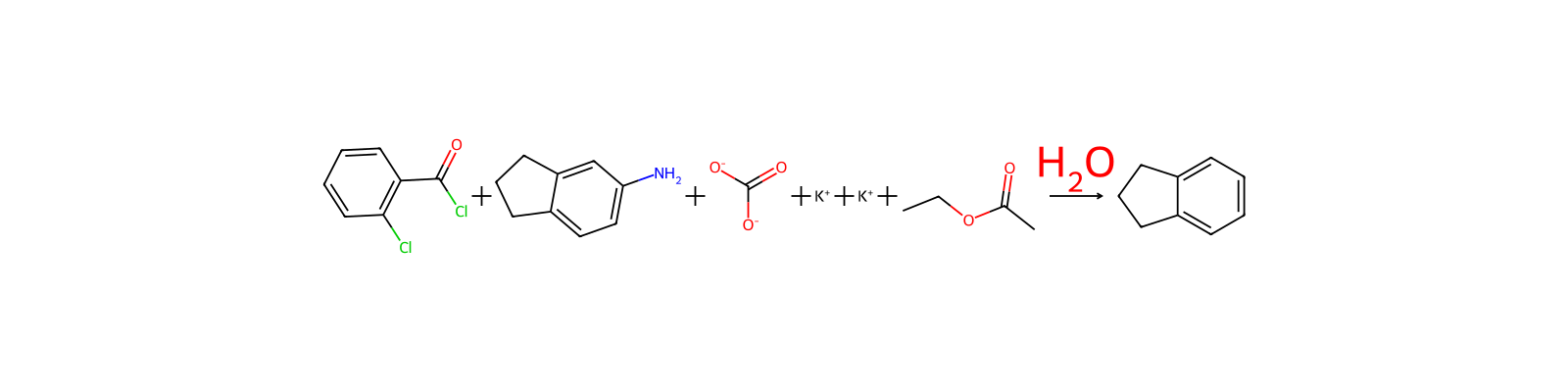

Basic information
- CAS
496-11-7- Standard SMILES
c1ccc2c(c1)CCC2- InChIKey
PQNFLJBBNBOBRQ-UHFFFAOYSA-N- Molecular formula
- C9H10
- Average molar mass
- 118.18 g/mol
- Monoisotopic mass
- 118.07825032
Overview
Indane is an ortho-fused bicyclic hydrocarbon consisting of a benzene ring fused to a cyclopentane ring; a high-boiling (176 oC) colourless liquid. It is an ortho-fused bicyclic hydrocarbon and a member of indanes.
Names & identifiers
- Preferred name
- Indane
- IUPAC
- 2,3-dihydro-1H-indene
- English name
- Indan
- Molecular formula
- C9H10
- Molecular weight
- 118.18
Names & synonyms
INDANIndane2,3-Dihydro-1H-indene496-11-7Hydrindene1H-Indene, 2,3-dihydro-BenzocyclopentaneHydrindonaphtheneDTXSID4052132H9SCX043IGNSC-5292DTXCID9030701
Show more names
2,3-dihydro-1h-indenDihydroindeneIndan>
CHEBI:37911RefChem:790887207-814-72,3-Dihydroindene1,2-HydrindeneIndene, 2,3-dihydro-NSC 5292MFCD00003795
Database identifiers
- CAS
496-11-7、56573-11-6- PubChem CID
- 10326
- DTXSID
DTXSID4052132- ChEMBL
CHEMBL370687- ChEBI
CHEBI:37911- UNII
- H9SCX043IG
- EC Number
- 207-814-7
- Nikkaji
- J20.933C
Properties
Computed structural properties
- XLogP
- 3.2
- Topological polar surface area
- 0 Ų
- Hydrogen bond donors
- 0
- Hydrogen bond acceptors
- 0
- Rotatable bonds
- 0
- Heavy atoms
- 9
- Formal charge
- 0
- Complexity
- 84.2
Experimental & physicochemical properties
Chemical ClassesOther Classes -> Aromatic Hydrocarbons
DrugsPharmaceuticals -> Synthetic Cannabinoids or Psychoactive Compounds
SpringerMaterials Properties13C nuclear magnetic resonance spectrum
LogP3.33
Density0.963 @ 20°C
Boiling Point176.5 °C @760 [mm Hg]
Melting Point-51.4 °C
Physical DescriptionLiquid; [Merck Index] Clear light yellow liquid; [Sigma-Aldrich MSDS]
Physicochemical properties
- Melting point
- -51 °C · -51 °C (lit.)
- Boiling point
- 176 °C · 176 °C (lit.)
- Density
- 0.965 g/mL · 0.965 g/mL at 25 °C (lit.)
- vapor pressure
- 1.5 at · 1.5 at 25 °C (extrapolated, Ambrose and Sprake, 1975)
- refractive index
- 20 · n20/D 1.537(lit.)
- Flash point
- 50 °C · 50 °C
- storage temp.
- Sealed in dry,Room Temperature
- solubility
- Soluble in alcohol, ether (Weast, 1986), and many aliphatic hydrocarbons (hexane, pentane), and aromatic hydrocarbons (benzene)
- pka
- 14 · >14 (Schwarzenbach et al., 1993)
- form
- Liquid
- color
- Clear colorless to yellow
- Odor Threshold
- 0.0037 ppm · 0.0037ppm
- Water Solubility
- Soluble in ethanol, diethyl ether, chloroform (slightly), and ether. Insoluble in water.
- Thermal Conductivity
- 0.135 W/ · 0.135 W/(m·K) at 25 ℃
- Specific Heat Capacity
- 1.61 J/ · Cp(liquid): 1.61 J/(g·K), at 25℃
- Merck
- 14 · 14,4931
- BRN
- 1904376 · 1904376
- Henry's Law Constant
- (x 10-3 atmm3/mol): 2.14 at 25 °C (approximate - calculated from water solubility and vapor pressure)
- Stability
- Stable. Flammable. Incompatible with strong oxidizing agents.
- InChI
- 1S/C9H10/c1-2-5-9-7-3-6-8(9)4-1/h1-2,4-5H,3,6-7H2
- InChIKey
- PQNFLJBBNBOBRQ-UHFFFAOYSA-N
- SMILES
- C1Cc2ccccc2C1
- CAS DataBase Reference
- 496 · 496-11-7(CAS DataBase Reference)
- EWG's Food Scores
- 1 · 1
- FDA UNII
- 9 SCX043IG · H9SCX043IG
- EPA Substance Registry System
- Indan (496-11-7)
- UNSPSC Code
- 41116107 · 41116107
- NACRES
- 24 · NA.24
- Symbol(GHS)
- 2 · GHS02,GHS08
- Signal word
- Danger
- Hazard statements
- 226 · H226-H304
- Precautionary statements
- 210 · P210-P301+P310+P331
- PPE
- Eyeshields, Faceshields, Gloves, type ABEK (EN14387) respirator filter
- Hazard Codes
- Xn,F
- Risk Statements
- 10 · 10-65
- Safety Statements
- 23 · 23-24/25-62
- RIDADR
- 3295 · UN 3295 3/PG 3
- WGK Germany
- 3 · 3
- RTECS
- 3750000 · NK3750000
- Hazard Note
- Flammable
- TSCA
- TSCA listed
- HazardClass
- 3 · 3
- PackingGroup
- III
- HS Code
- 29029090 · 29029090
- Storage Class
- 3 · 3 - Flammable liquids
- Hazard Classifications
- 1 Flam · Asp. Tox. 1Flam. Liq. 3
- Limited Quantities
- 5 L · 5.0 L (1.3 gallons) (liquid)
- Excepted Quantities
- Max Inner Pack (30g or 30ml) and Max Outer Pack (1Kg or 1L)
Safety & regulation
GHS classification
GHS Classification
Danger
H226 (100%): Flammable liquid and vapor [Warning Flammable liquids]
P210, P233, P240, P241, P242, P243, P280, P301+P316, P303+P361+P353, P331, P370+P378, P403+P235, P405, and P501 (click each P-code to see the statement)
Aggregated GHS information provided per 107 reports by companies from 3 notifications to the ECHA C&L Inventory. Each notification may be associated with multiple companies.
Hazard information
Regulatory Information1H-Indene, 2,3-dihydro-: Does not have an individual approval but may be used under an appropriate group standard
Hazards SummaryMay cause irritation; An aspiration hazard by ingestion (may cause lung injury); [Sigma-Aldrich MSDS] See Indene.
Hazard Classes and CategoriesFlam. Liq. 3 (100%)
Safety & protection
Protective Action Criteria (PAC)
20 [mg/m3]
220 [mg/m3]
1300 [mg/m3]
Safety data
- PPE
- Eyeshields, Faceshields, Gloves, type ABEK (EN14387) respirator filter
- wgk
- 3
- tsca
- TSCA listed
- rtecs
- NK3750000
- ridadr
- UN 3295 3/PG 3
- hs_code
- 29029090
- risk_code
- 10-65
- Signal word
- Danger
- Symbol(GHS)
- GHS02,GHS08
- hazard_code
- Xn,F
- hazard_note
- Flammable
- safety_code
- 23-24/25-62
- hazard_class
- 3
- Storage Class
- 3 - Flammable liquids
- packing_group
- III
- Hazard statements
- H226-H304
- Limited Quantities
- 5.0 L (1.3 gallons) (liquid)
- Excepted Quantities
- Max Inner Pack (30g or 30ml) and Max Outer Pack (1Kg or 1L)
- Hazard Classifications
- Asp. Tox. 1Flam. Liq. 3
- Precautionary statements
- P210-P301+P310+P331
Chemistry & industry
Pharmacology
Cellular LocationsMembrane
Uses & manufacturing
UsesFound in coal tar; [Merck Index]
Household ProductsInformation on 2 consumer products that contain Indan in the following categories is provided:
General Manufacturing Information1H-Indene, 2,3-dihydro-: ACTIVE
Applications
UsesIndane, is used as a catalytic agent, Petrochemical additive, used in organic synthesis. It is also used as pharmaceutical and chemical intermediate.
Preparation methods
PreparationTaking heavy benzene with a Indan content of 35% as a raw material, rectifying it through an emulsification tower, and cutting the 182°C fraction from the top of the tower, that is, Indan with a content of more than 90%.
Upstream & downstream products
Upstream raw materials
Downstream products
Additional notes
DefinitionChEBI: Indane is an ortho-fused bicyclic hydrocarbon consisting of a benzene ring fused to a cyclopentane ring; a high-boiling (176°C) colourless liquid. It is a member of indanes and an ortho-fused bicyclic hydrocarbon.
Related reactions
62 records


Compound notes
Loading…