
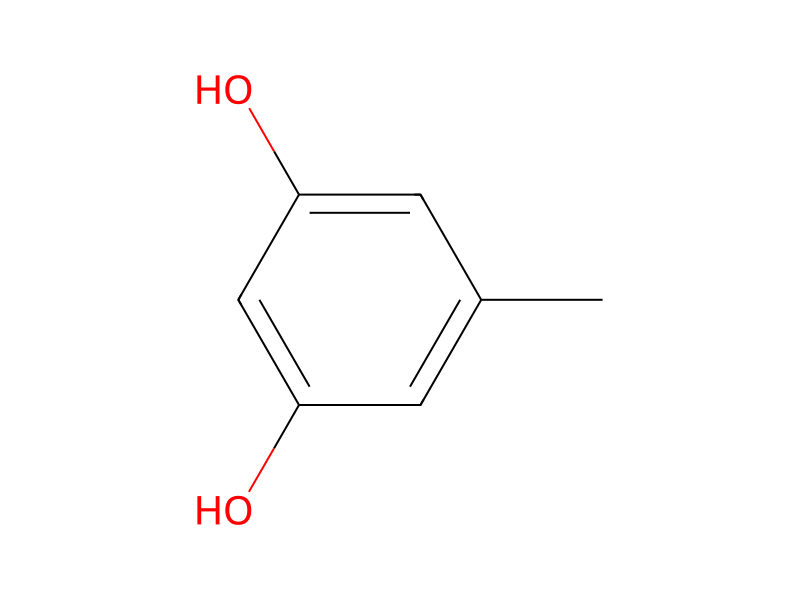
Basic information
- CAS
504-15-4- Standard SMILES
Cc1cc(O)cc(O)c1- InChIKey
OIPPWFOQEKKFEE-UHFFFAOYSA-N- Molecular formula
- C7H8O2
- Average molar mass
- 124.14 g/mol
- Monoisotopic mass
- 124.0524295
Overview
Orcinol is a 5-alkylresorcinol in which the alkyl group is specified as methyl. It has a role as an Aspergillus metabolite. It is a 5-alkylresorcinol and a dihydroxytoluene.
Names & identifiers
- Preferred name
- Orcinol
- IUPAC
- 5-methylbenzene-1,3-diol
- English name
- Orcinol
- Molecular formula
- C7H8O2
- Molecular weight
- 124.14
Names & synonyms
Orcinol3,5-Dihydroxytoluene504-15-45-METHYLRESORCINOL1,3-Dihydroxy-5-methylbenzeneOrcin5-Methyl-1,3-benzenediol1,3-Benzenediol, 5-methyl-3-Hydroxy-5-methylphenol3,5-Toluenediol534PMB3438DTXSID2060123
Show more names
Methylresorcinol5-Methyl-benzene-1,3-diolOrcilCrinoline
CHEBI:16536NSC-12441RefChem:168440DTXCID0040830207-984-25-methylbenzene-1,3-diol5-MethylresorcinResorcinol, 5-methyl-
Database identifiers
- CAS
504-15-4- PubChem CID
- 10436
- DTXSID
DTXSID2060123- ChEMBL
CHEMBL110059- ChEBI
CHEBI:16536- UNII
- 534PMB3438
- EC Number
- 207-984-2
- Nikkaji
- J6.215D
Properties
Computed structural properties
- XLogP
- 1.6
- Topological polar surface area
- 40.5 Ų
- Hydrogen bond donors
- 2
- Hydrogen bond acceptors
- 2
- Rotatable bonds
- 0
- Heavy atoms
- 9
- Formal charge
- 0
- Complexity
- 82.9
Experimental & physicochemical properties
Chemical ClassesOther Classes -> Phenols
SpringerMaterials PropertiesBoiling point
Vapor Pressure0.0028 [mmHg]
Physical DescriptionSolid; [Sigma-Aldrich MSDS]
Physicochemical properties
- Melting point
- 106 · 106-112 °C(lit.)
- Boiling point
- 290 °C · 290 °C
- Density
- 1.29 · 1.2900
- refractive index
- 1.4922 · 1.4922 (estimate)
- Flash point
- 159 °C · 159 °C
- storage temp.
- 20 °C · Store at <= 20°C.
- solubility
- 80 g/l · 80g/l
- pka
- 9.56 · 9.56±0.10(Predicted)
- form
- Crystalline Powder or Crystals
- color
- Pink-gray to pink-brown
- Water Solubility
- 80 g/L · 80g/L
- Sensitive
- Air Sensitive
- Merck
- 14 · 14,6864
- BRN
- 1071903 · 1071903
- Stability
- Hygroscopic
- InChI
- 1S/C7H8O2/c1-5-2-6(8)4-7(9)3-5/h2-4,8-9H,1H3
- InChIKey
- OIPPWFOQEKKFEE-UHFFFAOYSA-N
- SMILES
- Cc1cc(O)cc(O)c1
- LogP
- 1.221 · 1.221 (est)
- CAS DataBase Reference
- 504 · 504-15-4(CAS DataBase Reference)
- EWG's Food Scores
- 1 · 1
- FDA UNII
- 534 PMB3438 · 534PMB3438
- NIST Chemistry Reference
- 3 · 3,5-Dihydroxytoluene(504-15-4)
- EPA Substance Registry System
- 1 · 1,3-Benzenediol, 5-methyl- (504-15-4)
- UNSPSC Code
- 12352200 · 12352200
- NACRES
- 22 · NA.22
- Symbol(GHS)
- 7 · GHS07
- Signal word
- Warning
- Hazard statements
- 302 · H302-H315-H319-H335
- Precautionary statements
- 261 · P261-P264-P270-P301+P312-P302+P352-P305+P351+P338
- target organs
- Respiratory system
- PPE
- 95 · dust mask type N95 (US), Eyeshields, Gloves
- Hazard Codes
- Xn
- Risk Statements
- 22 · 22-36/37/38-41-37/38-20/21/22
- Safety Statements
- 22 · 22-26-36-37/39
- RIDADR
- 2811 · 2811
- WGK Germany
- 3 · 3
- RTECS
- 2100000 · VH2100000
- TSCA
- TSCA listed
- PackingGroup
- III
- HS Code
- 29072900 · 29072900
- Storage Class
- 11 · 11 - Combustible Solids
- Hazard Classifications
- 4 OralEye · Acute Tox. 4 OralEye Irrit. 2Skin Irrit. 2STOT SE 3
- Toxicity
- 50 orally · LD50 orally in Rabbit: > 2000 mg/kg LD50 dermal Rabbit > 5000 mg/kg
Safety & regulation
GHS classification
GHS Classification
Warning
H302 (100%): Harmful if swallowed [Warning Acute toxicity, oral]
P261, P264, P264+P265, P270, P271, P273, P280, P301+P317, P302+P352, P304+P340, P305+P351+P338, P319, P321, P330, P332+P317, P337+P317, P362+P364, P391, P403+P233, P405, and P501 (click each P-code to see the statement)
Aggregated GHS information provided per 66 reports by companies from 13 notifications to the ECHA C&L Inventory. Each notification may be associated with multiple companies.
Hazard information
Regulatory Information
Chemical: 1,3-Benzenediol, 5-methyl-
Orcinol: Does not have an individual approval but may be used under an appropriate group standard
Other Safety InformationEvaluation - Chemicals that are unlikely to require further regulation to manage risks to environment
Hazards Summary
Causes convulsions and coma in subcutaneous lethal-dose studies of guinea pigs and rats; [RTECS] A skin and strong eye irritant; Harmful by ingestion; Prolonged or repeated exposure may cause eye injury; [Sigma-Aldrich MSDS] See 2-Methyl-1,4-hydroquinone, 1,3-Benzenediol, 2-methyl-, Resorcinol, and Cresol, all isomers.
Hazard Classes and CategoriesAcute Tox. 4 (100%)
Safety data
- PPE
- dust mask type N95 (US), Eyeshields, Gloves
- wgk
- 3
- tsca
- TSCA listed
- rtecs
- VH2100000
- ridadr
- 2811
- hs_code
- 29072900
- Toxicity
- LD50 orally in Rabbit: > 2000 mg/kg LD50 dermal Rabbit > 5000 mg/kg
- risk_code
- 22-36/37/38-41-37/38-20/21/22
- Signal word
- Warning
- Symbol(GHS)
- GHS07
- hazard_code
- Xn
- safety_code
- 22-26-36-37/39
- Storage Class
- 11 - Combustible Solids
- packing_group
- III
- target organs
- Respiratory system
- Hazard statements
- H302-H315-H319-H335
- Hazard Classifications
- Acute Tox. 4 OralEye Irrit. 2Skin Irrit. 2STOT SE 3
- Precautionary statements
- P261-P264-P270-P301+P312-P302+P352-P305+P351+P338
Chemistry & industry
Pharmacology
MeSH Pharmacological Classification
Substances used for the detection, identification, analysis, etc. of chemical, biological, or pathologic processes or conditions. Indicators are substances that change in physical appearance, e.g., color, at or approaching the endpoint of a chemical titration, e.g., on the passage between acidity and alkalinity. Reagents are substances used for the detection or determination of another substance by chemical or microscopical means, especially analysis. Types of reagents are precipitants, solvents, oxidizers, reducers, fluxes, and colorimetric reagents. (From Grant & Hackh's Chemical Dictionary, 5th ed, p301, p499)
Uses & manufacturing
UsesFound in many lichen species; Used as a reagent for pentoses, lignin, beet sugar, saccharoses, arabinose, and diastase; [Merck Index]
General Manufacturing Information1,3-Benzenediol, 5-methyl-: ACTIVE
Applications
UsesOrcinol can be used to synthesize:Orcinol-containing azacryptands for use in optical amplifiers and light-emitting devices.Ternary co-crystal with 4,4′-bipyridine.Low-density carbon aerogels in the presence of formaldehyde.PEG-orcinol coumarins with potent tyrosinase inhibitory activity.
Preparation methods
PreparationOrcinol has been isolated from numerous lichen fungi (Robiquet, 1829) and can be synthesized by decarboxylation of orsellinic acid in Umbilicaria papulosa and Gliocladium roseum (Pettersson, 1965; Mosbach and Ehrensvard, 1966).Orcinol was first prepared by dehydroacetic acid, a conversion that involved ring-opening of the pyrone to a triketone. This early experiment helped establish the rich condensation chemistry of polyketides. It can be obtained by fusing extract of aloes with potash, followed by acidification.US3865884A: Preparation of orcinol
Upstream & downstream products
Upstream raw materials
Downstream products
Suppliers100 total
国药集团化学试剂有限公司86-21-63210123 · [email protected]
梯希爱(上海)化成工业发展有限公司021-67121386 · [email protected]
衢州润东化工有限公司0570-8789886 18892685668 · [email protected]
上海阿拉丁生化科技股份有限公司400-6206333 13167063860 · [email protected]
南京凯美西化工有限公司02558748998 18951874644 · [email protected]
北京诺德恒信化工技术有限公司010-84929330 13811281791 · [email protected]
INTATRADE GmbH+49 3493/605464 · [email protected]
爱斯特(成都)生物制药股份有限公司+86-28-85122536 85324413 · [email protected]
上海如吉生物科技发展有限公司+86-21-65211385-8001 36031160 · [email protected]
科瑞迪化学400-821-5857 021-64326257 · [email protected]
Syntechem Co.,Ltd[email protected]
阿法埃莎(中国)化学有限公司400-6106006 · [email protected]
安耐吉化学&3A(安徽泽升科技股份有限公司)400-0056266 · [email protected]
武汉凯威斯科技有限公司86-027-67849912 · [email protected]
上海瀚鸿科技股份有限公司021-54306202 13764082696 · [email protected]
上海景颜化工科技有限公司13817811078 · [email protected]
嘉兴市艾森化工有限公司0573-85285100 18627885956 · [email protected]
上海泰坦科技股份有限公司400-6009262 15618770481 · [email protected]
武汉丰泰威远科技有限公司027-87465837 19945049750 · [email protected]
云南西力生物技术股份有限公司0871-65217109 · [email protected]
Beckmann-Kenko GmbH+49 4241 9308 88 · [email protected]
山东西亚化学有限公司13355009207 13355009207 · [email protected]
玛雅试剂+86 (573) 82222445 (0)18006601000 452520369 · [email protected]
四川库利南科技有限公司400-1166-196 18981987031 · [email protected]
天津希恩思生化科技有限公司400 638 7771 · [email protected]
湖南汇百侍生物科技有限公司0731-85526065 13308475853 · [email protected]
上海乔木化学科技有限公司021-60451683 15021268886 · [email protected]
上海威翼化工有限公司18621196961 · [email protected]
上海思域化工科技有限公司86-21-34053660 · [email protected]
赛默飞世尔科技(中国)有限公司800-810-5118 · [email protected]
北京伊诺凯科技有限公司400-810-7969 010-59572699 · [email protected]
上海遐瑞医药科技有限公司+86 21 61551611
上海健超生物科技有限公司150-2103-5486 18017383231 · [email protected]
TCI AMERICA800-4238616 · [email protected]
TOKYO CHEMICAL INDUSTRY CO., LTD.03-36680489 · [email protected]
TCI Europe320-37350700 · [email protected]
深圳康特腾科技有限公司86-0755-86635001 · [email protected]
越林试剂021-62960152 · [email protected]
南京杜莱生物技术有限公司025-84699383-8003;025-846993838003-8003 18013301590 · [email protected]
北京环宇世纪化学科技有限公司hysj_bj.com
上海将来实业股份有限公司400-0066400 13621662912 · [email protected]
上海将来实业股份有限公司021-61552785 · [email protected]
HBCChem, Inc.+1-510-219-6317 · [email protected]
上海笛柏生物科技有限公司400-008-9730,021-54359730 400-008-9730 · [email protected]
美岚实业(上海)有限公司021-58958189 · [email protected]
上海爱蝶实业有限公司021-58957966 18930537195 · [email protected]
成都零六生物科技有限公司400-1166-196 13458535857 · [email protected]
广拓化学(上海)有限公司021-60899189-8001 18918189673 · [email protected]
雷丁试剂0510-85629785 18013409632 · [email protected]
上海卓因生物科技有限公司021-61317773 · [email protected]
Additional notes
DefinitionChEBI: Orcinol is a 5-alkylresorcinol in which the alkyl group is specified as methyl. It has a role as an Aspergillus metabolite. It is a 5-alkylresorcinol and a dihydroxytoluene.
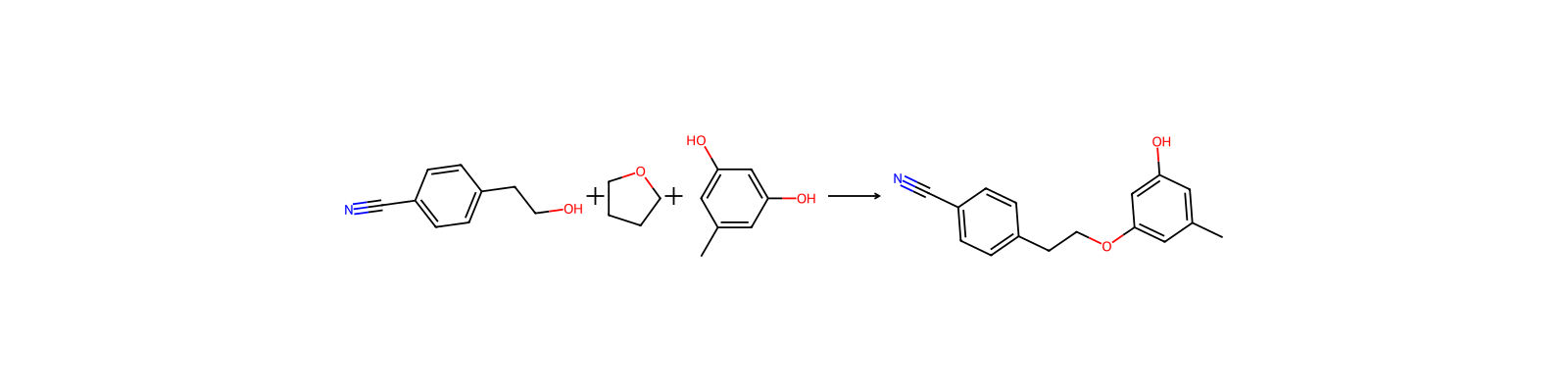
Related reactions
55 records




Compound notes
Loading…